Existing generative AI models are built on batch processing. Give instructions to the system. Perform calculations. and spit out the results.
Here, a Silicon Valley startup announced that it can generate Gen-AI videos (and other outputs) in real time. This could be a breakthrough. San Francisco-based Reactor was co-founded by Alberto Taiuti and Bryce Schmidtchen, former technical leads for the Apple Vision Pro AR/VR headset.
The pair received a vote of confidence from Hollywood mogul-turned-investor Jeffrey Katzenberg, who has acquired a stake in Reactor through his holding company WndrCo. Reactor has raised $59 million in Series A funding led by Lightspeed Venture Partners with participation from investors including WndrCo, Amplify Partners, Sky9 Capital, and FPV Ventures.
Katzenberg says that when he met Reactor’s founders and saw their demo, he was “incredibly impressed, if not blown away, by how innovative their approach to storytelling tools was.”
“Literally every aspect of your production pipeline can be powered with these tools. Live-action, television, film, commercial production, animation, and any other visual media can be powered with Reactor applications,” he says. The funding will allow Katzenberg to join Reactor as a board observer.
Katzenberg describes Reactor this way: “It’s a bridge between the model world and real-world applications.”
Reactor says its platform unlocks new forms of media. Rather than being pre-rendered, experiences are dynamically generated and shaped by user interaction. The Reactor platform provides an integrated software development kit (SDK) and application programming interface (API) that enables developers to build real-time, interactive applications with “just a few lines of code” and run them at scale.
“World models are redefining what AI can do, moving from systems that generate content individually to systems that recognize and respond in real time,” said Taiuti, CEO of Reactor. “We are building an important layer between Model Labs and the developers who want to collaborate with Model Labs to create.”
“Our mission is to democratize real-time video generation,” says Taiuti. The company’s website (reactor.inc) provides an example of the system in action.
Taiuti and Schmitchen founded Reactor in August 2025 after leaving Apple. “It’s been brewing in our heads for quite some time,” Taiuti says. “‘Reactor’ is the culmination of our entire career. It feels like we’ve been building for this moment for a while.”
According to Taiuti, text-to-video generation AI systems can take up to 10 minutes to generate a 10-second video. With Reactor, “the initial frame creation time on our platform is essentially zero,” he says. “We’ve optimized our platform for this content modality. You can generate videos instantly. You can do it unlimitedly. You can run as many as you want.”
Reactor’s platform also has applications beyond real-time video, such as software development and robotics. “What would happen if software was written this way?” Taiuti muses. In the future, he suggests, “humans will be working with pixels rather than text.”
Schmitchen, Reactor’s CTO, said companies using the company’s real-time AI platform include Overworld, a developer of interactive game models. When it comes to source material, Reactor partners with companies that have trained their own models, and “we take their models and optimize them from the inside out,” Schmidtchen says. Reactor has used more than a dozen models from various AI labs.
Taiuti said the company is negotiating deals with major Hollywood studios. “Studios want to train their own models internally,” he says.
Reactor plans to use the latest funding to expand in the U.S. and internationally to serve larger customers. The company also expects to invest in expanding GPU capacity for real-time processing and spend money on marketing.
Reactor is based in San Francisco’s South Park neighborhood and currently has 16 employees. The team includes engineers and researchers from Apple, Netflix, Meta, Google, Adobe, Replicate, and Microsoft with experience scaling graphics, real-time systems, interactive media, and AI infrastructure.
“Developers currently lack access to real-time video models due to a lack of infrastructure that can reliably serve them. Alberto, Bryce, and the team bring a rare combination of real-time systems expertise and product vision to this problem, and we believe Reactor is well-positioned to become the foundational platform for this new category,” Lightspeed partner Bucky Moore said in a statement.
Reactor’s partners include Amazon Web Services (AWS), which provides the compute infrastructure and delivery to support real-time generated video workloads on a global scale. Deap Ubhi, global director of startup technology at AWS, said Reactor is unique in its space at this time because it builds an AI inference engine that doesn’t rely on any model. He said Taiuti used Reactor’s platform on a Zoom call to transform Ubi’s face into that of Albert Einstein in real time. “The technology behind that inference engine is very powerful,” he says. “The components are very compelling and interesting.”
Jason Bennett, vice president and global head of startups and venture capital at AWS, added, “Reactor’s real-time video platform requires an inference infrastructure that can deliver not just at the speed of production, but at the speed of interaction. AWS is unparalleled in solving the latency, scale, and reliability required for these workloads.”
Katzenberg said of Reactor’s technology, “I’m very optimistic that this will ultimately be very empowering and successful for Hollywood.” Katzenberg is a former CEO who co-founded DreamWorks Animation after leading Walt Disney Studios and Paramount Pictures. He says he was “schooled” in traditional hand-drawn animation for the better part of a decade, and then became a “main figure” when CGI came along and transformed the business.
“I believe we are on the cusp of one of those transformative moments today,” Katzenberg added. “Storytelling is always evolving. It’s been evolving that way, going back to cave paintings. I look for tools that give storytellers an edge. For me, it’s all about the human touch.”
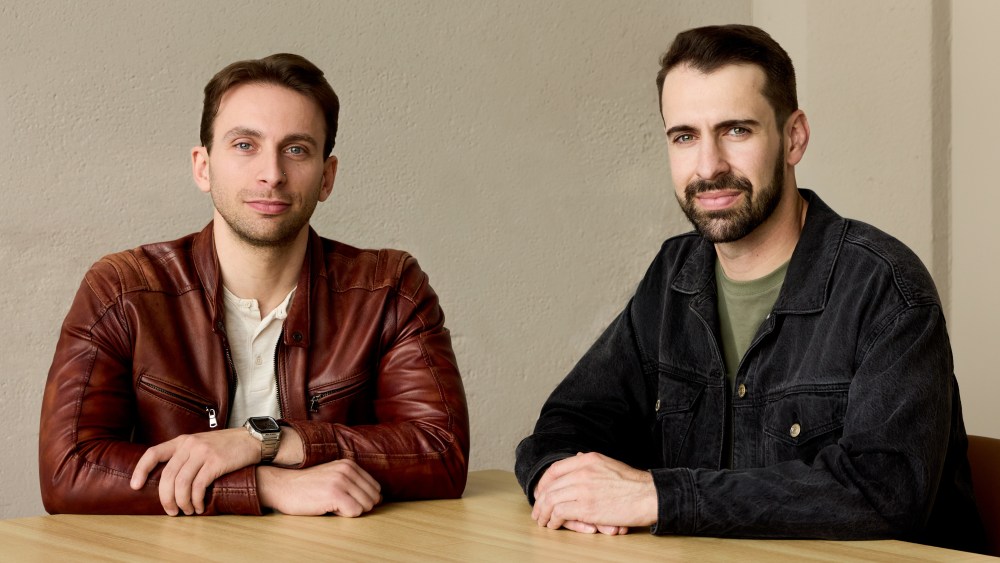
Top photo: Alberto Taiuti (left), Bryce Schmitchen