
QCon AI Boston 2026 was a turning point. We’ve been learning to build AI agents for the past two years. The question now is how to run them safely and reliably once they go live. Almost all the talks returned to the same theme. Agents are forcing teams to build real production infrastructure around them.
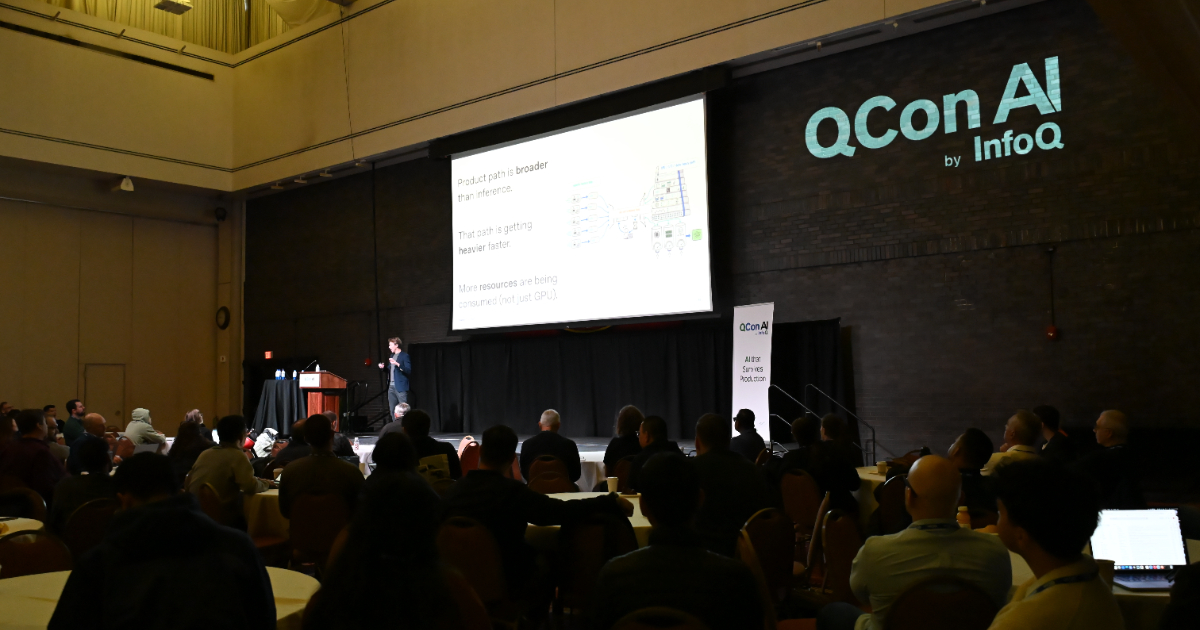
OpenAI’s Martin Spier set the tone with his opening keynote. His talk was about performance, but not in the narrow sense of “speeding up inference.” Before inference, there is a quiet stretch that the product needs to make the conversation available to the model. That means enough context to be useful, and enough trimming to keep it fast. In other words, even if the model is fast, there is still a lot of work to be done to make the product faster.

“The basics have become more important.”
Martin Spier’s “Keeping ChatGPT Fast as AI Development Accelerates”
It turned out to be a good lens for the rest of the conference. Agent workarounds are becoming less shiny. Determining whether a system can maintain contact with real users is becoming a tedious infrastructure task. The first recurring trend was for the context and agent infrastructure to rise to its own platform layer. Teams are moving beyond single-purpose applications to shared systems of context, tool access, identity, and state. This is where ideas like context engineering, MCP gateways, and semantic tool catalogs start to look like core infrastructure. And as a core component, you need an owner and a contract.

“Accuracy + Security + Cost”
Fabian Nardon’s “Designing the Data Layer for AI Agents: From Transactional Systems to MCP and Semantic Models”

“Context engineering is an architecture, not a feature. If you get this right, everything else becomes easier.”
“Beyond the Prompt: Context Engineering for Production-Grade AI” by Ricardo Ferreira

“Own the nation, command the mutations, prove the actions.”
“The Agent Harness: Control Planes, Invariants, and Approval Boundaries for Production AI Agents” by Vinoth Govindarajan
The second trend is trust. It’s a transition from immediate level guardrails to reliable execution, or harnesses. Once agents have access to tools and files, security can no longer rely on prompt instructions. A harness is a system that attaches around a model. Production systems require clear ownership of state, ordered writes, authorization boundaries, and a real audit trail, as tools may run when users are not looking. The question is not whether the agent will give a good answer, but whether the system can prove what actions were performed, by what components, and under what constraints and permissions.
“The most effective organizations do two things:
- Radically improve the use of AI across the SDLC
- Resolve bottlenecks that limit performance.”

“Five Stages of AI Maturity in Engineering Organizations — Where and Why Teams Get Stuck” by Lizzie Matusov

“Develop your strategy early. Build it around your customers. Create your own surface that’s right for your company.”
“Building a GenAI Platform on DoorDash” by Siddharth Kodwani and Swaroop Chitlur
The third trend was for AI deployment itself to become an engineering operating model. As usage spreads, boring questions quickly arise, such as who pays for it, who gets to call on what tools, where failures appear, and how teams learn from them. It’s not enough to expose a model through an API or hand a chatbot to an engineer. Teams need paved paths, shared policy surfaces, evaluation loops, observability, cost attribution, and feedback mechanisms that facilitate good action over quick, risky action.
A topic of interest is how engineering organizations should think about evaluation. One-shot tests can detect obvious failures, but the agent doesn’t necessarily fail on the first turn. Single-turn tests and static benchmarks are poorly suited for systems that use tools, maintain state, convey context, and behave differently at each turn. Therefore, testing must be close to the product’s form, including conversations, tracing, simulation, and production feedback. Without it, the user may encounter failures that the benchmark did not perform while the test reports successes.
Taken together, QCon AI Boston 2026 suggested that production AI is increasingly focused on systems problems rather than rapid engineering. The hard questions are moving to context, data contracts, LLM and MCP gateways, state, reputation, latency, cost, observability, and ultimately security and trust. The harness around the model becomes just as important as the model inside. Agents may talk like colleagues, but like software they fail, and their successful operation relies on old lessons from platform engineering and distributed systems.


