AI is on nearly everyone's lips: Edtech companies are recklessly hawking AI-embedded products, the United Nations has outlined the ethical use of AI, and teachers and students alike are using AI in and outside of the classroom.
San Diego Unified School District is no exception: The fact that some teachers in the district are using AI to grade student work came as a surprise even to board members, who were unaware that the AI products were embedded in contracts they approved without discussion last year.
That has some San Diego Unified School District officials wondering if they should pump the brakes. But the door is already open and showing no signs of closing. District officials seem more interested in how to best integrate AI into the classroom than banning it altogether.
Still, what role AI plays in the district’s classrooms now, and what role it will play in the future, appears to be an open question.
Arena
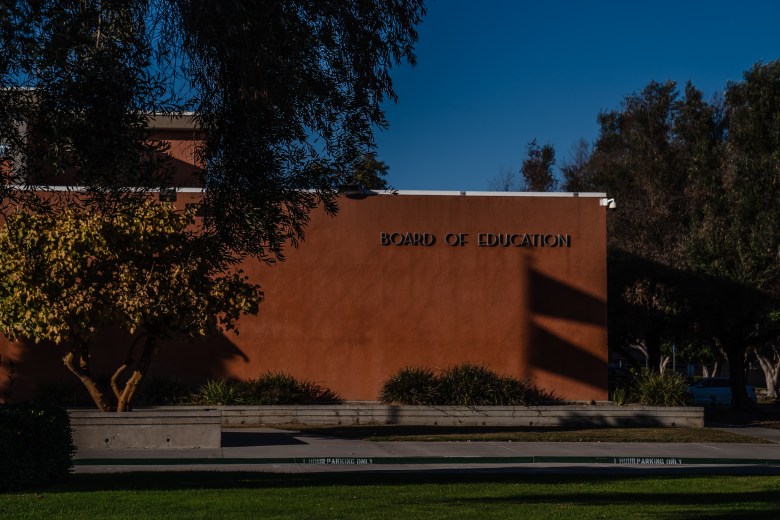
Education officials across the county appear to be assembling the planes as they fly.
The San Diego Unified School District doesn't have an explicit policy on AI, but district spokeswoman Maureen McGehee said officials are working to change it.
So far, they've followed guidance issued by the state last year, which is not binding like a district policy. McGehee wrote in an email that the district's Department of Instruction, Integration and Technology has formed a task force of school officials and community members to develop a policy. They plan to submit a proposal by early next year.
McGehee also wrote that officials are working with officials from the San Diego County Office of Education and San Diego State University.
For Stacey Brandt, spokeswoman for the San Diego County Office of Education, this was the first news she had heard.
“I have not heard of the SDCOE being involved with any such group,” Brandt said in an email.
Brandt wrote that district representatives attended county training earlier this year to provide the district with resources on how to address AI.
McGehee couldn't estimate how often San Diego Unified School District teachers are using AI, or even provide a definitive list of all the AI-powered programs teachers are using.
“Due to the rapid evolution of educational technology and the widespread integration of AI capabilities across many programs, it is difficult to provide a comprehensive list of all AI products currently in use,” McGehee wrote.
At least eight programs used by district staff and students are supported by AI, but McGehee said those programs either didn't have AI capabilities or had features that weren't advertised as AI until last year.
Even without an exhaustive list or dedicated policies, teachers are using AI in surprising ways. Some teachers use AI to enhance their lesson plans or provide starting points for student projects. Others simply incorporate lessons on the appropriate use of AI into their classes. Some teachers are getting even more creative.
“AI is also being used innovatively by educators incorporating classroom engagement tools into their lessons, such as student-designed personalized storybooks with AI-generated imagery and historically accurate chatbots,” McGehee wrote.
Some experts have slammed the use of “historically accurate chatbots” for their apparent penchant for inaccuracy. AI-generated images have also been controversial due to their outright appropriation of the artworks they are based on.
“As with most emerging technologies, there are ethical and practical considerations,” McGehee wrote. “As the district works with its education partners to develop AI guidelines, we will consider how to best leverage what this technology has to offer, including grading programs.”
View from the classroom
Jennifer Roberts is an English teacher at Point Loma High School who is incorporating AI into her classes. She also runs a blog where she writes about AI applications and mentors teachers interested in incorporating AI into their classes.
Roberts uses the AI tool Writable to grade papers, which she says has lightened her heavy workload and allowed her to give more writing assignments. She says the extra practice has helped her students become better writers.
Roberts also incorporates AI lectures into his curriculum and frequently uses tools like ChatGPT in his classes, which he said helps students understand how AI can be useful and how it can fall short.
“I use the tools in front of my students in the classroom because I want them to understand the benefits and limitations of the tools,” Roberts says. “They need to see them fail, and they often do.”
Roberts acknowledged he is optimistic about AI, but said he is concerned about issues of fairness and access that could reproduce existing inequalities in society. But he's not concerned that AI will lead to an increase in cheating, because students have always cheated. He also pointed to research showing that cheating levels have remained relatively stable since ChatGPT came on the scene.
Ultimately, Roberts believes AI benefits students and teachers and isn't going away. She believes we're moving to a world where writing is an “AI-assisted task,” so she thinks it's better to help students understand how to use it responsibly. She's also created assignments that require the use of AI, and says it has helped improve performance for all students, including English language learners and students with disabilities.
“My students are going to live in the future,” Roberts said, “and it's going to be a future where everything is going to be AI-assisted. I don't think we're going to prepare our students for that future if we ban AI, block it, forbid it, never talk about it, tell them it doesn't exist.”
View from the podium

San Diego Unified School District Trustee Richard Barrera has long been wary of technology companies that “claim to have the magic answers” for improving education.
The rise of AI has created a near-endless number of such companies, none of which are shy about claiming that AI can transform the classroom. In Varela's view, tech companies want customers to use their products before evaluating the challenges surrounding them.
“There's always this pressure that technology is inevitable, that it's the way of the future, that keeping kids away from that future is doing them a disservice,” Varela said.
Barrera believes the district needs to take a step back and reevaluate what role AI should play before jumping into new contracts: When the board approved the contract to bring the AI tool, Writable, into classrooms, they had no policy for how to handle AI.
Developing it should be their first step, he said.
Varela is concerned about how the proliferation of AI programs will affect the education industry, and one challenge he's heard from teachers is that there's no winning strategy to monitor whether what students write is actually written by an AI.
Still, he said he's not entirely opposed to AI in education, as long as it enables high-quality instruction rather than replacing it.
Varela said he has heard thoughtful teachers argue that AI tools can free them from worrying about syntax and grammar and engage students in deeper conversations about writing. AI is to writing what calculators are to math, some teachers told him: a tool to improve student performance.
Varela thinks this is a compelling argument, but he doesn't seem particularly convinced.
“I think the real question is, is the use of AI in writing making students write worse, so much so that they become so reliant on the machine that they write and think worse? Or is it adding depth to their writing by helping them with the tedious tasks of writing?” Varela said.
“My guess is that these particular tools could go either way, and probably will go either way.”