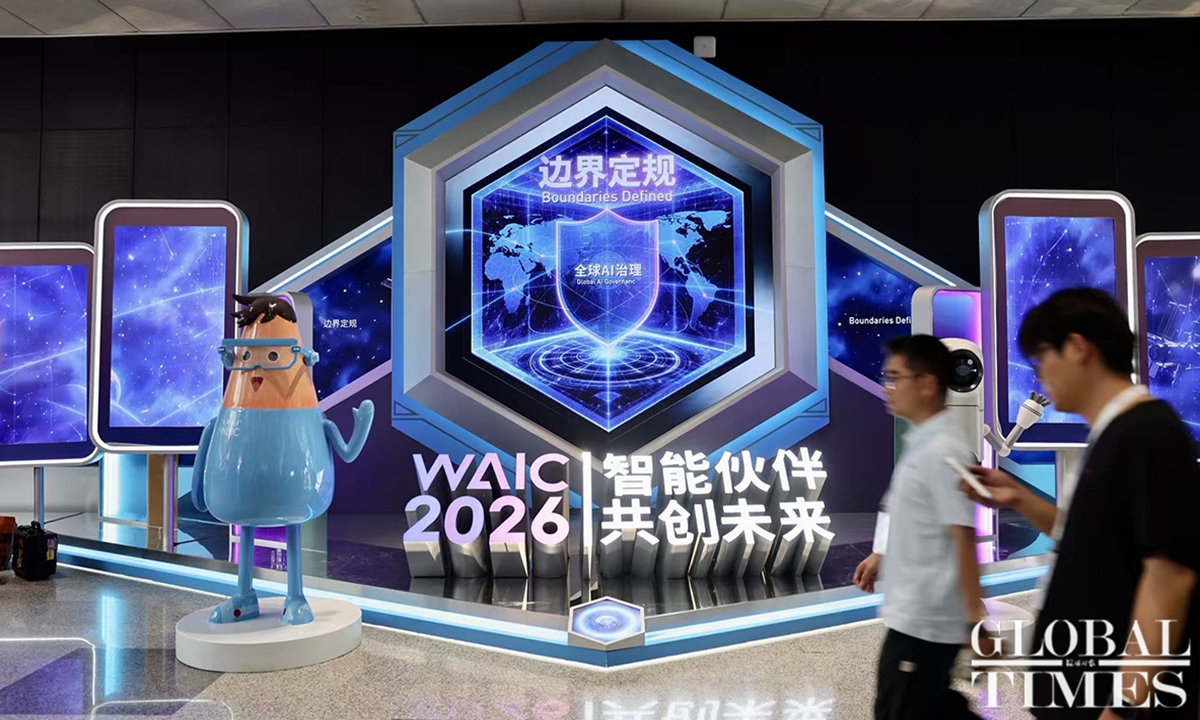
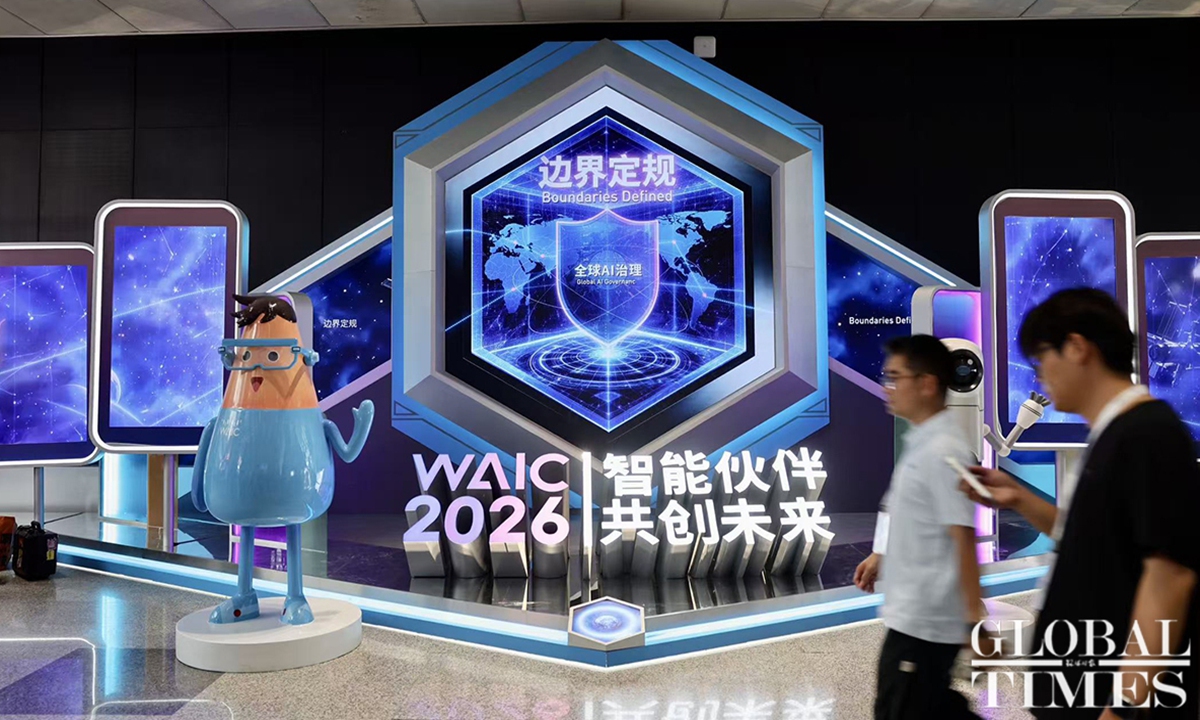
The 2026 World Congress on Artificial Intelligence and High-Level Conference on Global AI Governance opened in Shanghai on July 17, 2026. Photo: Chen Xia/GT
Leading Chinese technology companies unveiled their latest computing power innovations at the 2026 World Artificial Intelligence Conference (WAIC) in Shanghai, highlighting the country’s rapid expansion of artificial intelligence (AI) infrastructure as demand soars.
From a completely domestically developed 100,000-card AI supercluster to an integrated space and ground AI infrastructure system, Chinese companies at WAIC showcased advances in computing power and AI applications. Experts said these cutting-edge developments reflect China’s accelerating efforts to strengthen its computing power infrastructure, which provides critical support for large-scale AI applications across industries.
As an important platform for cooperation, WAIC has held more than 140 forums and this year will gather 1,400 guests from China and abroad under the theme of “AI Partnership for a Bright Future,” Xinhua News Agency reported.
Among the exhibits at the conference, large-scale computing systems received widespread attention. The “Dengfeng” version of Sugon 8000, the country’s first fully domestically developed 100,000-card AI supercluster, has made its global debut.
The Sugon 8000 AI supercluster, developed by Sugon, a subsidiary of China’s leading supercomputer manufacturer Dawning Information Industry Co., is equipped with 100,000 computing cards and adopts a super-intelligent integrated technology approach that combines scientific computing and intelligent computing, China National Broadcasting (CNR) reported.
The Sugon 8000 supports full-precision computing from FP64 to INT8 and can be applied to a variety of scenarios such as scientific computing, large-scale language model (LLM) training and inference, and industrial simulation, the CNR report said.
Sugon 8000 is connected to the National Integrated Computing Power Network through the National Supercomputing Internet and has completed optimization of more than 300 major applications across fields such as LLM, robotics, medicine, new materials, quantum computing, and astronomy.
Also, during WAIC, the first satellite constellation under Shanghai’s “Starshu Project”, the city’s flagship space computing constellation project, was officially announced. The plan stands for “starry sky core hub and computing power core hub” and is a flagship project in the strategic development of Shanghai’s space-based computing power industry, Securities Times reported.
The project will expand from two computing satellites and 12 edge computing satellites in the validation phase to a constellation of 1,000 satellites for commercial operations, according to the report.
China’s space-based computing power sector is developing rapidly and has broad application prospects across various fields. Fudan University professor Chi Nan told the Global Times that Shanghai enjoys unique advantages as it is the domestic leader in integrated circuits and is home to several startups in the computing power sector.
Qi said the Xingshu Project plans to launch two to 12 satellites next year, complete the deployment of 200 satellites by 2030, and launch 800 satellites by 2032.
On Saturday, Chinese technology company SenseTime announced several data center cooperation projects at WAIC, including domestically developed computing power clusters and space-based computing power. The company said it plans to launch four computing satellites with Adaspace this year and build five homegrown computing power clusters, each with more than 10,000 cards, within two years.
On the same day, SenseCore, SenseTime’s AI infrastructure platform, signed a strategic cooperation agreement with Chengdu-based Adaspace Technology Co. The two companies announced plans to co-build the SenseTime Computing Power Constellation. The constellation will be expanded to a constellation of 1,000 satellites with computing power measured in multiples of 10,000 petaflops, the company told the Global Times on Sunday.
Petaflops is a unit used to measure the speed of computation for AI and data-intensive tasks, with 1 petaflop equaling 1 quadrillion calculations per second.
In a statement sent to the Global Times on Sunday, Chinese chip company Biren Technology announced a next-generation supernode solution with near-packaged optics optical interconnect and distributed decoupling architecture, supporting up to 1,024 graphics processing units in a single supernode for scale-up expansion.
According to SenseTime, the joint project aims to evolve AI infrastructure from a 10,000-card cluster on the ground to multiple satellite computing coordinated in orbit, creating a global integrated space-ground AI infrastructure system.
With the rapid growth of AI, especially with the advent of the era of physical AI, computing power is moving beyond the boundaries of the ground and into space, Zhao Honjie, vice president of Adaspace Technology Co, told the Global Times on Sunday, noting that the concept of space-based computing power is gradually becoming widely recognized in both the AI and aerospace industries.
“Space-based computing has advantages such as global coverage, low cost, and sustainability,” Zhao said.
China is a world leader in AI development. According to a report by Xinhua News Agency, in 2025, the value of the core AI industry will exceed 1.2 trillion yuan ($176.6 billion), and the number of AI companies nationwide will exceed 6,200.
For the first time, China’s 2026 central government work report called for building a “new form of smart economy” with hyperscale intelligent computing clusters and coordinated computing capacity and power development as key challenges.
Against this backdrop, the latest advances unveiled at the AI conference reflect China’s efforts to expand its computing power infrastructure and accelerate AI adoption across industries, veteran industry analyst Xiang Ligang told the Global Times on Sunday.
With the rise of LLMs and embodied intelligence, the demand for computing power is rapidly increasing. Xiang said China’s expansion from ground-based clusters to space-based systems will help build a more flexible computing ecosystem and support future AI applications around the world.