

Researchers at Princeton University and the Princeton Plasma Physics Laboratory have used machine learning to suppress energy bursts at the plasma edge of a fusion reactor, improving performance without causing damage. Credit: SciTechDaily.com
Developed by a team from Princeton University Machine Learning How to control plasma Edge bursting in fusion reactors provides high performance without instabilities and significantly reduces computation time for real-time system tuning.
Achieving a sustained fusion reaction is a complex and delicate balancing act: many moving parts must work together to maintain a high-performance plasma dense enough, hot enough, and confined for long enough for fusion to occur.
But as researchers push the limits of plasma performance, they face new challenges in controlling the plasma. One of those challenges is that bursts of energy can escape from the edges of the super-hot plasma. These edge bursts can negatively affect overall performance and, over time, can even damage plasma-facing components of the reactor.
A breakthrough in suppressing edge instability
Now, a team of fusion researchers led by engineers from Princeton University and the U.S. Department of Energy's Princeton Plasma Physics Laboratory (PPPL) has successfully deployed machine learning techniques to suppress these harmful edge instabilities without sacrificing plasma performance.
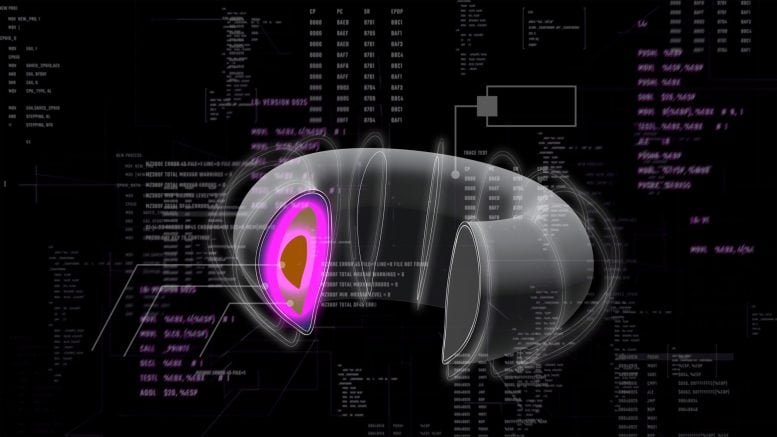
A depiction of a tokamak. Credit: Bumper DeJesus, Andlinger Center for Energy and the Environment
The team's approach to optimizing the system's suppression response in real time demonstrated best fusion performance in the absence of edge bursts at two different fusion facilities, each with its own operating parameters. The researchers reported their findings on May 11. Nature CommunicationsThis highlights the great potential that machine learning and other artificial intelligence systems have for rapidly suppressing plasma instabilities.
“We have not only shown that our approach can sustain a high-performance plasma free of instabilities, but also that it works in two different facilities,” said study leader Egemen Koremen, an associate professor of mechanical and aerospace engineering at the Andlinger Center for Energy and the Environment. “We have demonstrated that our approach is not only effective, but also versatile.”
Addressing the challenges of high confinement modes
Researchers have been experimenting for years with different ways to operate fusion reactors in order to achieve the conditions necessary for nuclear fusion. One of the most promising approaches is operating a fusion reactor in high-confinement mode, characterized by the creation of a steep pressure gradient at the edge of the plasma to enhance plasma confinement.
However, high-confinement modes have historically been closely linked to plasma edge instabilities, a challenge that has required fusion researchers to find creative workarounds.
One solution is to use magnetic coils surrounding the fusion reactor to apply magnetic fields to the edges of the plasma to break up structures that could develop into full-blown edge instabilities. However, this solution is imperfect: while successful in stabilizing the plasma, applying these magnetic perturbations typically results in poor overall performance.
“There are ways to control these instabilities, but the trade-off is that you have to sacrifice performance, which is one of the main motivations for operating in high-confinement mode in the first place.” PPPL.
The poor performance is due in part to the difficulty of optimizing the shape and amplitude of the applied magnetic perturbation, which is due to the computational burden of existing physics-based optimization approaches. These traditional methods involve a complex set of equations and can take tens of seconds to optimize a single time point, which is less than ideal when plasma behavior can change in just milliseconds. As a result, fusion researchers must preset the shape and amplitude of the magnetic perturbation every time they run fusion, losing the ability to adjust it in real time.
“Previously, we had to program everything in advance,” said co-first author Sang-Kyung Kim, a staff research scientist at PPPL and a former postdoctoral researcher in Koremen's group. “That limitation made it difficult to truly optimize the system, because we couldn't change parameters in real time depending on how the plasma conditions evolve.”
Improving Fusion Performance with AI
The Princeton-led team's machine learning approach reduces computation times from tens of seconds to milliseconds, paving the way for real-time optimization. A more efficient alternative to existing physics-based models, the machine learning model can monitor plasma conditions down to the millisecond and modify the amplitude and shape of magnetic perturbations as needed. This allows the controller to balance edge burst suppression and high fusion performance without sacrificing one over the other.
“Our machine learning replacement model allowed us to significantly reduce the computational time of the code we wanted to use,” said co-first author Ricardo Chaucha, a postdoctoral researcher at PPPL and a former graduate student in Colemen's group.
Because their approach is rooted in physics, the researchers say it can be easily applied to a variety of fusion devices around the world. For example, the paper demonstrates the success of the approach in both the KSTAR tokamak in South Korea and the DIII-D tokamak in San Diego. In both facilities, each with its own magnetic coils, the method achieved strong confinement and high fusion performance without harmful plasma edge bursts.
“Some machine learning approaches are criticized for being data-driven, meaning that their effectiveness is only as good as the amount of quality data used to train them,” says Shosha, “but our model is a proxy for a physics code, and the principles of physics apply equally everywhere, so our work can be easily extrapolated to other situations.”
Future outlook for nuclear fusion control systems
The team is already working to refine the model to make it compatible with other fusion devices, including planned future reactors such as ITER, which is currently under construction.
One area of research currently being addressed by Colemen's group is improving the predictive capabilities of the models. For example, current models cannot function effectively unless they encounter multiple edge bursts during the optimization process, which pose unwanted risks to future nuclear reactors. If researchers can improve the models' ability to recognize the precursors to these harmful instabilities, it may be possible to optimize systems without ever encountering a single edge burst.
Colemen said the work is another example of how AI may be able to overcome a long-standing bottleneck in developing fusion power as a clean energy source. Colemen and his colleagues previously successfully deployed a different AI controller to predict and avoid a different type of plasma instability in real time on the DIII-D tokamak.
“For many of the challenges we've faced in fusion, we've reached a point where we know how to approach solutions, but the computational complexity of traditional tools has limited our ability to implement those solutions,” Colemen said. “These machine learning approaches have unlocked new ways to tackle these well-known fusion challenges.”
Reference: “Best fusion performance without harmful edge energy bursts in a tokamak” SK Kim, R. Shousha, SM Yang, Q. Hu, SH Hahn, A. Jalalvand, J.-K. Park, NC Logan, AO Nelson, Y.-S. Na, R. Nazikian, R. Wilcox, R. Hong, T. Rhodes, C. Paz-Soldan, YM Jeon, MW Kim, WH Ko, JH Lee, A. Battey, G. Yu, A. Bortolon, J. Snipes, E. Kolemen, 11 May 2024, Nature Communications.
DOI: 10.1038/s41467-024-48415-w
Paper, “Maximum fusion performance without harmful edge energy bursts in tokamaks.” was published May 11 in the journal Nature Communications. In addition to Koremen, Kim and Shosha, co-authors include S. M. Yang, Q. Hu, A. Bortron and J. Snipes of PPPL; Princeton UniversitySH Han, YM Jeon, MW Kim, WH Ko, and JH Lee, Korea Fusion Energy Institute; J.-K. Park and Y.-S. Na, Seoul National University; NC Logan, AO Nelson, C. Paz-Soldan, and A. Battey, Korea Fusion Energy Institute. Columbia UniversityR. Najikian of General Atomics, R. Wilcox of Oak Ridge National Laboratory, R. Hong and T. Rose of University of California, Los Angeles, and G. Yu of University of California, Davis. This research was supported by the U.S. Department of Energy, the Korea National Research Foundation, and the Korea Fusion Energy Institute.


