How is artificial intelligence rapidly evolving from machine learning to learning machines?
“Previously, it took decades for the impact of a technology to become visible. Today, the journey from machine learning to machine learning is faster, deeper, and broader than ever before,” he added.
Emphasizing the need for a long-term perspective, he said, “We have to have a big vision and an equally big responsibility. We have to worry about the current generation as well as what form of AI we will pass on to the next generation.”
He further emphasized the urgency of action now, saying, “The real question today is not what artificial intelligence can do in the future. The question is what we will do with it today.” He cited nuclear power as an example of a technology that has both destructive and constructive outcomes.
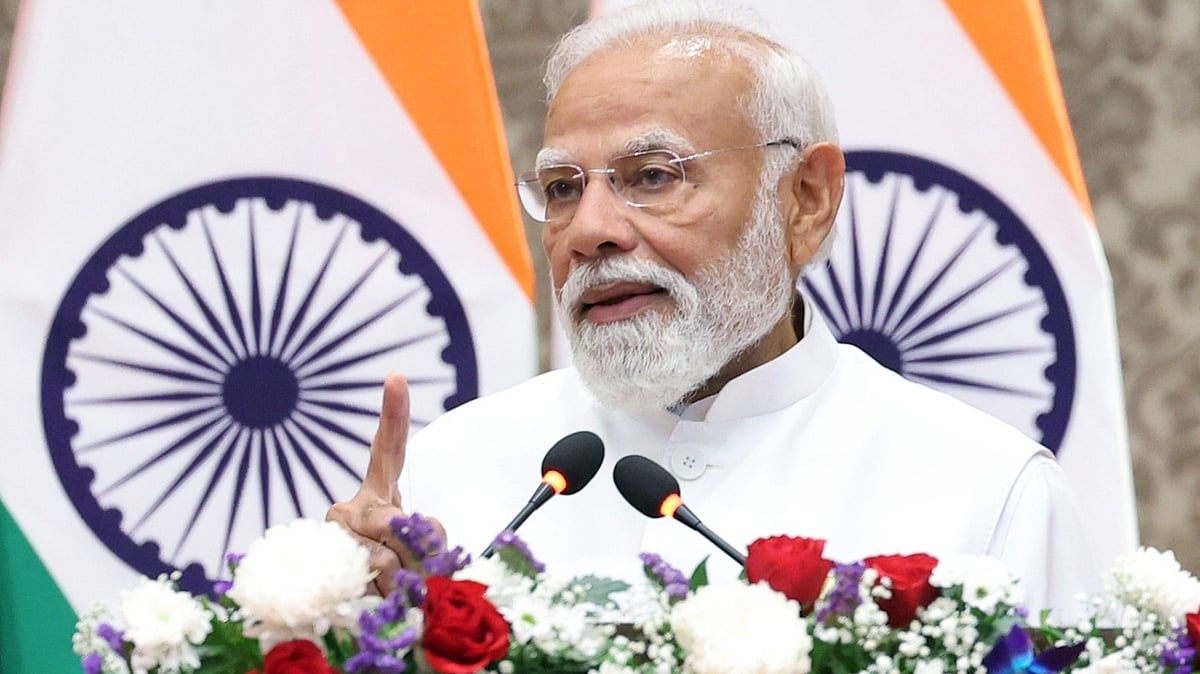
In his keynote address, the Prime Minister announced India’s human-centric framework for ethical, responsible and inclusive AI governance, titled MANAV Vision.
“Today, at the New Delhi AI Impact Summit, I am announcing the MANAV vision for AI. MANAV means humans,” he said.
Explaining the acronym, he added: “The ‘M’ stands for moral and ethical systems. AI must be based on ethical guidelines.”
“A” stands for responsible governance, meaning transparent rules and robust oversight. “N” stands for national sovereignty: whose data, his rights.
“A” stands for accessible and inclusive. AI should be a multiplier, not a monopoly. “V” stands for valid and valid. AI must be legal and verifiable. ”
He asserted that this framework will be the guiding link for the global AI ecosystem. “This MANAV vision of India will be a critical link for human welfare in the AI-based world of the 21st century,” he said.
He highlighted the new risks, especially for children, saying, “We need to be more careful about the safety of children. The field of AI should also be safe for children and should be guided by families.”
The Prime Minister also reflected on the evolving technological landscape and the need to make AI human-centred.
“We are entering an era where humans and intelligent systems co-create, co-work and co-evolve,” he said.
“AI is a transformative force. Without direction, it can be destructive, but if the right direction is found, it can be a solution. How to make AI from machine-centric to human-centric, how to make it sensitive and responsive, this is the fundamental objective of this Global AI Impact Summit. The theme of this summit clearly reflects the perspective from which India views AI: welfare for all, well-being for all. This is our benchmark…” PM Modi said.
Welcoming participants from all over the world, he said, “We welcome you to the world’s oldest AI Summit. India is at the center of the world’s largest technology pool. It is a matter of pride for the Global South that the AI Summit will be held in India.”
Reiterating India’s vision of democratizing AI, he added, “Mr. Bharat sees AI in a beneficial way and that is why we chose the theme ‘Sarwajan Hitayee, Sarwajan Sukhai’. We need AI to be democratic for everyone, especially the Global South.”
Highlighting India’s growing capabilities in this field, the Prime Minister said, “India sees a strong future in AI. We have the talent, energy capabilities and policy clarity.”
He also announced new innovations in the country and said, “I am happy to inform you that three Indian companies have launched AI models and apps at this summit. These models demonstrate the talent of our youth.” Calling for global cooperation, he said, “Design and develop in India and bring humanity to the world.”
In a symbolic display of international cooperation, the Prime Minister posed for a traditional family photo with world leaders, heads of state and global technology leaders at the venue.
The photo features key figures from the global technology ecosystem, including Sundar Pichai, Sam Altman, Alexander Wang and Dario Amodei, underscoring the summit’s purpose of bridging policy and innovation towards a human-centric digital future.