
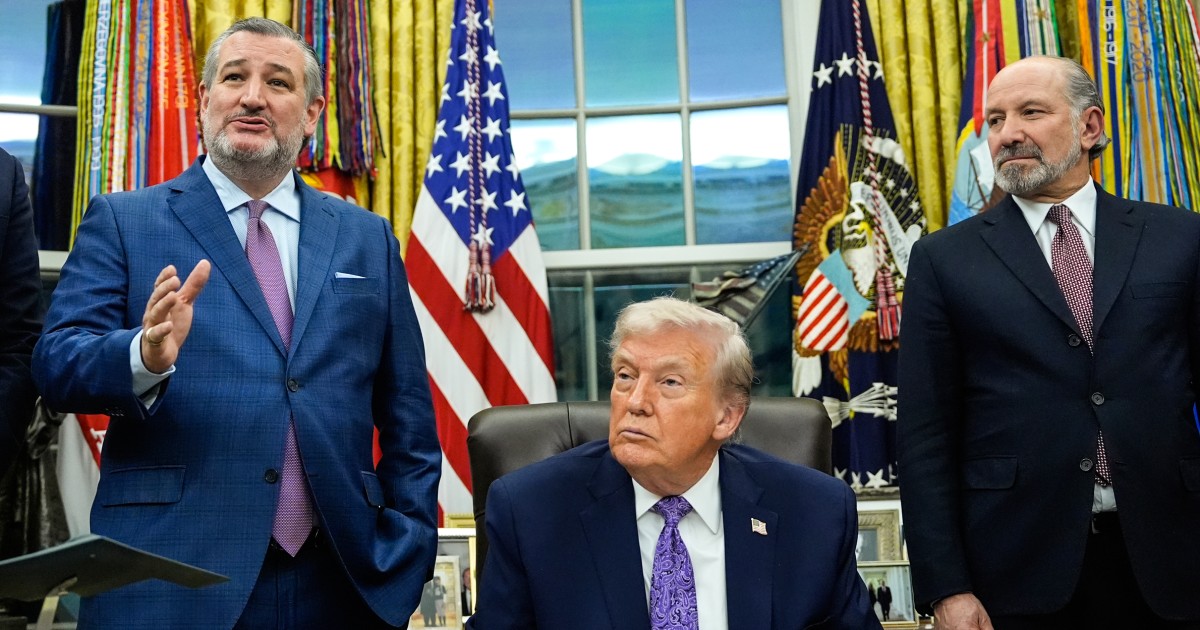
President Donald Trump signed an executive order Thursday night that seeks to limit states' ability to regulate artificial intelligence and block enforcement of existing state laws.
Trump said during a signing ceremony in the Oval Office, flanked by Sen. Ted Cruz (R-Texas), Secretary of Commerce Howard Lutnick and other key White House officials, that AI companies “want to come to America, we want to do it here, and we have a lot of investment coming in. But if you have to get 50 different approvals from 50 different states, you might forget about that.”
The order comes after a similar attempt failed in July and an unsuccessful attempt to enact a similar policy in Congress in late November. House Republicans recently tried to include a provision in the must-pass National Defense Authorization Act that would say only the federal government could legislate on AI. The initiative met with backlash, and the language was eventually removed.
Given the stalled and slow pace of efforts to regulate AI at the federal level, critics of the executive order see it as an attempt to block any meaningful regulation of AI and have little hope for Congress to replace existing state laws with national standards.
Brad Carson, a former congressman and director of Americans for Responsible Innovation, a bipartisan AI advocacy group, said the order is another attempt to push unpopular and unwise policies.
“Big tech has failed twice to enact AI amnesty legislation,” Carson told NBC News on Wednesday, predicting that the executive order would soon be blocked in court.
President Trump indicated in a post on Truth Social on Monday that he intends to sign the AI order this week.
“If we are to continue to lead in AI, there must be only one rulebook,” President Trump wrote. “If 50 states (many of them bad actors) are involved in the rules and approval process, it won't last long.”
Shortly after Trump's post, White House AI czar and Silicon Valley venture capitalist David Sachs detailed the rationale for the executive order in a post about X.
Sacks argued that this area of ”interstate commerce” was “the kind of economic activity that the framers of the Constitution intended to reserve for federal regulation.”
“We have 50 states running in 50 different directions. It just doesn't make sense,” Sachs said at a signing ceremony in the Oval Office.
“We're creating a patchwork of confusing regulations. What we need is a single federal standard, and that's what the EO says,” he added.
Mackenzie Arnold, director of U.S. policy at the Institute for Law and AI, said Wednesday that it's important to understand arguments like Sachs's in context. “Following the same logic, states would not be able to pass product safety laws, almost all of which affect out-of-state companies that sell products nationally. But these laws are classic examples of permissible state laws,” he said.
At the signing ceremony, supporters of the order also emphasized its importance in ensuring America's AI superiority over China.
“This is a competition, and if China wins that competition, then whoever wins, that country's values will influence AI as a whole,” Cruz said. “We don't want China's surveillance values to be centrally controlled by a communist government that governs AI.”
“We want the American values of free speech, personal freedom, and respect for the individual. So I believe this executive order is very important,” he added.
Regulation around AI is rapidly emerging as a hot political topic. From concerns about pollution, rising electricity costs, and noise from data centers to the possibility that AI chatbots may exacerbate mental health struggles among teenagers, many Americans on both sides of the aisle are starting to press for effective AI legislation.
Many MAGA supporters see the current AI boom as a de facto oligarchy of a small number of powerful AI companies and CEOs, with companies running out of control. On Wednesday's War Room podcast, Steve Bannon said there was “no point” if “we're having a Sputnik moment and we can't control Frontier Labs.”
“There are more regulations for setting up a nail salon on Capitol Hill than for a lab in the middle of nowhere. We have no idea what they're doing,” Bannon said.
Politicians on the other side of the political spectrum are similarly skeptical. Sen. Ed Markey of Massachusetts said in a statement earlier this week that President Trump's executive order was an “early Christmas present to CEOs' billionaire friends.” Markey called the order “irresponsible, short-sighted and an attack on our state's ability to protect voters.”
this is developing story. Please check back for the latest information.


