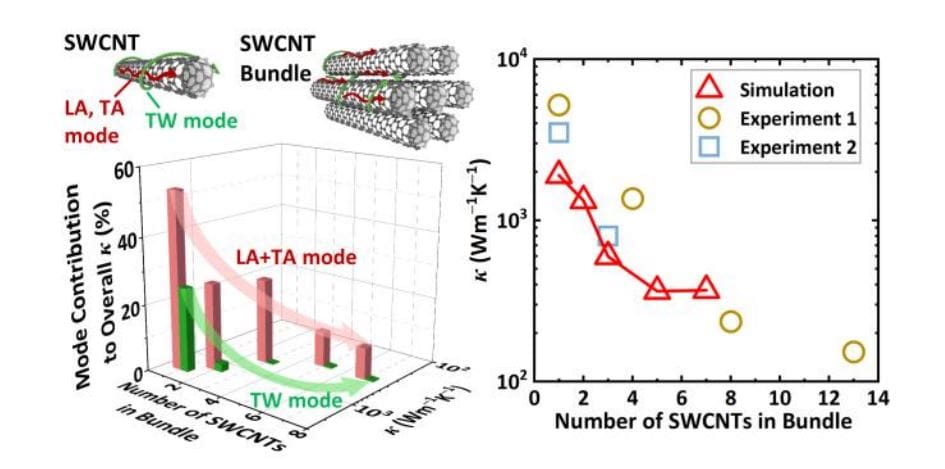
The dramatic decrease in thermal conductivity within bundles of single-walled carbon nanotubes (SWCNTs) has long puzzled scientists and hindered their application in advanced thermal management systems. Now, Feng Tao, Xiaoliang Zhang, Dawei Tang, and colleagues at research institutions such as Shigeo Maruyama's lab have demonstrated a breakthrough understanding of this phenomenon. Their work uncovered a dual mechanism that causes this “thermal conductivity collapse,” demonstrating that breaking rotational symmetry within individual nanotubes significantly increases scattering of specific vibrational modes, while the emergence of new vibrations between nanotubes creates additional paths for heat loss. Importantly, the team's innovative approach, combining machine learning and established physics, establishes a powerful new framework for accurately predicting experimental observations and designing nanoscale materials with tailored thermal properties.
Simulating heat transfer in carbon nanotubes using molecular dynamics
Scientists are developing a deeper understanding of how heat moves through carbon nanotubes, a material with great potential for advanced thermal management systems. The challenge lies in accurately predicting thermal conductivity, a critical property for designing effective heat dissipation technologies. The researchers focused on developing advanced simulation techniques to model heat transfer within these nanoscale structures, taking into account both ballistic and diffusive heat transfer. Their research aims to go beyond the limitations of traditional methods and improve the accuracy of thermal conductivity prediction.
The research team used molecular dynamics simulation, a powerful computational technique that tracks atomic vibrations within carbon nanotubes, to enable the observation of phonons, the quantized unit of vibrational energy that carries heat. They also utilized the Boltzmann transport equation, a theoretical framework that explains how phonons move and interact, contributing to thermal resistance. Non-equilibrium molecular dynamics were used to generate a temperature gradient within the nanotube, allowing for accurate measurements of thermal conductivity. Accurate modeling requires sophisticated many-body potentials to describe interactions between atoms, and the team carefully selected the potentials to ensure reliable results. We also used spectral energy decomposition to analyze the influence of different phonon frequencies on the overall thermal conductivity, and ab initio calculations were used to provide input for the simulations. Key innovations included the use of machine learning to develop accurate and efficient interatomic potentials, further increasing the reliability of the simulations.
Prediction of heat transport properties of nanotubes using machine learning
Scientists have developed a new methodology to predict heat transport in individual and bundled single-walled carbon nanotubes. By combining machine learning-based interatomic potentials with advanced lattice dynamics and Boltzmann transport equations, we establish a predictive framework that accurately reproduces experimental observations of thermal conductivity and bridges the gap between theoretical models and experimental measurements. To validate their approach, the researchers ran simulations using both newly trained machine learning potentials and more established potentials, and compared results obtained from spectral heat flow and nonequilibrium molecular dynamics methods. The results showed excellent agreement between these methods and validated the accuracy of the simulation technique over a wide range of nanotube lengths from 10 nanometers to 10 micrometers.
The simulations examined bundles containing 1, 2, 3, 5, and 7 identical nanotubes at a constant temperature of 300 Kelvin. Key innovations included using consistent boundary conditions within the framework of the Boltzmann transport equation, abandoning the assumption of local thermal equilibrium, and treating forward and backward energy fluxes separately. This approach provides an explicit expression for finite-length thermal conductivity, which is important for accurately modeling heat transfer in nanoscale systems. The team systematically tested the convergence of the calculations and demonstrated that incorporating Bose-Einstein statistics is essential to accurately capture the observed phenomena and enable quantitative reproduction of experimental observations.
Elucidation of dual mechanism of thermal conductivity of carbon nanotubes
Scientists have been able to quantitatively and mode-resolve heat transport in individual single-walled carbon nanotubes and bundles of single-walled carbon nanotubes. Machine learning-based interatomic potentials combined with advanced lattice dynamics and Boltzmann transport equations accurately reproduce experimental observations of thermal conductivity. Their analysis revealed a dual mechanism that suppresses thermal conductivity within the bundle. That is, rotational symmetry breaking in isolated nanotubes dramatically increases the scattering rate of sensitive phonon modes, and the appearance of new intertube phonon modes introduces additional scattering channels across the frequency spectrum. Importantly, the incorporation of Bose-Einstein statistics proved essential to accurately capture these phenomena, allowing approaches to quantitatively reproduce experimental observations.
Experiments demonstrated excellent agreement between spectral heat flow and nonequilibrium molecular dynamics calculations using newly trained neuroevolutionary potentials, validating the methodology for nanotube thermal conductivity calculations. Over lengths ranging from 10 nm to 10 μm, the team's values were in close agreement with previous data, but systematically underestimated thermal conductivity compared to calculations using established potentials due to inaccuracies in potential energy estimates. Investigating bundles of 1, 2, 3, 5, and 7 identical nanotubes at 300 K reveals that coupling between the tubes has little effect on ballistic transport, but thermal conductivity decreases when bundle size exceeds 1 μm. Measurements confirmed that the decrease in thermal conductivity with increasing bundle length is due to the hybridization and coupling of phonon modes driven by van der Waals interactions that primarily affect low-frequency phonon modes.
The research team recorded a 35.4% reduction in thermal conductivity for a bundle of seven nanotubes compared to a single nanotube at a length of 10 μm. However, the simulations still did not agree with the experimental observations, reporting a reduction of 75% for 3 nanotube bundles and 86% for 8 nanotube bundles at 5 μm. Further analysis using the Boltzmann transport equation incorporating Bose-Einstein statistics to enhance energy conservation provided a more accurate description of heat transport. The results demonstrate that for a length of 500 nm, the thermal conductivity calculated using Bose-Einstein statistics exceeds that calculated using equidistribution statistics, marking a transition to a region where detailed phonon dispersion and scattering physics are essential. This crossover highlights the importance of accurately representing phonon populations and scattering processes to predict heat transport in nanoscale materials.
Nanotube bundles reduce thermal conductivity due to scattering
This study shows that a quantitative and mode-resolved understanding of how heat is transferred through individual single-walled carbon nanotubes and bundles of single-walled carbon nanotubes is possible. By combining interatomic potentials developed through machine learning with advanced lattice dynamics and the Boltzmann transport equation, scientists accurately reproduce experimental observations of the thermal conductivity of these materials. This analysis reveals a dual mechanism responsible for the significant decrease in thermal conductivity when nanotubes are bundled. The symmetry breaking of the bundled nanotubes dramatically increases the scattering of certain vibrational modes, and the appearance of new vibrational modes between the tubes creates additional paths for heat to scatter. Importantly, the team demonstrated that to accurately model this process, quantum statistical effects must be incorporated. Classical approaches do not match experimental results. The findings show that even very short bundles reduce thermal conductivity by 18%, disproving the validity of the simple models used to predict heat transfer in these systems. This study not only elucidates the microscopic mechanisms governing heat transport within carbon nanotube bundles, but also provides a theoretical basis for designing bulk materials with tailored thermal properties for thermal management applications.
👉 More information
🗞 Predicting collapse of thermal conductivity in SWCNT bundles: symmetry breaking and scattering interactions revealed by machine learning-driven quantum transport
🧠ArXiv: https://arxiv.org/abs/2512.12940