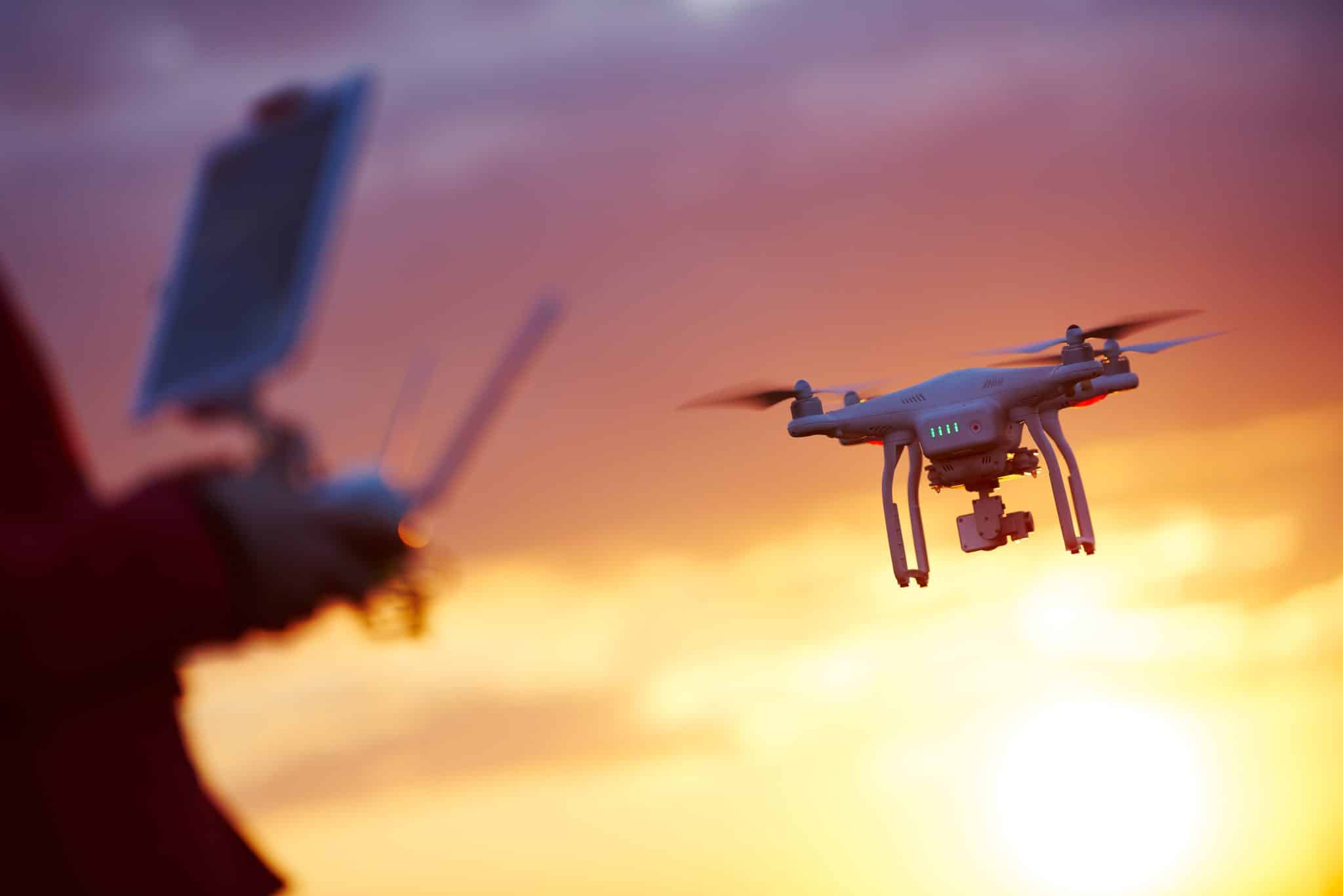
Law enforcement drone programs are transitioning from specialized public safety tools to broader surveillance infrastructure that can incorporate aerial cameras, live video feeds, automated tracking, and data sharing into routine police operations.
The concern isn’t just that police are flying drones. That means drone programs are becoming part of the larger public safety ecosystem before privacy rules, data retention limits, facial recognition restrictions, and public oversight catch up.
Government agencies across the country describe drones as tools for search and rescue, crash reconstruction, tactical support, missing persons cases, suspect containment, disaster response and officer safety. Their use is legal and can be lifesaving in some cases.
Drones can monitor dangerous scenes without sending police officers to the scene, helping firefighters assess burning buildings, rescue teams exploring difficult terrain, and giving commanders a broader view of emergencies.
This is the public case for the technology and why the drone program is gaining support from local authorities.
But the same capabilities that make drones useful in emergencies also make them powerful surveillance tools. Drones can hover over neighborhoods, monitor protests, track vehicles, record people moving through public spaces, and stream video to command centers.
And when those feeds are retained, searched, shared, or combined with other systems, the drone becomes more than a flying camera. Becomes a node in the monitoring network.
One of the reasons this technology is gaining popularity so quickly is funding. Police drone programs are paid for through regular local government budgets, federal grants, state homeland security programs, private donations, police foundations, asset forfeiture funds, or vendor pilot programs. This funding patchwork is important because each funding route has the potential to avoid or weaken public debate.
City councils may approve the purchase of small drones as a public safety expense without fully considering the data systems, analytics software, retention policies, or future integrations that come with them. Departments may start with a limited use case and expand once relationships with aircraft, operators, policies, and vendors are in place.
Federal funding is also helping normalize drone-related infrastructure. The Federal Emergency Management Agency’s Unmanned Aircraft Systems Countermeasures Grant Program helps state, local, tribal, and territorial governments combat illegal drone use, and the program combines detection, tracking, identification, surveillance, and mitigation capabilities.
The Department of Homeland Security also launched a program office for unmanned aircraft systems and counter-unmanned aircraft systems, and made $115 million in drone investments for the final stages of the America 250 and 2026 FIFA World Cups.
Counter-drone systems are primarily designed to detect, track, identify, and mitigate unauthorized aircraft rather than to monitor people on the ground. But it’s still relevant because it shows how rapidly the drone-related procurement pipeline is expanding under the banner of public safety and event security.
Large-scale events can justify large investments in sensors, cameras, command centers, detection platforms, and interagency coordination. And when you purchase and deploy these systems, they can become part of your permanent security architecture.
The same dynamic applies to local law enforcement drone programs. While the initial justification may be narrow, the operational environment tends to expand.
The department will start by using drones only for SWAT calls and missing persons calls, but could later use them for traffic enforcement, crowd monitoring, routine patrol support, or even a “drone as first responder” deployment, where drones are launched in response to 911 calls before officers arrive.
At that point, the drone will no longer be an ad hoc tool. They become part of the front end of the police force. The central problem is that many drone policies regulate flight operations, but not the broader surveillance lifecycle generated by drone data.
While there may be limits on when drones can be launched and how long footage is formally stored, there is often no mention of whether that footage can be streamed, copied, analyzed with AI, shared with other agencies or vendors, used for facial recognition, deployed at First Amendment-sensitive events, or stored indirectly through another system.
In reality, privacy risks do not arise from the drone itself, but from what happens to the images, video, metadata, and analysis after they are collected.
These gaps create opportunities to circumvent privacy and data retention restrictions. Many cities have adopted rules restricting or banning facial recognition, but those laws may not cover drone footage unless they are broadly codified.
This is where facial recognition becomes a major concern. Real-time facial recognition by drones isn’t the only thing that’s dangerous, but it’s one possible future. A more immediate risk is workflow convergence.
The original drone program may have been approved as an aviation-enabled tool, but the real result is biometrics from aerial surveillance imagery.
Object recognition and tracking raises similar concerns even when faces are not identified. Detect vehicles, people, bags, weapons, crowds, and unusual movements using AI-enabled video analytics.
Drones that can automatically track people and vehicles reduce the amount of effort required for surveillance and change the scale of police surveillance.
When analysts no longer need to manually monitor every feed, departments can monitor more locations, more often, and at a lower cost. In this way, technology designed for situational awareness can become a mass surveillance tool.
The risks are particularly acute regarding First Amendment activities. When drones are used in protests, demonstrations, labor movements, religious gatherings, political events, etc., even if no arrests are made, legitimate activities can be curtailed.
People may not know whether they are being recorded, how long the footage will be stored, whether their movements will be analyzed, or whether the images will later be compared to an identity database.
Airborne surveillance may have lower visibility than officers on the ground, and that visibility may weaken public accountability.
The vendor market is likely to drive these programs toward deeper integration. Drone companies and public safety technology vendors are increasingly selling platforms rather than standalone devices.
Aircraft may be equipped with links to cloud storage, video management, mapping, analytics, autonomous flight tools, thermal imaging, live streaming, evidence management, and command center software.
The broader debate surrounding AI-powered drones reflects how autonomy, spectrum access, domestic drone manufacturing, and national security are intertwined.
As agencies join the ecosystem, they can add functionality through software updates, new modules, or integration with existing monitoring tools.
Data retention is one of the most unsolved problems. Some government agencies immediately delete footage unless it’s related to a specific incident. Some companies retain video for long periods of time, especially if the video is classified as evidence, training materials, information, or part of an ongoing investigation.
Anti-drone debates have already shown retention rules to be at issue, as agencies argue that long retention periods are needed to identify patterns and adapt to evolving drone threats.
The same argument could easily transfer to law enforcement drone footage. Government agencies may argue that they need to store aviation data to identify crime patterns, assist in investigations, train AI systems, or improve responses.
The result is a common pattern in surveillance policy. Technology will be adopted for narrow purposes, scaled for efficiency, integrated for interoperability, and normalized before lawmakers revisit the rules. By the time privacy concerns surface, government agencies may already claim the tools are essential.
The most meaningful monitoring will focus on the entire lifecycle of drone data. The community needs to know not only when the drones fly, but also what they collect, where the footage goes, who has access to it, how long it is stored, whether it can be retrieved later, whether AI analytics are used, whether biometric identification is prohibited, and whether vendors can use the data for product development or model training.
The question is not whether drones can help police respond to emergencies. can. The question is whether the same system, funded by piecemeal grants and local procurement, will covertly build routine aerial surveillance without meaningful democratic control.
Without strict limits, police drone programs risk becoming just another surveillance technology that emerges as a public safety tool and matures into an infrastructure for tracking, identifying, and analyzing people in public spaces.
Article topics
Biometrics | Drones | Facial Recognition | Law Enforcement