

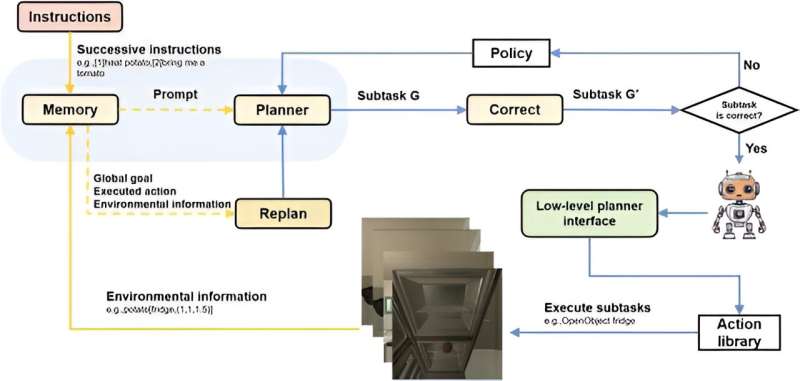
Scientists at Shanghai University's Institute of Future Technology have used large-scale language models (LLMs) to improve the efficiency and effectiveness of robots performing complex instruction-based tasks. Credit: Yuan Zhang, Shanghai University's Institute of Future Technology
In published studies, Cyborg Bionic SystemResearchers from Shanghai University have unveiled a new artificial intelligence framework that improves how robots interpret and execute tasks. The “Revise and Plan with Memory Integration” (CPMI) framework leverages large-scale language models (LLMs) to improve the efficiency and effectiveness of robots performing complex instruction-based tasks.
Traditionally, robots have required explicit programming and vast amounts of data to navigate and interact with their environments, and often struggle with unexpected challenges or changing tasks. However, a team led by Yuan Zhang and Chao Wang introduced a dynamic new approach that integrates memory and planning capabilities within LLMs, allowing robots to adapt and learn from experience in real time.
A breakthrough in robotic task management
The CPMI framework represents a significant departure from traditional methods by using LLMs not just as a language processing tool but as a central decision-making factor in robotic tasks. This innovative use of AI enables robots to break down complex instructions into actionable steps, plan actions more effectively, and course-correct in response to obstacles and errors.
One of the most impressive features of the CPMI framework is the memory module that allows the robot to remember and learn from previous tasks. This feature mimics human memory and experience, allowing the robot to work more efficiently over time and adapt to new situations faster than ever before.
Outstanding performance
The research team tested their framework using the ALFRED simulation environment and found that it outperformed existing models in “few-shot” scenarios, situations in which a robot has a limited number of examples to learn from. Not only did the CPMI framework achieve a higher success rate, it also demonstrated significantly improved task efficiency and adaptability.
“By integrating memory and planning into a single, AI-driven framework, we enable the robot to learn from each interaction and continuously improve its decision-making process,” explained Chao Wang, corresponding author of the study.
“This not only improves performance but also reduces the need for extensive pre-programming and data collection.”
Future Applications and Developments
Potential uses for the CPMI framework range from domestic robots that can better assist with household chores to industrial robots that can navigate complex manufacturing processes. As LLM continues to evolve, we expect the capabilities of CPMI-powered robots to expand, enabling more autonomous and intelligent machines.
The Shanghai University team is optimistic about the future of robotics technology and plans to continue refining their framework. “Our next steps are to enhance the memory capabilities of the CPMI framework and test it in more diverse and challenging environments,” says Yuan Zhang. “We believe this technology has the potential to transform not only robotics, but any field that relies on complex, real-time decision-making.”
This research not only establishes a new standard for AI in robotics but also paves the way for integrating advanced AI technologies into everyday life. With the continued development of frameworks like CPMI, the dream of intelligent, adaptable robots capable of performing a wide variety of tasks effectively and independently is becoming a reality.
For more information:
Yuan Zhang et al. “Leave it to large-scale language models! Revision and planning with memory integration” Cyborgs and Bionic Systems (2023). DOI: 10.34133/cbsystems.0087
Courtesy of Beijing Institute of Technology Press
QuoteBreaking New Horizons: Pioneering AI Framework Enhances Robot Efficiency and Planning (May 31, 2024) Retrieved May 31, 2024 from https://techxplore.com/news/2024-05-horizons-ai-framework-robot-efficiency.html
This document is subject to copyright. It may not be reproduced without written permission, except for fair dealing for the purposes of personal study or research. The content is provided for informational purposes only.


