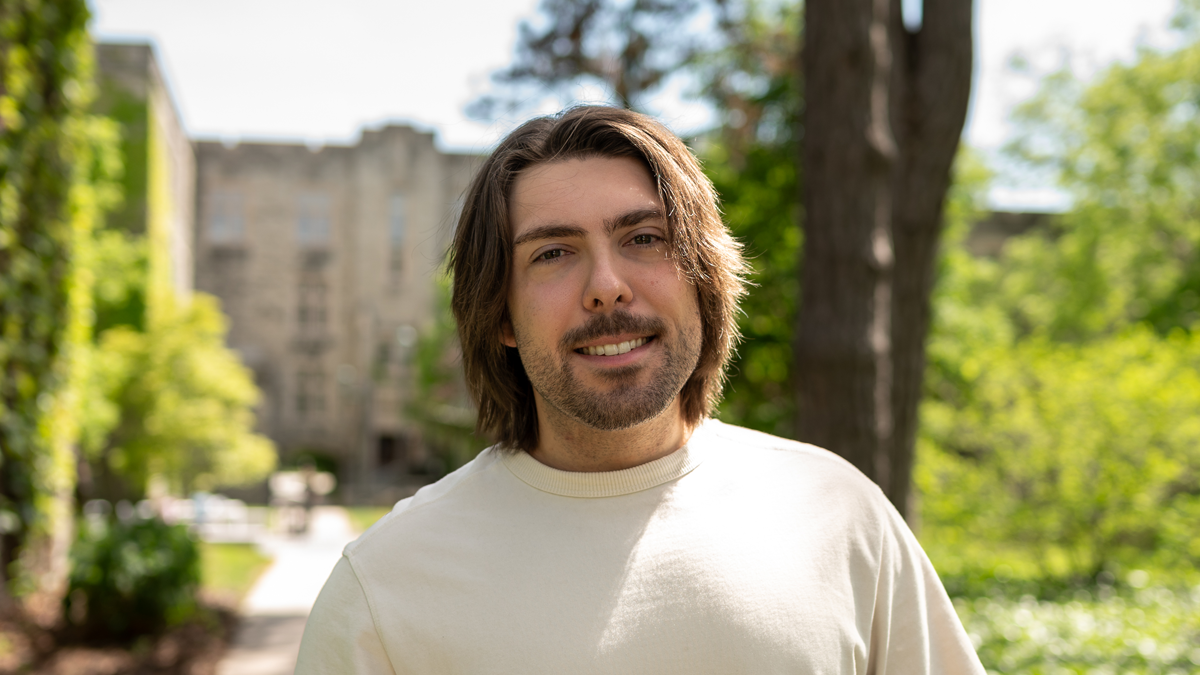
After an unexpected path into biochemistry, Tyler Brown is using machine learning to make gene editing tools safer and more efficient.

Written by Evelyn Jones
Tyler Brown’s path to biochemistry began in an unexpected place: political science.
Brown began his academic journey at King’s College, a few blocks from the lab where he would eventually earn his Ph.D. His path began to change as he pursued new interests across disciplines.
Curious, Brown took several summer courses in computer science and calculus and decided to try bioinformatics after an instructor mentioned the program.
“I never intended for it to end like that,” he said.
This month, Brown will graduate from Western’s Schulich School of Medicine and Dentistry with a doctorate in biochemistry, with a joint specialization in scientific computing and machine learning in the health and biomedical sciences.
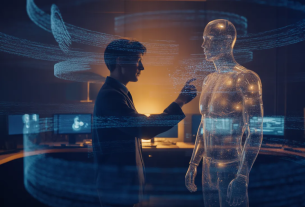
His research uses machine learning to better predict how the CRISPR-Cas9 gene editing tool will interact with DNA.
Browne describes CRISPR as molecular scissors designed to cut DNA at specific locations. The challenge is that these scissors don’t always cut the way researchers want.
DNA contains many potential target sites for CRISPR. Researchers need a way to narrow down the field because testing each one individually would take a lot of time and resources.
“My idea was to use machine learning to determine which DNA targets were most likely to work,” Brown said.
This idea led to CrisprHAL, a collection of machine learning models trained to recognize patterns in CRISPR-Cas9 data.
While much of the conversation around AI focuses on large-scale language models, Brown sees machine learning as a way to make scientific research more efficient. CrisprHAL allows researchers to classify potential gene targets more quickly.
By helping researchers narrow their field, tools like crisprHAL could facilitate the study of CRISPR-Cas9 activity and the design of more precise genetic tools.
Through his work, Brown also began to realize the value of his own contributions.
At one meeting, after Brown presented results that raised new questions, one of his supervisors asked what experiment he should run next to test his findings.
“That’s when I realized I was more than just a student,” he says. “I was an important part of the team.”
Much of Brown’s research is done in computers, and the effects can take years to become apparent, but he says his volunteer work with St John Ambulance has given him a way to help people more directly.
“Research is a long process and often we cannot see direct effects,” he said. “By volunteering, you can help people directly.”
Brown plans to continue working as a postdoctoral researcher at the Schulich Institute for Medical and Dental Research, exploring further applications of AI in biomedicine. In the long term, he hopes his research will help advance genetic disease research.
“There are a lot of unanswered questions in biology,” he said. “We know what we have to do. We just need to figure out how to do it safely and effectively.”