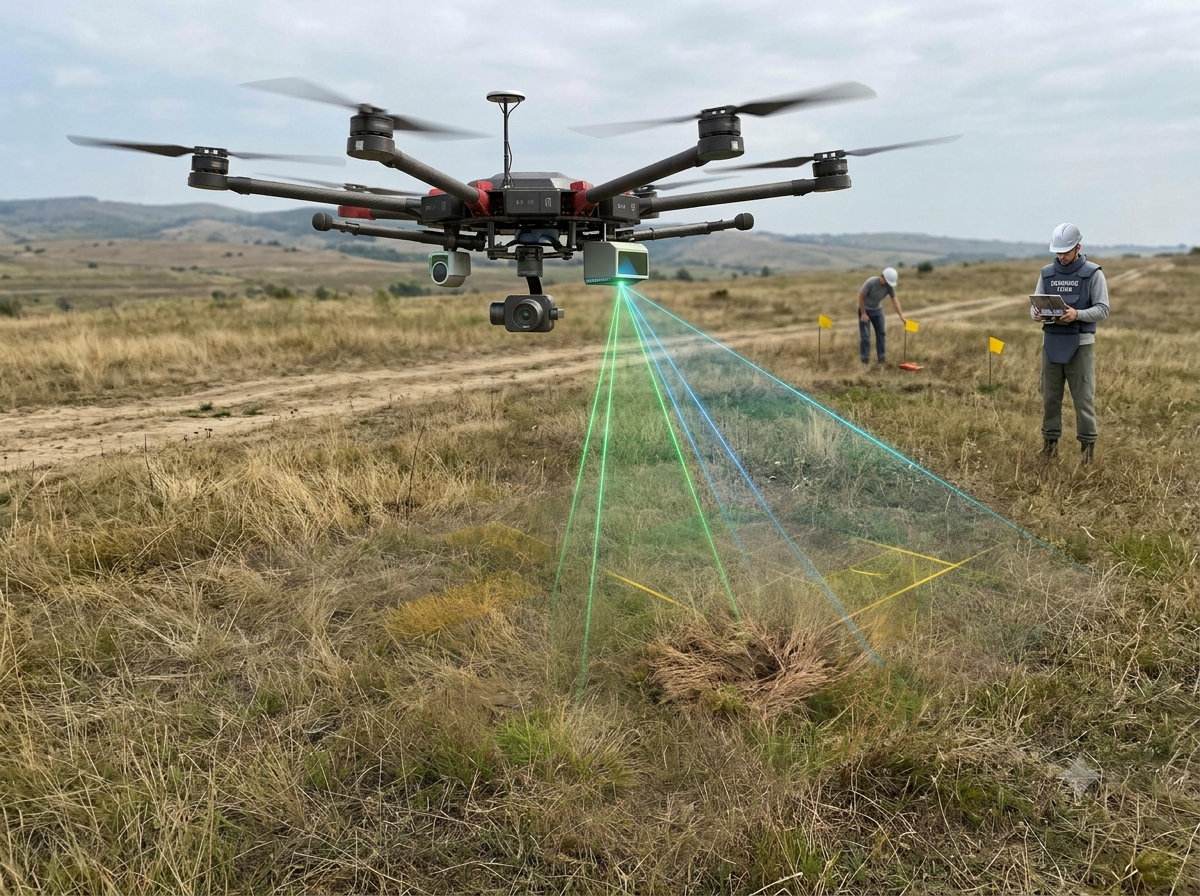
hidden antipersonnel mines It continues to threaten millions of people living in conflict and post-conflict areas around the world. Many of these explosives are made of plastic, making them difficult to detect with traditional metal detectors and other common detection methods. Researchers are currently exploring new techniques that could improve the search process and support humanitarian demining efforts. A team at Binghamton University has developed a system that combines drones, cameras, and machine learning software to identify suspected landmines in aerial imagery. This research aims to enable demining teams to work more efficiently while reducing risk during field operations and initial land surveys.
Plastic mines are antipersonnel explosive devices made primarily of plastic rather than metal. It is designed to injure anyone who steps on it or gets in its way. Since it contains very little metal, it is difficult to detect with regular metal detectors. Many plastic mines, including the PFM-1 butterfly mine, are small in size and can remain hidden in the ground or become buried under soil or vegetation over time. Even after a conflict ends, they continue to pose a danger to civilians and demining teams.
Can AI detect it?
Artificial intelligence can help detect plastic mines by analyzing drone images using machine learning algorithms. In this study, researchers used the YOLO object detection model to identify PFM-1 mines from aerial photographs taken at low altitude. The AI system was trained using images of real mines and 3D printed mines in a variety of environments and lighting conditions. Designed to quickly identify potentially dangerous areas, trained demining teams can focus on searching while working safely in the field, even without internet connectivity.
Researchers introduce new detection system
Researchers have developed a new artificial intelligence-based method to detect widespread plastic landmines. The study, titled “Deep Learning and Multi-View-Based Detection of Distributed PFM-1 Mines: Performance, Out-of-Sample Evaluation, and Field Readiness,” was published in the journal Geomatics. The project was led by Binghamton University geology graduate Sharifa Kalwandiar, associate professor of geography Thomas Pingel, and associate professor of earth sciences Alex Nikulin.
The study focuses on plastic antipersonnel landmines, which are difficult to detect because they are small and often made almost entirely of plastic. Traditional metal detectors usually cannot identify these mines. Other geophysical methods, such as ground-penetrating radar, magnetometry, and electromagnetic induction, are also less effective at searching for plastic mines compared to metal mines.
Why are plastic mines still so difficult to detect?
Plastic anti-personnel landmines pose a major challenge in humanitarian demining efforts. Their small size and plastic housing make them difficult to identify with existing detection systems. One of the biggest concerns is the PFM-1 landmine, a flying mine first developed during the Soviet era. These mines are designed to spread over large areas after being released from the air. Its shape resembles a maple seed and falls slowly, making it useful for covering large areas.
According to Alex Nikulin, these mines were designed to injure people, not kill them. He explained that treating wounded soldiers is a greater strain on military resources than the number of deaths. He also pointed out that every part of the mine’s design helps it avoid detection. These mines can remain hidden for years, continuing to pose a danger to civilians, demining workers, and communities to which they return after conflict.
Why are drones important for finding hidden mines?
The researchers explained that the location of these mines is determined by the conditions in the affected area. In areas of active conflict, such as Ukraine, deployable mines are often left close to the surface. In areas where conflict ended many years ago, mines can become buried under soil or covered by vegetation over time.
Each PFM-1 mine is about the size of a cell phone, so the drone must fly close to the ground. Flights are typically performed at heights of approximately 10 to 20 meters to collect images with sufficient detail for analysis. Sharifa Kalwanyar said the technology is designed as an initial evaluation. As an alternative to manual demining, it can help determine whether an area should be classified as a hazardous location requiring further investigation.
Researchers trained AI using real and replica landmines
The research began as part of Kalwanjal’s master’s thesis. She took aerial photos using a camera mounted on a drone. The software combined the images into a larger map before being analyzed using the You Only Look Once (YOLO) machine learning algorithm. The research team used an inert PFM-1 mine and a 3D printed copy to train the AI system.
The mines were placed in different locations and under different conditions throughout the Binghamton University Preserve. Images were collected from multiple viewing angles, lighting conditions, and environmental settings. This allowed researchers to build a large dataset showing what mines look like in real landscapes. The goal was to prepare the AI model for situations likely to be encountered during real-world humanitarian operations.
Two AI models were tested during the study
Researchers created two different versions of the YOLO detection model. The first model was trained solely to recognize PFM-1 mines. The second model learned to identify both PFM-1 mines and many other common objects that can appear in outdoor environments.
The second system had a lower performance score because it had to distinguish between landmines and natural objects such as leaves and other materials visible in camera images. The researchers say these lower results may actually provide a more realistic picture of field performance, since real environments always contain many distracting objects.
The system is designed to be used in the field without internet access
Most of the computing work is done before deployment. Thomas Pingel explained that training an AI model can take anywhere from a few hours to up to a day, depending on the number of images used. Once training is complete, the system can operate with simple equipment. Researchers said all they needed on site was a consumer-grade laptop, drone, and camera.
Karwandyar also focused on enabling the software to process images in real time or near real time. This allows demining teams to examine results while working in the field, without having to return to another location for analysis. The system works without an internet connection.
This capability is important because communications infrastructure is damaged in many conflict and post-conflict areas. Signal jamming and GPS interference can also make online systems unreliable in places like Ukraine.
Technology supports trained demining teams
The researchers stressed that artificial intelligence cannot replace trained demining experts. Mine clearance continues to rely on experts who understand safe demining procedures and local communities who are familiar with the terrain. The AI system is designed to make the search process more efficient by helping identify locations worthy of closer inspection.
Nikulin said there is often a gap between laboratory research and the practical challenges faced during humanitarian demining operations. By working closely with non-governmental organizations, the research team ensured that the technology was responsive to field requirements, rather than remaining a laboratory project. If more widely deployed, this system could improve initial mine detection, reduce search times and support safer humanitarian operations in areas affected by landmine contamination.
FAQ
Q1. What are plastic landmines? Why are they difficult to detect?
Plastic mines contain very little metal, making them difficult to detect with metal detectors. Their small size and plastic housing also reduce the effectiveness of many traditional geophysical detection methods.
Q2. Can AI replace human demining teams?
No, AI uses drone imagery to help identify areas that may be dangerous. Trained demining professionals and local communities continue to identify, safely remove and dispose of landmines during humanitarian operations.