

Anyone who is having a baby knows there is a long list of things to avoid during pregnancy. While stress management may not always be top of mind, high levels of stress can be dangerous to both the mother and fetus. However, machine learning (ML) systems may offer a solution.
Researchers with the Center for Advancing Safety of Machine Intelligence (CASMI) are studying expectant mothers’ stress levels to combat them in real time and even prevent them. Maia Jacobs, Northwestern assistant professor of computer science and preventive medicine, and Nabil Alshurafa, Northwestern associate professor of preventive medicine and of computer science and electrical and computer engineering, are principal investigators (PIs) of the CASMI-funded research project, “Co-Designing Patient-Facing Machine Learning for Prenatal Stress Reduction.”
Alshurafa, along with his students in the Health Aware Bits (HABits) Lab, created an ML system that predicts next-day stress. The system measures stress using sensors on the body and participant responses to smartphone-based questions to predict if tomorrow is going to be a stressful day. The work started about five years ago as part of the Promoting Healthy Brain Project (PI: Lauren Wakschlag, Northwestern professor of medical social sciences, pediatrics, psychiatry and behavioral sciences), which is aimed at improving maternal and fetal health outcomes. Researchers collected 12 weeks of data from 100 pregnant women, who were divided into two groups, the control and intervention. Both groups self-reported stress levels using a smartphone-based questionnaire and wore a sensor that measured heart activity and physical activity.
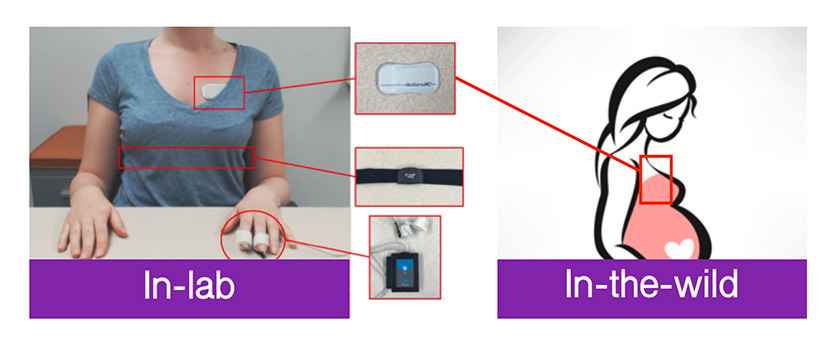
“Based on both a person’s perception of how stressed they are, obtained from self-reported data, and sensor data measuring heart activity, we can build a machine-learned model that predicts whether you are going to be stressed tomorrow,” Alshurafa said. “If there is a high likelihood, maybe we can do something about it today, to reduce their stress level tomorrow.”
If high stress levels are detected, pregnant women will receive text messages or links to videos that have been proven to reduce stress. These “just-in-time adaptive interventions” include explanations about the data and are aimed at being interpretable and transparent.
 “We have the algorithms to make meaningful health outcomes,” Jacobs said. “What we didn’t know at the start of this project was how to communicate these machine learning suggestions to the general public.”
The CASMI study worked with 20 pregnant people (both low-risk and high-risk pregnancies) to get their feedback on the next-day stress prediction tool. Researchers are analyzing the data before redesigning how the tool interfaces with pregnant people. Then, they plan to test the prototype to learn how it can be improved.
Jacobs emphasized the importance of involving patients in the design of these tools. Historically, developers have worked more often with clinicians and medical staff to create medical decision-making software, and patients are often unaware of their presence within health systems. Jacobs said this can result in unexpected harms to patients, and “we have seen how these tools can inadvertently amplify existing social inequities that exist within health systems.”
“Patients should play a role in all phases of developing tools,” she said. “There is a missed opportunity to involve patients, who bring their own health expertise, in shaping machine learning technologies.
“In our research, we build out new methods and tools that allow us to meaningfully involve patients in the design of ML tools,” Jacobs continued. “We work with each participant to co-design the intervention. Then, we have a follow-up survey where we ask them to reflect on the method itself. Was it successful in giving them a voice? Were the terms clear?”


