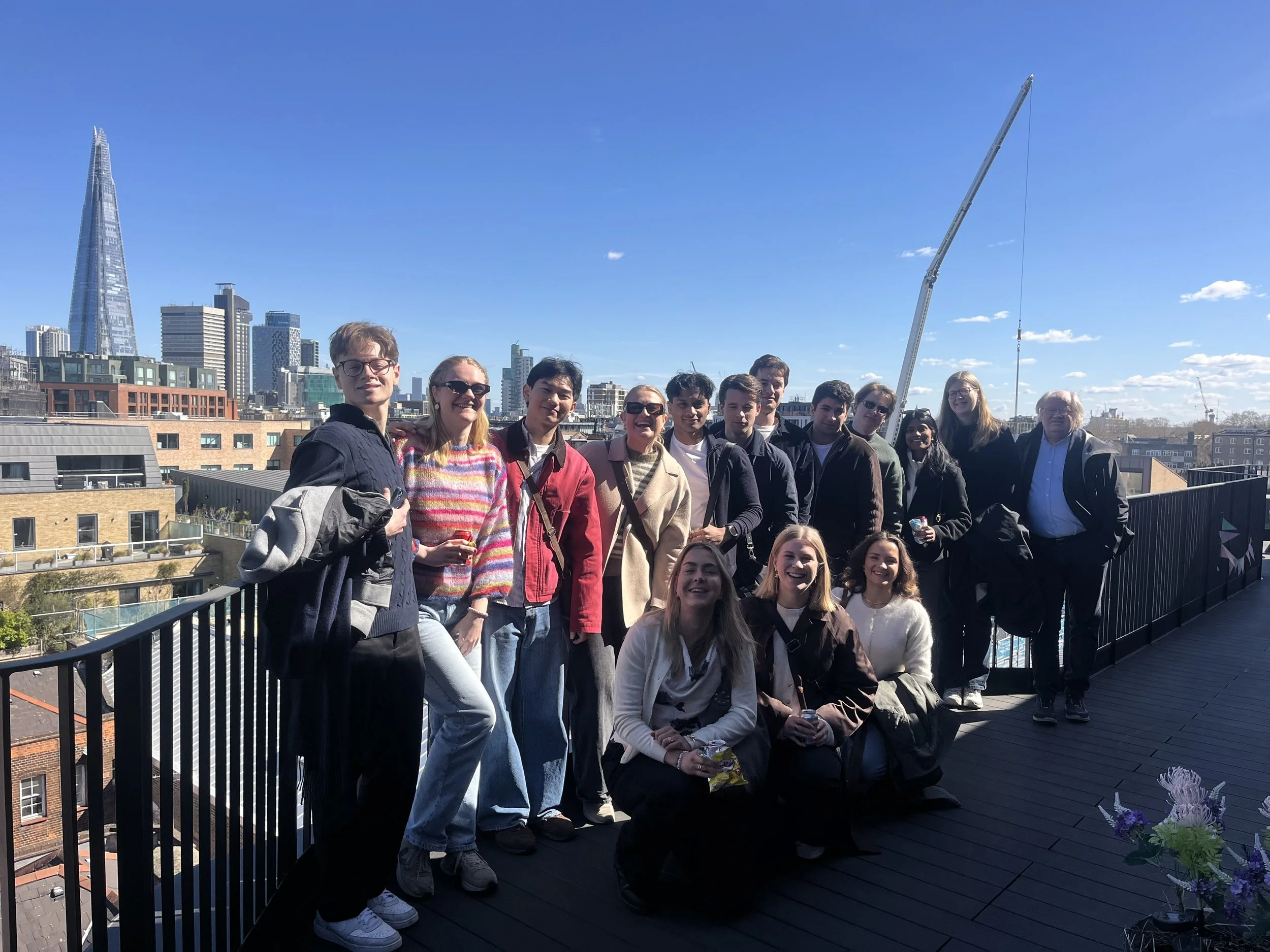
Visited by students from Norwegian University of Science and Technology (NTNU) Atenshi’s The London office last week asked A.I.-Driven simulation and multi-agent systems are built for real-world training.
This session reflects broader changes in EdTech and workplace learning, with a shift in focus from prompt-based tools to more structured, experience-driven AI systems.
More than 20 MSc Industrial Economics and Technology Management students attended the visit and worked directly with Attensi’s product and AI teams to understand how digital training environments are designed and deployed.
Beyond prompt-based AI
A key focus of the session was the distinction between standalone AI capabilities and systems designed around tailored agents, context, and specific learning outcomes.
Students considered how simulation-based platforms can be structured to provide consistent, scenario-driven interactions rather than relying on a single prompt-response model. This approach reflects how some training providers are positioning AI not only as a content tool but also as a mechanism for behavior change and skill development.
Christopher Ryen-Scalard, MSc, Department of Industrial Economics and Technology Management, NTNU, said: “All students got a lot out of this visit, especially understanding the difference between AI capabilities that simply employ a prompted interface, and native AI products that are designed to create experiences with multiple agents working together in the background to perform specific tasks.”
Testing virtual humans in training scenarios
The group tested Attensi’s RealTalk platform, which uses AI-powered virtual humans to simulate workplace conversations. Students worked with the system in real-world scenarios and evaluated how the system addresses communication challenges and maintains consistency between responses.
This session focused on tailoring responses to keep them realistic and appropriate for the training environment, and also explored how to use context engineering to shape interactions.
Justin Blanchard, Creative Director at Attensi, said: “We asked our students to put RealTalk through its paces, and they did not disappoint. They engaged with the AI virtual humans with the same energy and enthusiasm they showed to the Attensi experts.”
For EdTech and workforce learning providers, this type of effort reflects a broader push to connect AI theory and implementation. Simulation, multi-agent design, and context-aware systems are becoming more prominent as part of how organizations approach training, particularly in areas such as communication, decision-making, and field skills.