
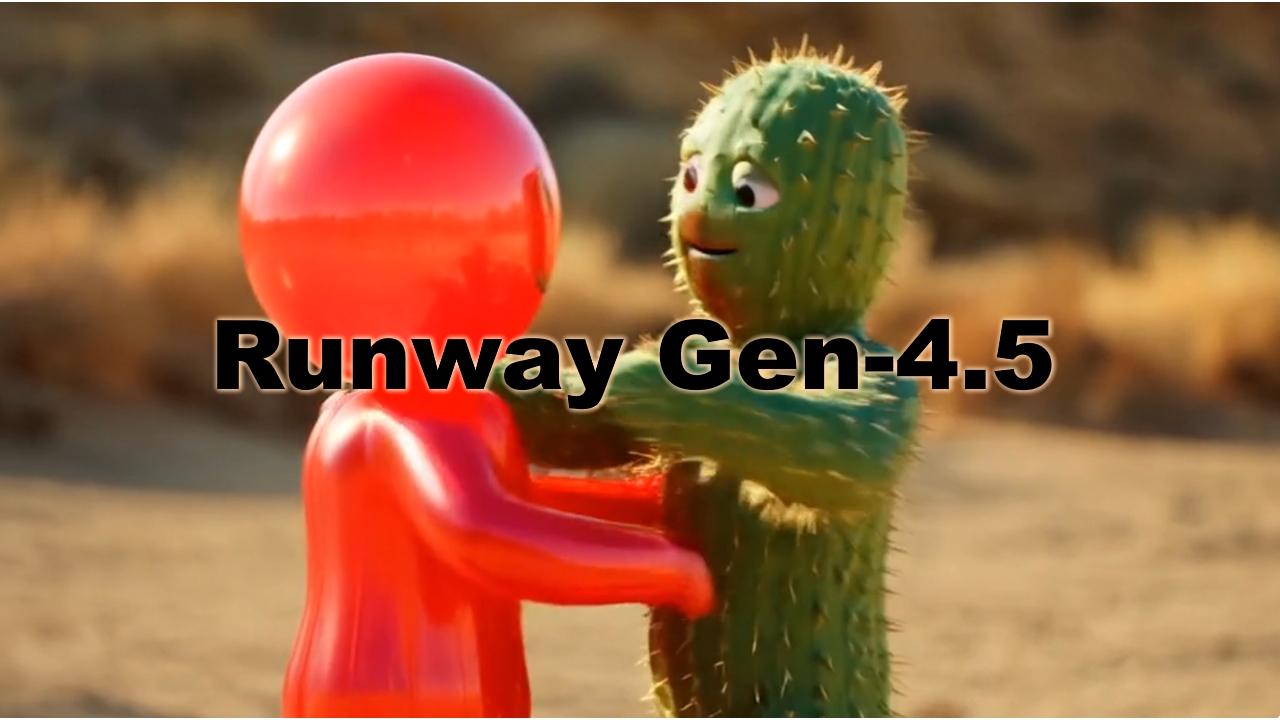
Claiming a decisive victory over multi-trillion dollar incumbents, Runway has released Gen-4.5, a new video generation model that secures the top spot on the independent benchmarking platform Video Arena leaderboard.
The system achieved an Elo score of 1,247, overtaking Google’s Veo 3 and pushing OpenAI’s Sora 2 Pro to seventh place. Inference runs on NVIDIA’s new Blackwell architecture, a rare product rollout for high-end chips.
The release is structured as validation of Runway’s independent strategy after it rejected a takeover offer from Meta earlier this year.
David vs. Goliath: Defeating the trillion dollar giant
Defying the conventional wisdom that size is an advantage, Runway beat out its larger rivals in head-to-head comparisons. The startup’s new model, called Gen-4.5, took the number one spot on the Artificial Analysis Video Arena leaderboard. This leaderboard is a metric derived from blind A/B testing, where human evaluators compare output without knowing the source model.
Securing the top spot is especially important because benchmarks rely not only on resolution and frame rate, but also on “instant compliance” and “motion quality.” By focusing on these qualitative metrics, Runway was able to overtake Google’s Veo 3, which is currently in second place, and push OpenAI’s Sora 2 Pro down to seventh place.
Introducing the new frontier video model, Runway Gen-4.5. Formerly known as Whisper Thunder (aka) David.
Gen-4.5 is cutting edge and sets new standards for motion quality, quick compliance, and visual fidelity for video production.
See below for more details. pic.twitter.com/2J945S4bQt
— Runway (@runwayml) December 1, 2025
These results highlight the vulnerability of generalist AI labs to specialized, vertically oriented startups. While major companies like Google and OpenAI spread their resources across text, code, and multimodal research, Runway focuses solely on video dynamics.
Explaining the efficiency of this focused approach, Runway CEO Cristóbal Valenzuela said: “With a team of 100 people, we’ve been able to compete against multi-trillion dollar companies. It only takes a lot of focus and hard work to reach the frontier.”
This size difference suggests that small, agile teams can effectively compete with the R&D departments of larger companies by maintaining a strong focus on the product.
Under the hood: The Blackwell advantage
The model marks a major shift in the competitive landscape, moving beyond simple “video generation” to what the company describes as a “world model” that understands physics. All development, from R&D to inference, was done on NVIDIA infrastructure.
Importantly, inference is explicitly optimized for NVIDIA’s new Blackwell architecture alongside existing Hopper GPUs. Prioritizing a particular architecture suggests that Runway is focused on inference efficiency to manage the high costs of large-scale video generation.
The official announcement highlights technological advances in physics simulation and details new features in the model.
“Gen-4.5 delivers unprecedented physical and visual precision. Objects move with realistic weight, momentum, and force. Fluids flow with the right dynamics. Surface details are rendered with great fidelity.”
Gen-4.5 delivers unprecedented levels of physical and visual precision. Objects move with realistic weight and momentum. Surfaces behave as they do in the real world. The laws of physics can be observed or ignored, depending on your vision.
Despite being big… pic.twitter.com/AsbLQ0ZSDH
— Runway (@runwayml) December 1, 2025
Specific improvements to the simulation include realistic fluid dynamics, object weight, and conservation of momentum. Surface details and textures now remain consistent even during rapid camera movements and object deformations, addressing common failure points in generated videos.
Validating the technology partnership, NVIDIA CEO Jensen Huang said: “We’re proud that Runway has built groundbreaking video and world models on NVIDIA GPUs, and we’re excited to see Runway revolutionize the video generation industry.”
By deploying on Blackwell, Runway will be one of the first companies to leverage architecture-specific optimizations for generative inference, potentially giving it a cost-performance advantage over competitors that still rely on older hardware.
Super Sunday: A three-way battle for video supremacy
December 1, 2025 has emerged as a notable “Super Sunday” for the AI video industry with three major releases taking place simultaneously. While Runway is targeting the high-end proprietary market, the Chinese tech giant launched an aggressive open source challenger on the same day.
ByteDance has released ByteDance’s Vidi2, a 12 billion parameter model focused on “spatiotemporal grounding.” Unlike pure generators, Vidi2’s architecture prioritizes editing and understanding, identifying where objects are in time and space to enable precise manipulation.
At the same time, Tencent launched Tencent’s HunyuanVideo-1.5, an 8.3 billion parameter model. Tencent’s strategy targets consumer hardware, with models optimized to run on GPUs with as little as 14 GB of VRAM, effectively commoditizing high-quality production for enthusiasts.
A clear contrast exists between these approaches. Although Runway offers a closed, high-performance SaaS product, the Chinese company is democratizing technology through open source. These differences create a bifurcated market, with corporate users paying for Runway’s fidelity, while individual creators flock to free, locally viable alternatives.
The Cost of Independence: Why Runway Rejected Meta
Today’s release provides strategic vindication following Runway’s rejection of an unsuccessful acquisition offer from Meta in early 2025. Meta was looking to strengthen its video capabilities and was looking to acquire startups to fill gaps in its generative media stack.
Instead of selling, Runway focused on building an inclusive ecosystem. Functionally, the new model links with the Aleph video editor released in July to create workflows that mirror Adobe’s approach but use native AI tools. That is, capture with Gen-4.5 and adjust with Aleph.
Reflecting on his decision to remain independent, Valenzuela emphasized: “It feels like a very interesting moment because we are entering an era of efficiency and research. [We’re] I’m excited about making sure AI isn’t dominated by two or three companies. ”
Gen-4.5 pricing is described as “comparable” to previous tiers, indicating an aggressive move to maintain market share against commoditized rivals. Building on the foundation laid by Runway’s Gen-4, which introduced cinematic controls earlier this year, this strategy further strengthens the company’s position as a premium tool for professional creators.


