
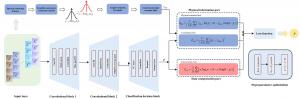
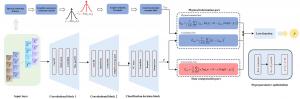
Architecture of the proposed PCNN framework.
Georgia, USA, July 10, 2026 /EINPresswire.com/ — Global Navigation Satellite System (GNSS) spoofing, the transmission of false signals that trick receivers into reporting a false location or time, poses a growing threat to aviation, shipping, power grids, and autonomous systems. While machine learning has improved detection, most models fail when faced with never-before-seen attack scenarios because they learn data patterns rather than the underlying physics of the actual signal. The new approach embeds fundamental physics directly into the neural network training process, enabling the model to detect spoofing with over 92% accuracy, even in completely unfamiliar attack environments.
Traditional spoof detectors rely on statistical rules and data-intensive deep learning models. These models perform well in the scenarios in which they were trained, but break down when the attack changes, for example when the receiver moves from a static to a dynamic state or when the spoofing power profile changes. Machine learning models learn the statistical quirks of the training dataset rather than the immutable physical relationships that define real Global Navigation Satellite System (GNSS) signals. As a result, in unseen scenarios, essentially random guesses, accuracy can plummet to about 50%. These challenges require approaches that go beyond pattern matching to capture fundamental signal characteristics that cannot be fully reproduced by spoofing.
Now, researchers at the National University of Defense Technology in Changsha, China have developed the Code Carrier Consistent Physically Constrained Neural Network (CCC-PCNN), a detection framework that integrates the laws of physics into the learning process. The study (DOI: 10.1186/s43020-026-00199-8), published in the journal Satellite Navigation on June 26, 2026, demonstrates the inherent consistency between code phase and carrier phase, a relationship that genuine GNSS signals follow but spoofed signals systematically violate. We show that by embedding , as a constraint in the loss function, both accuracy and generalization improve dramatically.
The team designed a one-dimensional convolutional neural network with parallel “physical paths” that compute real-time consistency metrics from raw signal measurements. Rather than simply supplying physics-derived features as additional inputs (a common but limited strategy), the researchers reformulated the loss function to penalize predictions that violate the code-carrier relationship. This hybrid goal forces the model to learn both data-driven and physically grounded representations. On benchmark datasets spanning static and dynamic receiver platforms, power advantages from 0.4 to 10 dB, and both time and location manipulation attacks, CCC-PCNN achieved an average detection accuracy of over 98% in intra-scenario evaluations. More importantly, when tested on 10 completely unseen scenarios, the model maintained an accuracy retention rate of over 92.7%, outperforming standard 1D convolutional neural networks by 23.5%, long short-term memory networks by 18.4%, transformers by 9.4%, support vector machines by 28.8%, residual networks by 24.2%, and graph attention networks by 24.2%. Traditional CCC‑Detector increased by 27.0% and decreased by 46.2%. The adaptive threshold parameters controlling the physical constraints converged reliably regardless of initialization, with standard deviations less than 0.04. Inference latency remains at 0.353 ms, only 32% slower than a bare 1D convolutional neural network, but significantly faster than the Residual Network and Transformer models.
“What makes this work different is that we don’t just feed numbers from physics into a neural network and hope it makes sense of things,” the authors said. “We force the network to adhere to the laws of physics during training, and if its predictions violate code carrier consistency, it is penalized. This forces the model to learn not just what the training data happens to be, but what the real signal should be like. The result is a detector that doesn’t panic when it encounters new kinds of attacks; it just checks and recognizes the physics.”
Its impact extends far beyond navigation. Systems that rely on time-synchronized signals, such as power grid synchronization, telecommunications networks, financial trading platforms, and autonomous vehicles, face similar risks of spoofing. For example, financial networks rely on GNSS to obtain accurate transaction timestamps, and 5G base stations require phase-synchronized clocks. Both are equally vulnerable to spoofing. CCC‑PCNN provides a blueprint for building AI-based security systems that are less vulnerable to distributional changes because they base their decisions on physical invariants rather than statistical chance. The framework is computationally intensive enough for real-time deployment on resource-constrained receivers, taking only 0.353 ms per inference. Future research will address cold-start scenarios (receiver power-on under active attack) by investigating preloaded calibration baselines and satellite-to-satellite consistency checks, working toward a new generation of physical intelligent navigation security.
References
Toi
10.1186/s43020-026-00199-8
Original source URL
https://doi.org/10.1186/s43020-026-00199-8
About satellite navigation
Satellite Navigation (ISSN: 2662-1363; ISSN: 2662-9291) Satellite Navigation is the journal of the Aerospace Information Institute. It aims to report innovative ideas, new results, or advances in theoretical methods and applications of satellite navigation. This journal welcomes original articles, reviews, and commentaries.
Lucy Wang
biodesign research
please email here
Legal disclaimer:
EIN Presswire provides this news content “as is” without warranty of any kind. Our company does not assume any responsibility or liability
The accuracy, content, images, videos, licenses, completeness, legality, or reliability of the information contained herein;
article. If you have any complaints or copyright issues related to this article, kindly contact the author above.


