

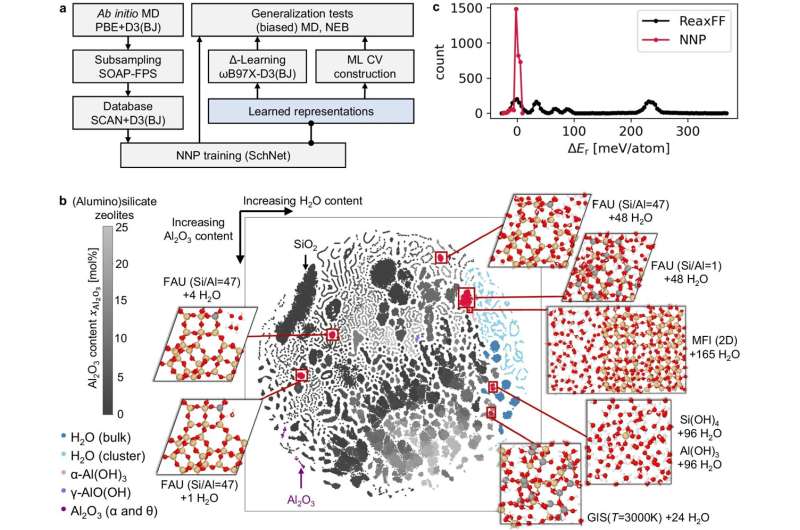
a. Computational workflow for creating the SCAN+D3(BJ) database using a subset of ab initio molecular dynamics (MD) trajectories selected by farthest point sampling (FPS) and smooth atomic position overlap (SOAP) descriptors. The generality of NNP was tested by (biased) MD and nudged elastic band (NEB) calculations. The end-to-end learned representations are used to build Δ-learning and ML ensemble variables (ML CV). b. t-distributed stochastic neighbor embedding (t-SNE) plot of the average representation vector of all configurations in the training database (color code shown on the left). Generalization tests are highlighted in red (Si: yellow, Al: grey, O: red, H: white). c. Reaction energy error distribution ΔEr of NNP compared to ReaxFF (see Eq. 1). Credit: Charles University
The Nanomaterials Modeling Group of Dr. Grajciar and Dr. Heard at Charles University’s Faculty of Science develops and applies a variety of computational methods to study and optimize materials that have great industrial potential or that are already in industrial use.
They established a new machine learning-based framework that enables the comprehensive investigation of such materials under operating conditions. Nature Communications.
Zeolites are a class of microporous aluminosilicates with great structural and chemical diversity resulting from numerous stable three-dimensional arrangements of covalently bonded silica/alumina tetrahedra. This makes them a versatile class of materials with applications ranging from thermal energy storage to gas separation and water purification, but they are primarily used in heterogeneous catalysis.
However, until now, a comprehensive investigation of their vast structural and chemical diversity has been mainly based on trial-and-error experimental approaches and simplified theoretical models.
The advent of machine learning has opened up opportunities both to greatly accelerate computational simulations and to employ more realistic and complex models of (catalytic) materials. Dr. Grajciar and Dr. Heard's groups have exploited this, developing models based on convolutional neural networks that can accelerate atomistic simulations of different classes of materials by orders of magnitude.
In particular, they focused on a crucial class of proton-exchanged aluminosilicate zeolites, which are both the basis of existing petrochemical processes produced at megaton scale and are also one of the prime candidates for new applications in sustainable chemistry.
Importantly, in addition to accelerating atomistic simulations, the researchers showed that machine learning models can uncover previously unseen chemical processes and species in these materials. They also demonstrated how these baseline neural network models can be extended and combined with other advanced machine learning-based tools to further improve accuracy and sampling efficiency.
In summary, the ML-based framework introduced in the work of the Nanomaterials Modeling Group is a major step towards large-scale simulation of zeolites, a crucial class of catalytic materials, addressing long-standing challenges in the field, ranging from understanding the mechanisms of zeolite hydrothermal (in)stability to characterizing active species and defects under operating conditions.
This work represents an important use case demonstrating the potential of machine learning in rational materials design.
For more information:
Andreas Erlebach et al. “Reactive Neural Network Framework for Acidic Zeolites Containing Water” Nature Communications (2024). Publication date: 10.1038/s41467-024-48609-2
Courtesy of Charles University
Quote: New neural network framework advances large-scale simulations of zeolites (May 31, 2024) Retrieved June 2, 2024 from https://phys.org/news/2024-05-neural-network-framework-advances-large.html
This document is subject to copyright. It may not be reproduced without written permission, except for fair dealing for the purposes of personal study or research. The content is provided for informational purposes only.

