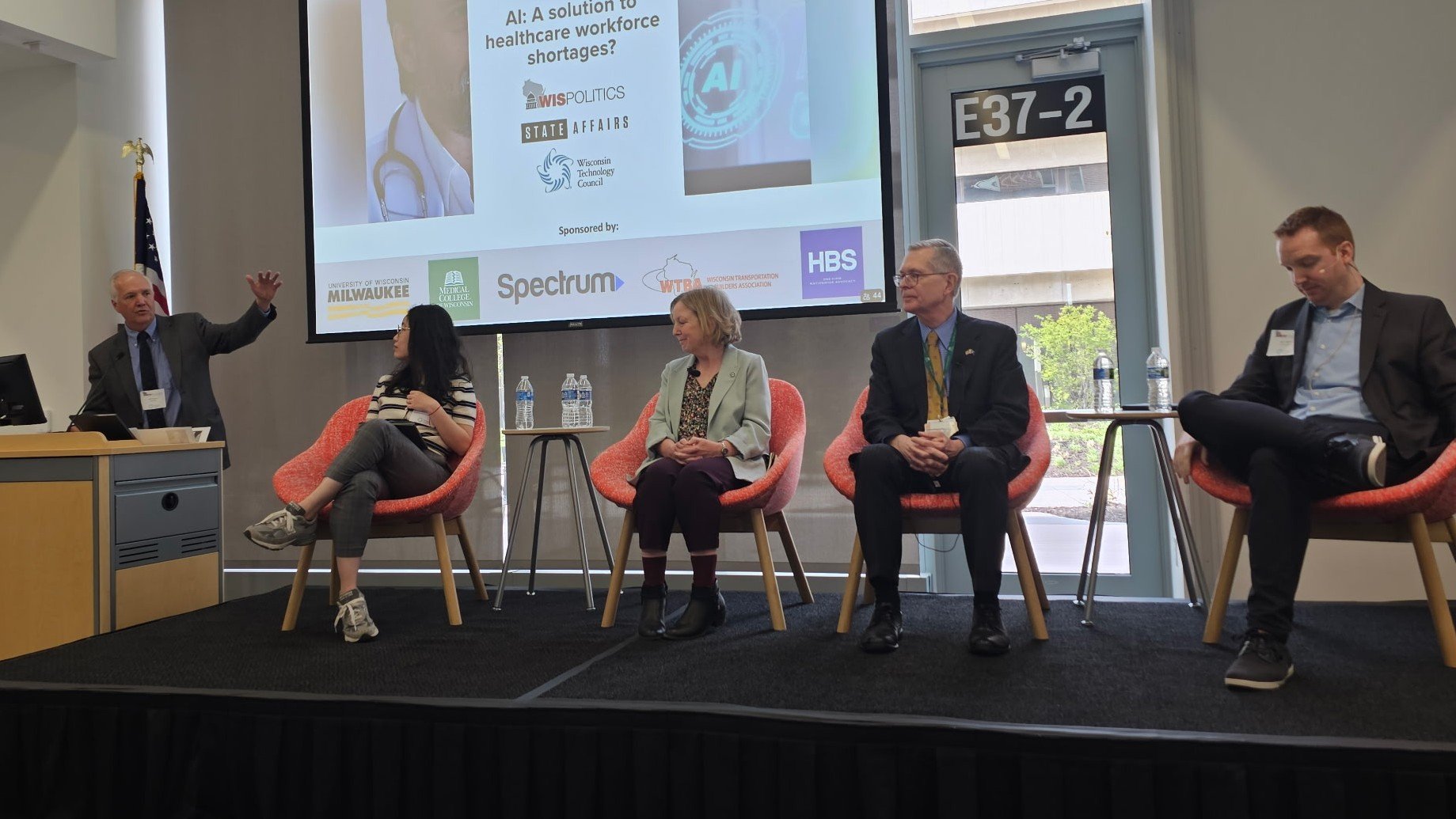
While previous concerns about AI in healthcare are easing, new questions are emerging regarding the rapidly evolving technology.
That’s one conclusion from the WisPolitics-State Affairs and Wisconsin Technology Council event held May 5 at the Medical College of Wisconsin. The luncheon explored the use of AI to address healthcare worker shortages.
Outgoing MCW President and CEO Dr. John Raymond has warned that new risks are emerging in the use of AI in healthcare.
“Initially, the pitfalls were the quality of the data in the training set and the tendency of some of these algorithms to hallucinate or … fabricate things, and that was a big concern,” he said. “They are not completely under control now, but they are mostly under control.”
But as ambient AI note-taking systems become the norm for clinicians, new concerns about data privacy and disclosure of how AI and personal data are used are gaining traction. A recent American Medical Association survey found that more than 80% of clinicians use AI in their daily practice.
“The ethics of using AI and the disclosure to patients about how their data is used, how it’s processed, whether it’s HIPAA compliant in terms of security, compared to electronic health records… those are real concerns and we need to monitor them,” Raymond said yesterday.
The discussion touched on the potential for AI to reduce some of the workload of healthcare workers to reduce burnout, as well as its potential applications in diagnosing diseases, improving the patient experience, and supporting physician decision-making.
But all of these benefits are only possible if the underlying technology infrastructure is in place, according to medical informatics expert Lu He, a professor at the University of Wisconsin-Milwaukee. This poses real problems, especially for efforts to support underserved communities and rural areas, she said.
“With AI, assuming they have a smartphone, they will have a sufficient system to run large language models and even speech recognition software,” she said. “But in many communities, that infrastructure just doesn’t exist, and it’s a real burden on patients.”
She also pointed to the lack of “human infrastructure” to maintain and fix AI systems when they fail, adding that there is “a long way to go” to ensure the technology benefits everyone.
Meanwhile, labor experts at the Wisconsin Hospital Association yesterday called for “acting cautiously but quickly,” noting that the pace of change in health care has accelerated in recent decades.
“AI will advance even faster than other technologies and electronic health records,” said Anne Zenk, WHA’s senior vice president of workforce and clinical operations. “This is good news because we are facing a population problem in Wisconsin. Baby boomers like me are all retiring, and the demand for health care is increasing.”
He cited the industry’s “dual challenges” of a shrinking workforce and growing demand, and pointed to AI as a key tool to fill that gap. Still, she and Raymond raised the issue that artificial intelligence could actually increase the burden on health care workers if they are forced to see more patients by replacing other tasks they perform.
Raymond noted that even though AI increases clinician productivity and efficiency, “there will always be a temptation for employers to reduce clinician work.”
“And perhaps even if the institution does not direct them to do so, many clinicians may act on their own to do so because they have adopted productivity-based reimbursement models,” he said. “We need to make sure we address all aspects of the medical field.”
Yesterday’s panel discussion also touched on the role of government in setting standards for the use of AI in healthcare. Nick Myers, entrepreneur and director of AI innovation at Recovery.com, argued that more regulation of the technology is “sorely needed”.
“Until that happens, we will continue to exist in this environment without standards, without a code of ethics, without governance of any kind, and of course trying to consolidate this industry into the most highly regulated industry in this country after finance,” he said.
“This is the Wild West,” Raymond added, calling for a regulatory framework for interoperability. He also supported uniform national standards for HIPAA compliance.
Listen to audio from the event below.