


LLM, or Large Language Models, are taught to incorporate many patterns that are woven into the structure of the language. They are used in robotics to act as high-level planners for directed tasks, to synthesize programs that represent robot policies, to design reward functions, and to generalize user preferences. They also demonstrate a range of out-of-the-box abilities, such as generating sequences of inferences, solving logic puzzles, and completing math problems. These settings remain semantic in input and output, relying on examples within the context of a few shots in the text prompt that establish the domain and input/output format of the job.
One of the key findings of their study is that LLMs may serve as simpler types of general pattern machines due to their ability to express, modify and extrapolate more abstract non-verbal patterns. . This discovery may defy conventional wisdom. To illustrate this topic, consider an abstract reasoning corpus. This extensive AI benchmark contains a collection of 2D grids with patterns that suggest abstract concepts (object filling, counting, rotation, etc.). Each task starts with some instance of the relationship between inputs and outputs and proceeds to test the inputs. Its goal is to predict relevant outcomes. Most program synthesis-based approaches are either built manually using domain-specific languages or evaluated against condensed variations or subsets of benchmarks.
Prompted in-context in the style of ASCII art (see Figure 1), LLM can accurately predict solutions for up to 85 (out of 800) problems without the need for additional model training. outperforms some of the most performant techniques in According to their experiments, it can also be fine-tuned. On the other hand, end-to-end machine learning techniques can solve only a small number of test problems. Surprisingly, they found that this holds true for more than just ASCII numbers, and that even if the LLM permutation is a mapping from a dictionary to tokens randomly chosen from a dictionary, it may still produce a good response. bottom. These findings raise the interesting possibility that LLMs may have broader representation and extrapolation capabilities regardless of the specific token under consideration.


This is consistent with and supports previous findings that ground truth labels outperform random or abstract label mappings when used for in-context classification. In robotics and sequential decision making, many problems involve patterns that are difficult to reason about precisely in words, so ARC’s ability to underpin pattern reasoning enables common pattern manipulations at different levels of abstraction. They hypothesize that it might be possible. For example, the way things on your desk are spatially rearranged can be represented using random tokens (see Figure 2). Another example is extending the sequence of status his tokens and action tokens with increasing returns to optimize the trajectory with respect to the reward function.
Researchers from Stanford University, Google DeepMind, and the Technical University of Berlin have two main goals in this work: To evaluate possible zero-shot capabilities, (ii) to investigate how these capabilities can be used in robotics. These efforts are orthogonal and complementary to developing multitasking policies by pre-training with large amounts of robot data or robot foundation models that can be fine-tuned for downstream tasks. These skills are arguably insufficient to completely replace specialized algorithms, but characterizing them can help determine the most important areas to focus on when training generalist robot models. Helpful. According to the evaluation, LLM falls into his three categories: sequence transformation, sequence integrity, or sequence extension (see Fig. 2).

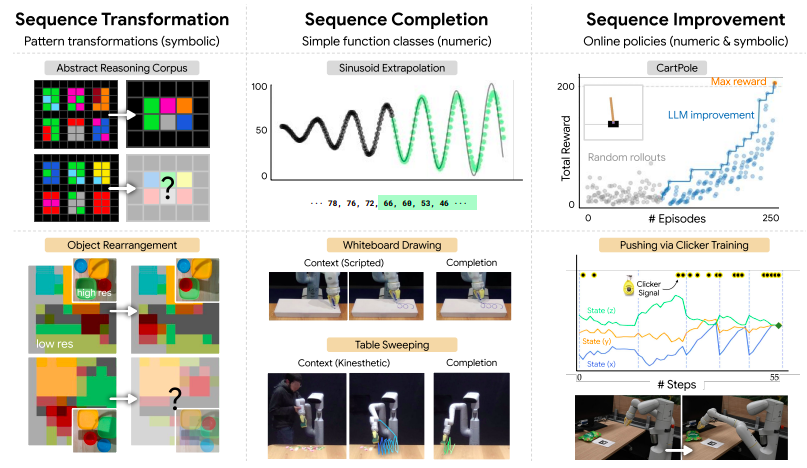
First, they demonstrate that LLM can generalize several sequence transformations of increasing complexity with token immutability, which could be used in robotic applications that require spatial thinking. suggests. They then evaluated LLM’s ability to complete patterns from simple functions (such as sine waves), which extended from tactile demonstrations to wiping motions and robotic activities such as creating patterns on a whiteboard. demonstrate how it can be used for LLM can perform a basic type of sequence improvement through a combination of extrapolation and in-context sequence transformation. These use reward-labeled trajectory contexts and online interactions to allow LLM-based agents to navigate a small grid, find stable CartPole controllers, and use human-participating “clicker” incentives to base It shows how it can help you learn how to optimize your trajectory. training. They publish code, benchmarks and videos.
Please check paper and plan. don’t forget to join 26,000+ ML SubReddit, Discord channeland email newsletterShare the latest AI research news, cool AI projects, and more. If you have any questions regarding the article above or missed something, feel free to email me. Asif@marktechpost.com
🚀 Check out 100’s of AI Tools at the AI Tools Club


Aneesh Tickoo is a consulting intern at MarktechPost. He is currently pursuing his Bachelor of Science in Data Science and Artificial Intelligence from the Indian Institute of Technology (IIT), Bhilai. He spends most of his time working on projects aimed at harnessing the power of machine learning. His research interest is in image processing and he is passionate about building solutions around it. He loves connecting with people and collaborating on interesting projects.


