Written by Diana Udell University of Miami News
MIAMI — Scientists have created an AI model that predicts moderate heat stress, a key precursor to coral bleaching, up to six weeks in advance at locations along Florida’s coral reefs. Predictions are usually accurate within a week.
This study presents a site-specific explainable machine learning framework to support coral scientists and restoration professionals in developing local reef management and emergency response plans.
“This model allows coral scientists and resource managers to know in advance whether heat stress is likely to occur during a given season and, more importantly, the week in which heat stress is most likely to begin,” said lead author Marybeth Arcodia of the University of Miami’s Rosenstiel School of Marine, Atmospheric, and Earth Sciences. Arcodia holds a dual appointment within the Department of Atmospheric Sciences and the Frost Institute for Data Science and Computing. “Through explainable AI, we can also identify the environmental factors that drive predictions in each reef area.”
“Our model identifies potential factors that influence thermal stress at specific reef locations,” said co-author Richard Karp, a postdoctoral fellow at Rosenstiel University’s Cooperative Institute for Oceanic and Atmospheric Research. “This information gives managers the opportunity to identify trigger points for emergency action plans and can support planning and response decisions.”
The research team combined atmospheric science, coral ecology, and data science to build a predictive tool tailored for Florida’s coral reefs.
Localized AI predictions on practical timescales
The research team used the XGBoost machine learning model to predict the onset of moderate coral heat stress at three reef sites using environmental data from 1985 to 2024. Inputs include cumulative and instantaneous heat stress indicators, sea surface temperature anomalies, air temperature, wind, solar radiation, loop current and El Niño conditions indicators, leveraging NOAA Coral Reef Watch and other public datasets.
“Our prediction system produced good predictions up to six weeks in advance and was accurate in most cases within about a week after heat stress actually began,” Karp said. “We also outperformed two benchmark approaches, a multiple logistic regression model and a frequency-based method, in predicting whether heat stress will occur and identifying when heat stress begins.”
The researchers also applied an explainable AI technique using SHAP. SHAP is a method that shows which environmental factors most strongly influence each forecast to understand how the drivers of heat stress vary by reef location and forecast lead time.
Although surface temperature consistently ranks as one of the most important predictors, other key environmental factors vary by site and lead time, highlighting the value of local predictions.
“These insights are delivered on a timescale where management action is still possible,” Karp added. “These can help prioritize monitoring, inform when to initiate emergency actions, and guide where resources are most effectively targeted.”
Actionable predictions that support proactive coral reef conservation
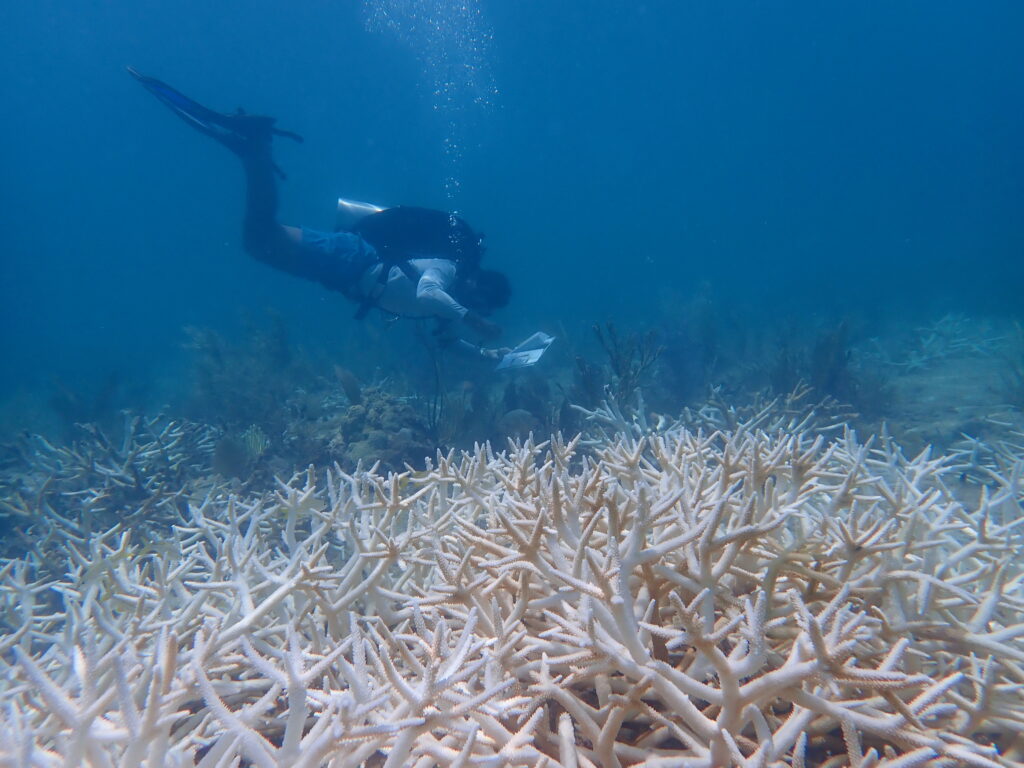
Coral reefs in Florida and the Caribbean are experiencing increasingly frequent severe heat stress and bleaching events, including the record marine heat wave in 2023, increasing the need for site-level early warning tools.
The authors emphasize that the new AI framework is intended to complement, rather than replace, existing operational systems such as NOAA Coral Reef Monitoring by adding local seasonal timing signals for the onset of heat stress.
the study, “Explainable machine learning prediction system provides early warning of heat stress on Florida coral reefs,”was published open access in Environmental Research Communications on December 16th.
The study took two years to complete from conceptualization to publication. Funding was provided by the Regional and Global Model Analysis Program Area of the U.S. Department of Energy’s Office of Biological and Environmental Research as part of PCMDI, NOAA grants #NA19OAR4590151 and #NA24OARX431C0022, and NOAA Coral Reef Conservation Program grants #31476 and #31640.
Authors include Marybeth C. Arcodia of the University of Miami Rosenstiel School of Oceanic, Atmospheric, and Earth Sciences and the University of Miami Frost Data Science Institute, Richard Karp of the Rosenstiel Collaborative Institute for Oceanic and Atmospheric Research, and Elizabeth A. Barnes of the University of Colorado Department of Atmospheric Sciences.
This article was originally published at https://news.miami.edu/rosenstiel/stories/2026/01/new-ai-model-can-assist-with-early-warning-for-coral-bleaching-risk.html. Banner photo: Bleached wild and explanted giant corals and brain corals at Sombrero Key Reef in the central Florida Keys in summer 2023. (Ananda Ellis/NOAA, Public Domain, via Wikimedia Commons).
To sign up for The Invading Sea newsletter, visit here. To support the invading seas, click here to make a donation. If you are interested in contributing an opinion piece to The Invading Sea, Email Editor Nathan Crabbe.