


overview
- Micron Technology has undergone a major revaluation, with its stock up 15% reflecting the growing importance of memory in AI infrastructure.
- The company reported record revenue of $23.9 billion in the second quarter of fiscal 2026, driven by strong demand for DRAM, NAND, and high-bandwidth memory.
- Supply constraints are a structural tailwind for Micron, as long-term contracts with customers provide revenue certainty and cushion demand volatility.
- While its current valuation looks attractive relative to its peers, analysts caution that Micron’s stock may be overvalued based on intrinsic cash flow analysis.
For most of its history, Micron Technology (NASDAQ: MU) has been seen as a producer of cyclical products that are cheap in good times and painful in bad times. We watch the frame fall apart before our eyes. A more than 15% jump on May 8th, with the stock price at $746.79 and a market value of over $850 billion, rightly reassesses the critical importance of memory to AI infrastructure.
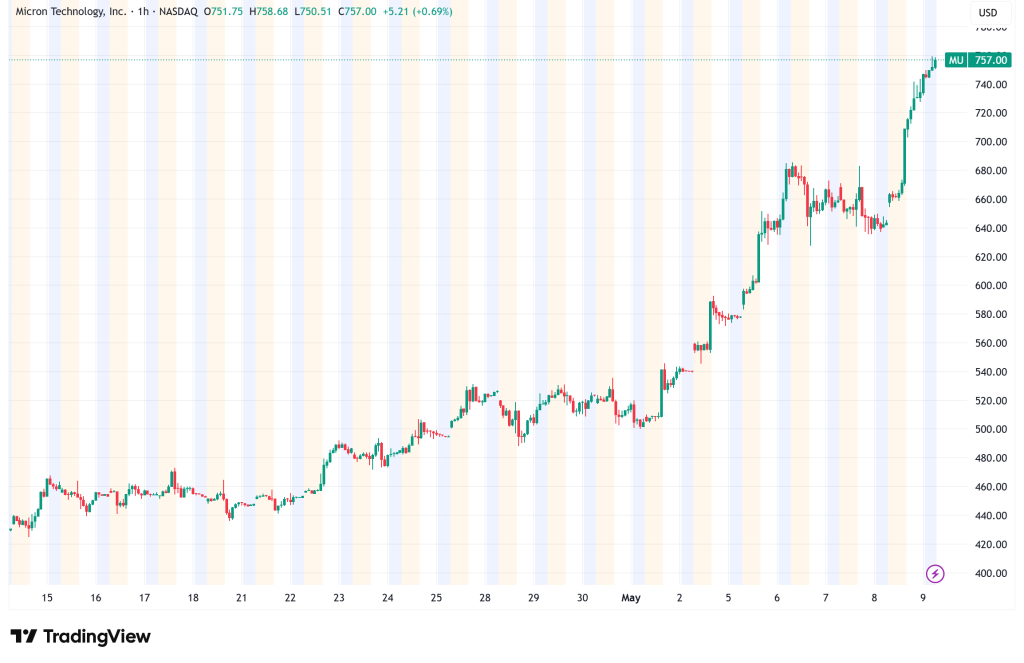
Is memory the new AI infrastructure deal?
The reason is simple. AI inference workloads (the phase in which deployed models respond to user queries at scale) require faster access to larger datasets than previous computing paradigms. That’s a direct demand for high-bandwidth memory: DRAM, NAND, and most importantly, the specific chip architectures that power Nvidia’s GPUs and AMD’s AI accelerators. “Memory is a strategic asset,” said CEO Sanjay Mehrotra, making it clear that AI “requires more memory and faster performance memory with each successive generation.”
Evidence supports that statement. Micron $MU’s fiscal 2026 second quarter sales were $23.9 billion, an increase of 196% year over year and the company’s fourth consecutive sales record. HBM, DRAM, and NAND all hit sales peaks at the same time, an unusual occurrence that speaks to broader demand rather than a single product cycle.
Supply constraints provide structural tailwinds
Where today’s memory environment differs from past booms is on the supply side. Mehrotra said supplies were “very tight.” Evidence of structural limits is accumulating. All of Micron’s 2026 HBM4 production has already been sold out with binding agreements in advance of 2020. Hyperscalers, struggling with memory cost pressures that have been publicly highlighted by customers, especially Meta, Microsoft, and Amazon, are increasingly entering into three- to five-year supply contracts rather than quarterly contracts.
This behavioral change is important. Long-term contracts cushion demand fluctuations, provide revenue certainty, and insulate Micron from spot market price fluctuations that compress memory margins during economic downturns. This is a structural maturation of the memory business model, and if it holds, it will significantly change the investment thesis.
Two other global HBM suppliers, Samsung and SK Hynix, are both effectively leveraged through their own long-term contracts. It takes 18 to 24 months to bring new production capacity online, so even if the three companies ramp up investment, the imbalance between supply and demand is unlikely to be corrected quickly.
Launch of 245TB SSD adds new growth vector
On the memory demand side, Micron recently began shipping the 245TB Micron 6600 ION SSD, a high-capacity enterprise drive for AI and hyperscale data center workloads. At this scale, the drive targets the “warm data” storage layer that AI inference systems rely on to quickly access vast model weights and datasets. This will enable Micron to capture the highest profits in the enterprise SSD market and also contribute to the development trajectory of HBM and DRAM.
What is the bear case for Micron (MU) stock?
Micron’s paper emphasizes valuation, not demand. The stock is priced at $746.79, or about 34.9 times forward earnings, which looks cheap compared to the peer average of 76.1 times, and provides real value on a relative multiple. However, Simply Wall Street’s DCF analysis suggests the stock is trading at a 47% premium to its true value, based on cash flows with an intrinsic value of approximately $507.88.
At a forward P/E of about 11 times based on near-term earnings estimates, analysts say Micron remains one of the cheapest bets on the AI infrastructure theme. The solution depends on whether demand for HBM remains at current levels or whether competitors, especially Chinese NAND suppliers, eventually bring enough capacity online to squeeze prices.
MU stock technical picture: prolonged but momentum-driven
Technically, a 15% single-session spike followed by a 5% extension in after-hours trading puts MU clearly in short-term overbought territory. Following this rally, the RSI is likely above 75 and the stock is trading comfortably above its 20-day, 50-day, and 200-day moving averages on all time frames.
The previous resistance zone around $650-$680 has now turned into a medium-term support zone. $700 is the first major technical floor to watch on the downside, and $650 is a deeper support level where long-term buyers are likely to intervene. On the upside, the psychological level of $800 is the immediate target, with analyst price targets suggesting a potential move towards $850-$900 if the AI Memory supercycle persists.
Stock splits are increasingly likely – Micron has split three times in the past, and the current price of $746 is close to the point where retail accessibility becomes a factor. In a 10-for-1 split, the stock would be worth about $75, the same price level as before.
Is it a good time to buy Micron stock?
Micron’s 15% rise is not just speculative momentum, but a real and rational reassessment of the importance of memory in AI infrastructure. HBM supply sell-outs, record sales, long-term customer agreements, and new 245TB enterprise SSDs represent a company in a fundamentally advantageous position.
The risks are clear. The memory cycle will eventually change and a 700% return per year is priced with great confidence. For traders, the $700-$720 zone is short-term support to target for an exit entry, with an immediate upside target of $800. Long-term investors should monitor the 11x short-term P/E and DCF for overvaluation signals and adjust their positions accordingly.

Arslan Butt
Lead Market Analyst – Multi-Asset (FX, Commodities, Crypto)
Arslan Butt serves as Principal Commodity and Index Analyst and brings a wealth of expertise to this area. With an MBA in Behavioral Finance and actively progressing towards a PhD, Arslan has a deep understanding of market dynamics. His professional background includes significant roles as a senior analyst at a major brokerage firm, complementing his extensive experience as a market analyst and day trader. Adept at educating others, Arslan has a commendable track record as a lecturer and public speaker. His incisive analysis, especially in the area of cryptocurrencies and foreign exchange markets, has been featured in reputable financial publications such as ForexCrunch, InsideBitcoins, and EconomyWatch, cementing his reputation in the financial community.


