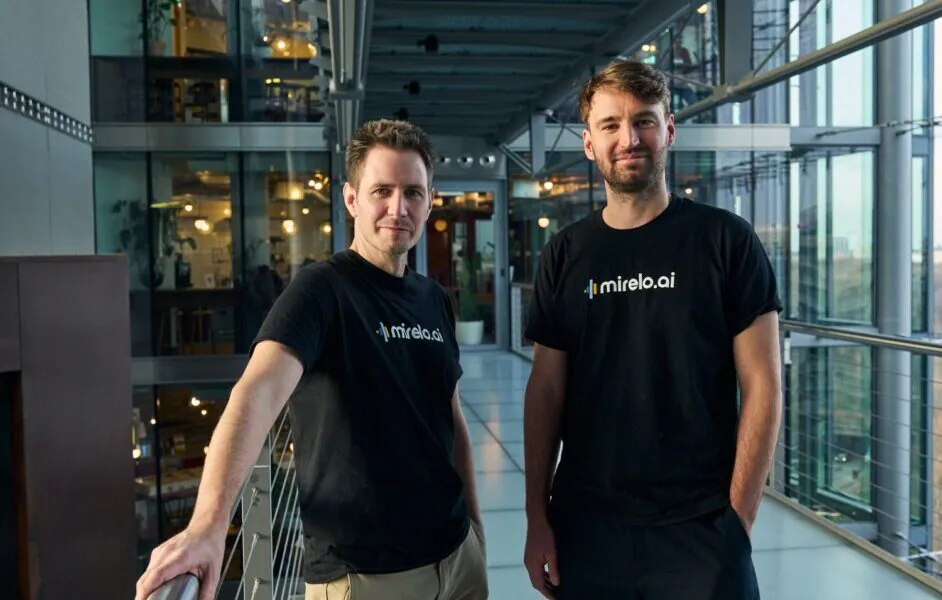
Berlin-based Mirelo has raised $41 million in a seed round to help solve one of the most persistent blind spots in generative media: sound. The funding, co-led by Index Ventures and Andreessen Horowitz, with participation from Atlantic.vc and TriplePoint Capital, confirms investors' growing confidence that audio is the next major frontier of AI-driven creativity.
Artificial intelligence has rapidly transformed the way we create text, images, and video, but audio has lagged behind. Despite having a huge impact on how content is perceived, music, sound effects, and ambient sounds are still labor-intensive and are often added late in the creative process. Mirelo's goal is to change that by making producing high-quality, emotionally resonant sound as easy as visuals.
Why is sound left behind?
Sound has a unique ability to shape emotion, tension, and atmosphere. Silent videos, no matter how visually impressive, rarely feel complete. But for most creators, adding audio means searching through stock libraries, manually adjusting sound effects, and iterating through timelines until everything feels right.
As video creation accelerates, this discrepancy is becoming more pronounced. AI-generated visuals, short-form social content, and adaptive gaming environments all operate faster than traditional audio workflows can support. As a result, the gap between what creators can imagine visually and what can realistically be executed sonically is growing.
Mirelo's founders saw this gap not as a limit of creativity, but as a limit of the tool.
Building a basic audio model
Founded in 2023, Mirelo has developed a unique foundational model designed specifically for sound in video. Rather than reusing large language models or image-based systems, the company focused on audio from the ground up. Users can upload videos and within seconds receive synchronized sound effects that react to movement, timing, and on-screen events.
This approach is particularly relevant in environments where the content is dynamic. AI-generated videos, personalized social feeds, and modern video games all benefit from audio that can adapt in real time. Mirelo's system generates sound faster than real time, allowing you to respond to changing experiences on the fly.
The company recently released Mirelo SFX v1.5, a video-to-sound effects conversion model. This is available through Mirelo Studio, a self-service API and web application. According to the company, its models are lightweight and require significantly less computing than typical large-scale language models, while delivering competitive or superior audio quality in external evaluations.
Musicians at the core of technology
One of Mirero's distinguishing features is its founding team. CEO CJ Simon-Gabriel and CTO Florian Wenzel are both accomplished musicians and experienced AI researchers. Simon-Gabriel received his PhD in Machine Learning and Causal Inference from the Max Planck Institute and completed his postdoctoral fellowship at ETH Zurich. Wenzel holds a PhD in deep learning from Humboldt University and previously worked as a researcher at Google Brain.
Music has always been a parallel in both their lives. Simon-Gabriel was trained in piano, organ, and composition, and spoke openly about pursuing music almost professionally. Wenzel plays electric guitar and continues to produce electronic music as part of a Berlin-based band.
These dual backgrounds have shaped Mirero's cultural and technical direction. Rather than treating sound as a secondary output, the team approaches sound as a primary creative medium where mathematical precision and expressive nuance must coexist.
What comes next for AI-generated sounds?
Mirero's long-term ambitions go far beyond simple automation. The company sees its technology as a way to take the friction out of creative work, taking care of tasks like synchronization and timing, allowing artists and sound designers to focus on expression and storytelling.
As visual content becomes more personalized and interactive, audio must evolve with it. Games that adapt to player behavior, video generated on demand, and immersive virtual environments all require sound that can respond dynamically rather than being fixed in advance.
In the future, technologies like Mirero could redefine the way we create, share, and experience sound. Instead of a static soundtrack, audio can become a living component of visual media, generated in real time to suit context, emotion, and intent. In that future, sound will no longer be an afterthought, but an integral layer woven directly into how stories are told across video, games, movies, and the new digital world.