MicroStrategy has announced a multi-year partnership with Microsoft to add generative AI capabilities to MicroStrategy’s business intelligence suite.
MicroStrategy has long been an independent analytics vendor, already offering advanced analytics capabilities such as natural language processing (NLP) and supporting AI through notebooks and integrations with vendors such as DataRobot and H2O.ai.
But before June 6th, when the analytics vendor and technology giant announced a new partnership, MicroStrategy hadn’t yet tackled generative AI.
Meanwhile, Microsoft has invested in generative AI developer OpenAI since 2019. Two months after the November 2022 release of ChatGPT, which marks significant advances in generative AI tools and its large-scale language model capabilities, the tech giant is pouring another $10 billion into OpenAI.
In May, Microsoft invited select users to try Azure OpenAI Service, a tool in preview aimed at enabling developers to access Microsoft’s generative AI technology and integrate it with their own capabilities. Did.
Under the terms of the partnership between MicroStrategy and Microsoft, the analytics vendor now plans to integrate its existing capabilities with the Azure OpenAI Service to inject generative AI and LLM capabilities across the MicroStrategy platform.
MicroStrategy says it plans to use this integration to develop natural language capabilities. These will allow users to generate new visualizations and dashboards, while also reducing the manual effort currently required to build workflows and other content.
Analytics and LLM
In addition to MicroStrategy, analytics platforms like Microsoft’s Power BI, Sisense, Tableau, and ThoughtSpot all have generative AI capabilities.
The hope of vendors is that generative AI and LLM technologies will facilitate widespread use of complex tools.
The percentage of analytics users in an organization has been fixed at around 25% for about 20 years. Vendors are making their tools accessible to more users with low-code/no-code capabilities and advanced intelligence features such as NLP that allow users to enter queries and commands in natural language instead of code. I have tried.
However, vendor-developed NLP tools are not intuitive enough to eliminate the need for data literacy training. Their vocabulary is limited, requiring users to phrase their business questions in a precise way to get the desired response, a limitation that makes it even more difficult to ask logical follow-up questions. Become.
An LLM with a much broader vocabulary could change this situation, allowing a truly free-form language and ultimately the use of a wider range of analytics.
Therefore, according to Ventana Research analyst David Menninger, integration with generative AI tools and LLMs being developed by analytics vendors could be an industry-changing technology.
“Analysis is difficult,” he said. “These require skills and disciplines that aren’t necessarily present across organizations. Generative AI is making analytics more widely available by making natural language processing and conversational computing a reality.” It has potential.”
Not only that, but it also makes the job easier for those who already have the expertise to work with the data, said Constellation Research analyst Doug Heschen.
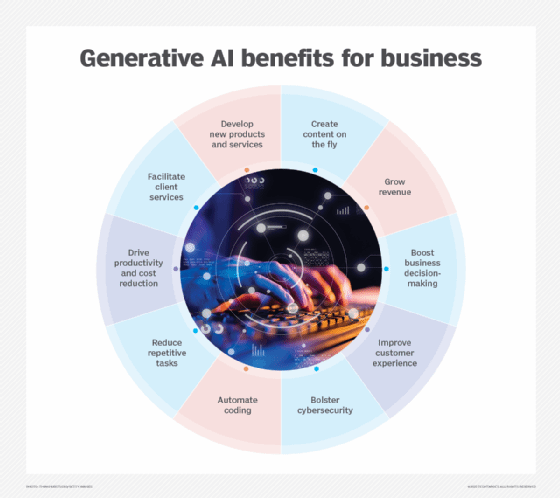
7 Benefits of Generative AI for Enterprises.
Just as eliminating at least some coding requirements can make data more accessible to more people in your organization, data pipelines and other parts of your data can be developed and Reducing the amount of code that must be written to monitor can help data professionals work more efficiently. and analytical operations.
“Generative AI has the potential to take the manual tedium out of the steps of data preparation, analysis, and predictive analytics, while taking natural language querying and explanation to new levels of utility and depth. ,” said Hengsheng.
That’s why data management and analytics vendors, including MicroStrategy, are now announcing plans to bring generative AI to their platforms.
Even companies that have not yet started integrating with generative AI tools, such as SAS and Tibco, will eventually incorporate generative AI. They’re just waiting until they’re confident that integration with generative AI tools won’t expose their customers to security risks or bad data.
MicroStrategy and Generative AI
Despite the Microsoft integration coming almost seven months after ChatGPT’s launch and following integrations with generative AI tools by many other analytics vendors, MicroStrategy is at a competitive disadvantage. Not, says Hengsheng.
Most of MicroStrategy’s competitors have simply announced plans to incorporate generative AI rather than introduce real functionality. Even the developed tools are in their early stages.
”As Tom Siebel [CEO] C3.ai recently said, “We are in the first half of the first inning where generative AI is involved,” Hengsheng said, adding, “This is clearly the beginning of a partnership, built on Azure OpenAI. The actual functionality that has been implemented has not yet been established.” fleshed out. But MicroStrategy is hitting the ground with this announcement to join the ranks of leaders. ”
Analysis is difficult. The required skills and disciplines are not necessarily present throughout the organization. Generative AI has the potential to make analytics more widely accessible by enabling natural language processing and conversational computing.
David MenningerVentana Research Analyst
Similarly, Menninger pointed out that it is too early for any vendor to develop generative AI capabilities that can differentiate them from others, or for one vendor to fall hopelessly behind.
MicroStrategy’s plans for generative AI align with those of its competitors through a roadmap that includes integration with the Azure OpenAI Service and NLP to drive analytics and simplify data workflows.
“Almost every vendor has an announcement,” Menninger said. “Some have introduced limited features based on generative AI, but most provide a roadmap for future features. They use generative AI to improve their analytical processes.”
Menninger added that while users of all analytics vendor platforms are likely to benefit from generative AI, users of MicroStrategy are likely to benefit more than most.
The vendor offers a wide range of features, some aimed at sophisticated users with deep knowledge of data science and analytics, and others aimed at more casual self-service users, he said. pointed out. Many other vendors offer tools aimed only at her one user, either a data professional or a business her analyst.
Generative AI has the potential to make the entire MicroStrategy platform more accessible to all users.
“MicroStrategy has a wide range of capabilities, [which] “That’s one of our strengths,” says Menninger. “The challenge is that when you have such a wide range of capabilities, it’s hard to know when to use which. You can hide some of your ugliness.”
next step
The partnership between MicroStrategy and Microsoft enables the inclusion of generative AI capabilities, but those generative AI capabilities are tied to Microsoft.
However, historically, MicroStrategy has offered multi-cloud capabilities, allowing users to use the clouds of their choice for MicroStrategy deployments.
As such, Henschen said he hopes MicroStrategy will develop a generative AI and LLM integration that is not as tightly aligned with its Azure deployment as its initial generative AI efforts.
”One of MicroStrategy’s great strengths is its multi-cloud and cross-cloud deployment capabilities. So we expect to provide comparable AI/LLM options that aren’t tied to Azure deployments or Microsoft tools,” he said.
Menninger, on the other hand, strongly believes in the benefits of scenario planning, a form of decision intelligence. However, very few analytics vendors offer such functionality as part of their platform, leaving scenario planning to his niche vendors such as Anaplan.
We recognize that developing generative AI tools is a priority for MicroStrategy, but scenario planning is another area where vendors can add tools for the benefit of their customers.
“MicroStrategy has laid out ambitious plans for generative AI that will impact almost every aspect of its product,” he said. “This will keep a good chunk of the engineering team busy. [resources]I look forward to continuing to see them and other analytics vendors tackle the areas of driver-based planning and, more broadly, decision intelligence. ”
Eric Avidon is a Senior News Writer for TechTarget Editorial and a journalist with over 25 years of experience. He is responsible for analytics and data management.