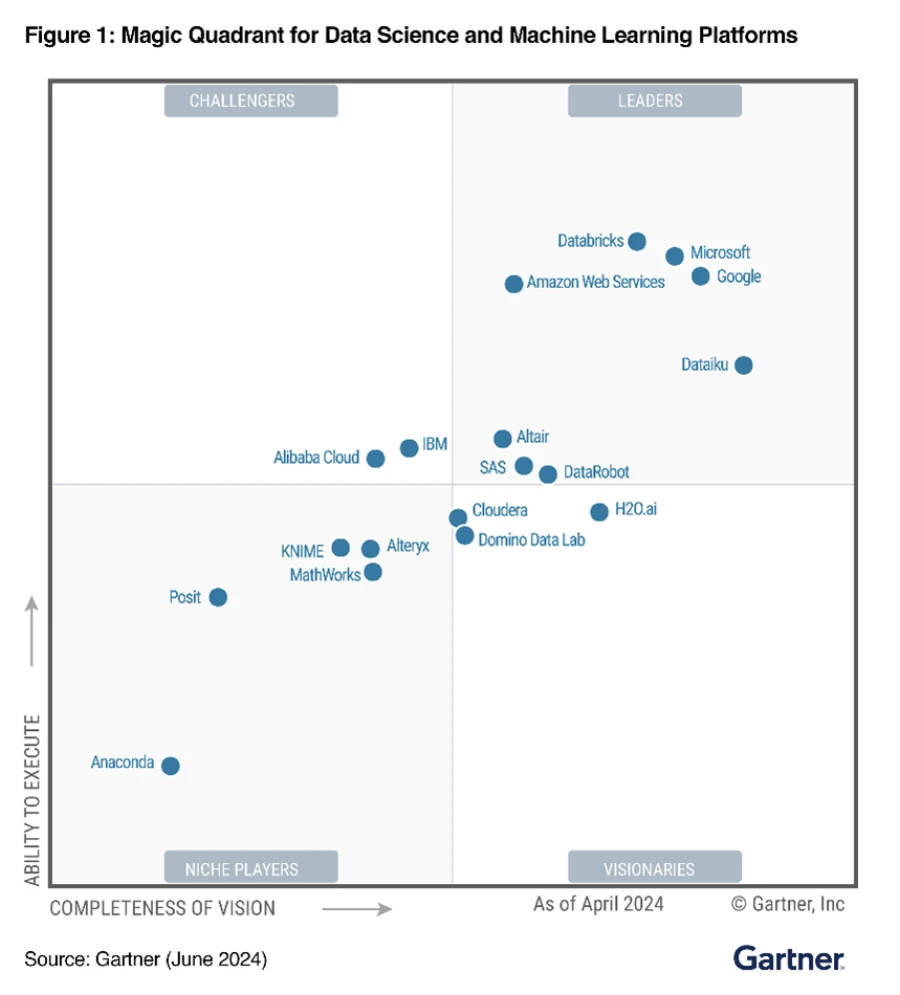
Microsoft was named a Leader in this year's Gartner® Magic Quadrant™ for Data Science and Machine Learning Platforms. Azure AI provides a powerful, flexible, end-to-end platform to accelerate innovation in data science and machine learning, while providing the enterprise governance every organization needs in the AI era.
In May 2024, Microsoft was named a Leader in the Gartner® Magic Quadrant™ for Cloud AI Developer Services for the fifth consecutive year, ranking highest in completeness of vision. We are pleased to receive this recognition from Gartner as we continue to help customers, from large enterprises to agile startups, operationalize AI and machine learning models and applications securely and at scale.
Azure AI has been at the forefront in helping cross-functional teams collaborate effectively with purpose-built AI infrastructure, responsible AI tools, and machine learning operations (MLOps) for generative AI and traditional machine learning projects. Azure Machine Learning provides access to a wide range of foundational models in the Azure AI model catalog (including the latest releases of Phi-3, JAIS, and GPT-4o) and tools to fine-tune or build your own machine learning models. Additionally, the platform supports a rich library of open source frameworks, tools, and algorithms to enable data science and machine learning teams to innovate in their own way on a trusted foundation.

Azure AI
Microsoft named a Leader in the 2024 Gartner® Magic Quadrant™ for Data Science and Machine Learning Platforms.
Accelerate time to value with Azure AI infrastructure
“Azure Machine Learning enabled us to have a functional model with the right insights in production in just two weeks, and we were even able to create a validated model in just four to six weeks..”
—Dr. Nico Wintergerst, AI Research Engineer, Relayr GmbH
Azure Machine Learning helps organizations build, deploy, and manage high-quality AI solutions quickly and efficiently, whether they are building large-scale models from scratch, running inference on pre-trained models, using models as a service, or fine-tuning models for specific domains. Azure Machine Learning runs on the same powerful AI infrastructure that powers some of the world's most popular AI services, including ChatGPT, Bing, and Azure OpenAI Service. Additionally, Azure Machine Learning is compatible with ONNX Runtime and DeepSpeed, allowing customers to further optimize training and inference times for better performance, scalability, and power efficiency.
Whether your organization is training deep learning models from scratch using open-source frameworks or bringing existing models to the cloud, Azure Machine Learning enables your data science teams to scale out training jobs with elastic cloud compute resources and move seamlessly from training to deployment. Managed online endpoints enable you to deploy models to powerful CPU and Graphics Processing Unit (GPU) machines without managing the underlying infrastructure, saving you time and effort. Similarly, when you deploy foundational models as a service from the Azure AI model catalog, you don't need to provision or manage infrastructure. This means you can easily deploy and manage thousands of models across your production environments, from on-premises to the edge, for batch and real-time predictions.
Flexible MLOps and LLMOps for operational efficiency
“The rapid flow helped streamline development and testing cycles, establishing the foundation necessary to ensure that customers were interacting with the solution in realistic ways..”
—Fabon Dzogang, Senior Machine Learning Scientist, ASOS
Machine learning operations (MLOps) and large-scale language model operations (LLMOps) sit at the intersection of people, process, and platforms. As data science projects grow in size and applications become more complex, effective automation and collaboration tools become essential to achieve high-quality, reproducible outcomes.
Azure Machine Learning is a flexible MLOps platform built to support data science teams of any scale. The platform enables teams to easily share and manage machine learning assets, build repeatable pipelines using built-in interoperability with Azure DevOps and GitHub Actions, and continuously monitor model performance in production. Data connectors with Microsoft sources like Microsoft Fabric and external sources like Snowflake and Amazon S3 further simplify MLOps. Interoperability with MLflow enables data scientists to seamlessly extend existing workloads from local runs to the cloud and edge while storing all MLflow experiments, run metrics, parameters, and model artifacts in a centralized workspace.
Azure Machine Learning Prompt Flow streamlines the entire development cycle of generative AI applications using LLMOps capabilities to orchestrate executable flows consisting of models, prompts, APIs, Python code, and tools for vector database search and content filtering. Azure AI Prompt Flow can be used with popular open source frameworks such as LangChain and Semantic Kernel, allowing developers to bring experimental flows into Prompt Flow to extend those experiments and perform comprehensive evaluations. Developers can collaboratively debug, share, and iterate on applications by integrating built-in testing, tracing, and evaluation tools into their CI/CD systems to continuously reassess the quality and safety of their applications. Developers can then one-click deploy their applications when they are ready and monitor the flows for key metrics such as latency, token usage, and generation quality in production. The result is end-to-end observability and continuous improvement.
Develop more reliable models and apps
“The Responsible AI Dashboard provides valuable insights into the performance and behavior of your computer vision models, provides a better understanding of why some models perform differently than others, and provides insight into how different underlying algorithms and parameters affect performance. The benefit is that you can enable and optimize better performing models with less time and effort..”
—Teague Maxfield, Senior Manager, Constellation Clearsight
AI principles like fairness, safety, and transparency are not enforced automatically, which is why Azure Machine Learning provides data scientists and developers with practical tools to operationalize responsible AI within their workflow, including assessing and debugging traditional machine learning models for bias, protecting underlying models from prompt injection attacks, and monitoring model accuracy, quality, and safety in production.
The Responsible AI dashboard helps data scientists evaluate and debug traditional machine learning models to ensure fairness, accuracy, and explainability throughout the machine learning lifecycle. Users can also generate a Responsible AI scorecard to document model performance details and share with business stakeholders to make more informed decisions. Similarly, Azure Machine Learning developers can review model cards and benchmarks, perform their own evaluations, and choose the best underlying model for their use case from the Azure AI model catalog. They can then apply a defense-in-depth approach to mitigate AI risks using built-in capabilities such as content filtering, processing on the latest data, and prompt engineering with safety system messages. The prompt flow assessment tool allows developers to iteratively measure, improve, and document the impact of mitigation measures at scale using built-in and custom metrics. This allows data science teams to confidently deploy solutions while providing transparency to business stakeholders.
Learn more about responsible AI with Azure here.
Enabling enterprise security, privacy and compliance
“Due to the sensitive data we handle, we needed to choose a platform that offered best-in-class security and compliance. We also needed to choose a platform that offered best-in-class services because we didn't want to be an infrastructure hosting company. We chose Azure because of its scalability, security, and the enormous support it offers for infrastructure management..”
—Michael Calvin, Chief Technology Officer, Kinectify
In today's data-driven world, effective data security, governance, and privacy require every organization to have a comprehensive understanding of their data and AI & machine learning systems. AI governance also requires effective collaboration among various stakeholders including IT administrators, AI & machine learning engineers, data scientists, and risk and compliance officers. Azure Machine Learning not only enables enterprise observability through MLOps and LLMOps, but also helps organizations protect their data and models and adhere to the highest standards of security and privacy.
Azure Machine Learning allows IT administrators to restrict access to resources and operations by user accounts or groups, control inbound and outbound network communications, encrypt data both in transit and at rest, scan for vulnerabilities, and centrally manage and audit configuration policies through Azure Policy. Data governance teams can also connect Azure Machine Learning to Microsoft Purview so that metadata for AI assets such as models, datasets, and jobs are automatically published to the Microsoft Purview Data Map. This allows data scientists and data engineers to observe how components are shared and reused, examine the lineage and transformations of training data, and understand the impact of dependency issues. Similarly, risk and compliance professionals can track what data was used to train models, how base models were fine-tuned or extended, and where models are used in various operational applications, which can be used as evidence for compliance reports and audits.
Finally, the Azure Machine Learning Kubernetes Extension enabled by Azure Arc allows organizations to run machine learning workloads on any Kubernetes cluster, ensuring data residency, security, and privacy compliance across hybrid public cloud and on-premises environments. This allows organizations to process data where it resides, helping them meet strict regulatory requirements while maintaining the flexibility and control of MLOps. Customers who use federated learning techniques with Azure Machine Learning and Azure Confidential Computing can also train powerful models on disparate data sources without having to copy or move the data out of secure locations.
Get started with Azure Machine Learning
Machine learning continues to transform how companies operate and compete in the digital age – optimizing business operations, improving customer experiences, and innovating. Azure Machine Learning provides a powerful and flexible machine learning and data science platform to operationalize AI innovation responsibly.
*Gartner, Magic Quadrant for Data Science and Machine Learning Platforms, Afraz Jaffri, Aura Popa, Peter Krensky, Jim Hare, Raghvender Bhati, Maryam Hassanlou, Tong Zhang, 17 June 2024.
Gartner, Magic Quadrant for Cloud AI Developer Services, Jim Scheibmeir, Arun Batchu, Mike Fang, 29 April 2024.
GARTNER is a registered trademark and service mark of Gartner, Inc. and/or its affiliates in the U.S. and internationally. Magic Quadrant is a registered trademark of Gartner, Inc. and/or its affiliates and is used herein with permission. All rights reserved.
Gartner does not endorse any vendor, product or service depicted in its research publications, and does not advise technology users to select only those vendors with the highest ratings or other designation. Gartner research publications consist of the opinions of Gartner's research and advisory organization and should not be construed as statements of fact. Gartner disclaims all warranties, expressed or implied, with respect to this research, including any warranties of merchantability or fitness for a particular purpose.
This graphic was published by Gartner, Inc. as part of a larger research document and should be evaluated in the context of the entire document. The Gartner document is available upon request at this link.