microsoft outlined new data transmission technologies designed to improve the way data is transmitted. A.I. Build your infrastructure by replacing internal copper wires and laser-based fiber optics with MicroLEDs data center.
The system was developed by Microsoft Research in Cambridge, UK, and uses commercially available MicroLED chips and imaging fibers to transmit data using light. The company says this approach has the potential to reduce energy usage, improve reliability, and ease physical constraints in AI data center design as computing demands continue to increase.
Doug Burger, managing director of Microsoft Research Core Labs, addressed the announcement in a post on LinkedIn, saying this innovation is “poised to advance the way we build AI (and other) systems.” He added that Microsoft has chosen to make the technology widely available, noting that reducing energy consumption is “good for the industry as a whole.”
Limitations of current data center networking systems
This development addresses growing constraints in how data is sent between servers and GPUs, especially in AI workloads.
Currently, most short-distance data transmission within data centers relies on copper cables that use electrical signals. Copper is still widely used due to its low cost, but it has physical limitations. As transmission speeds increase, the maximum effective distance of copper cables decreases, often to around 2 meters. This increases power density within the rack, makes cooling more complex, and limits how systems can be designed.
For long distances, data centers use laser-powered fiber optic cables. These can transmit data over much longer distances with higher bandwidth, but come with tradeoffs such as increased power consumption, larger components, and increased sensitivity to environmental conditions such as temperature and dust.
Burger summed up the challenge in a LinkedIn post, saying that increasing data rates are forcing chips closer together and “rapidly increasing rack power density,” which he described as “unsustainable.”
Introducing an alternative architecture with the MicroLED approach
The new system replaces both copper wire and laser-based transmission with a MicroLED-based approach that uses thousands of parallel channels to transmit data through light.
The concept was born in 2020 when researchers considered whether commercially available LED chips, similar to those used in consumer electronics, could be adapted for high-speed data transmission. The team developed a system that uses imaging fibers, a type of cable commonly used in medical endoscopy. Imaging fibers contain thousands of inner cores that can transmit parallel streams of light.
Paolo Costa, partner research manager at Microsoft, explains how this differs from existing approaches: “Imaging fibers look like standard fibers, but they have thousands of cores inside.” “That was the missing piece. We finally have a way to carry thousands of parallel channels over a single cable.”
Unlike traditional fiber optics, which transmits data through a small number of high-speed channels, MicroLED systems distribute data over many low-speed channels. Costa describes this as a “broad and slow” approach compared to the “narrow and fast” model used in laser-based systems.
“The initial concept of using LEDs to transmit data more cheaply and with lower power than copper wire or fiber optics seemed like a fantasy,” says Berger. “This breakthrough has the potential to transform nearly every aspect of computing infrastructure, including high-bandwidth optical cables.”
Performance, energy, and reliability considerations
According to Microsoft’s internal testing, MicroLED systems could use approximately 50% less energy than current laser-based optical systems. The company also expects improved reliability, as LEDs are less susceptible to environmental factors that can affect laser-based components.
The system is designed to operate over distances of tens of meters and is positioned between copper wire and traditional optical fiber in terms of communication range, aiming to combine the advantages of both.
To move this technology toward adoption, Microsoft has worked with partners such as MediaTek to develop a proof-of-concept system that can be integrated into existing data center infrastructure. The team miniaturized the system to a transceiver device that is compatible with current server hardware.
Complementary network development on Azure infrastructure
The MicroLED system is being developed alongside other networking technologies within Microsoft’s infrastructure, including hollow core fiber (HCF), which is already deployed in some Azure regions.
HCF differs from traditional fiber in that it transmits light through air in a hollow core rather than through glass, allowing for faster data transmission and lower latency over longer distances. According to Microsoft, HCF can deliver up to 47% faster data transmission and approximately 33% lower latency compared to traditional fiber.
Frank Rey, General Manager of Azure Hyperscale Networking, explains how the two technologies work together. “With MicroLED, you get the pure efficiency of an LED over a laser,” he says. “This has a pure net impact on power usage for a given data center.”
He added that hollow core fiber will extend the reach of data centers. “If you can travel much longer distances without having to do signal amplification, that means fewer buildings, less power, less generators, less energy.”
These technologies are designed to work together to support different parts of the network, with MicroLED focused on connectivity within the data center and HCF enabling faster, lower-latency connectivity over longer distances.
From research concept to industrial development
MicroLED systems reflect a broader shift in how AI infrastructure is designed as computing demands increase and existing networking approaches reach their physical and operational limits.
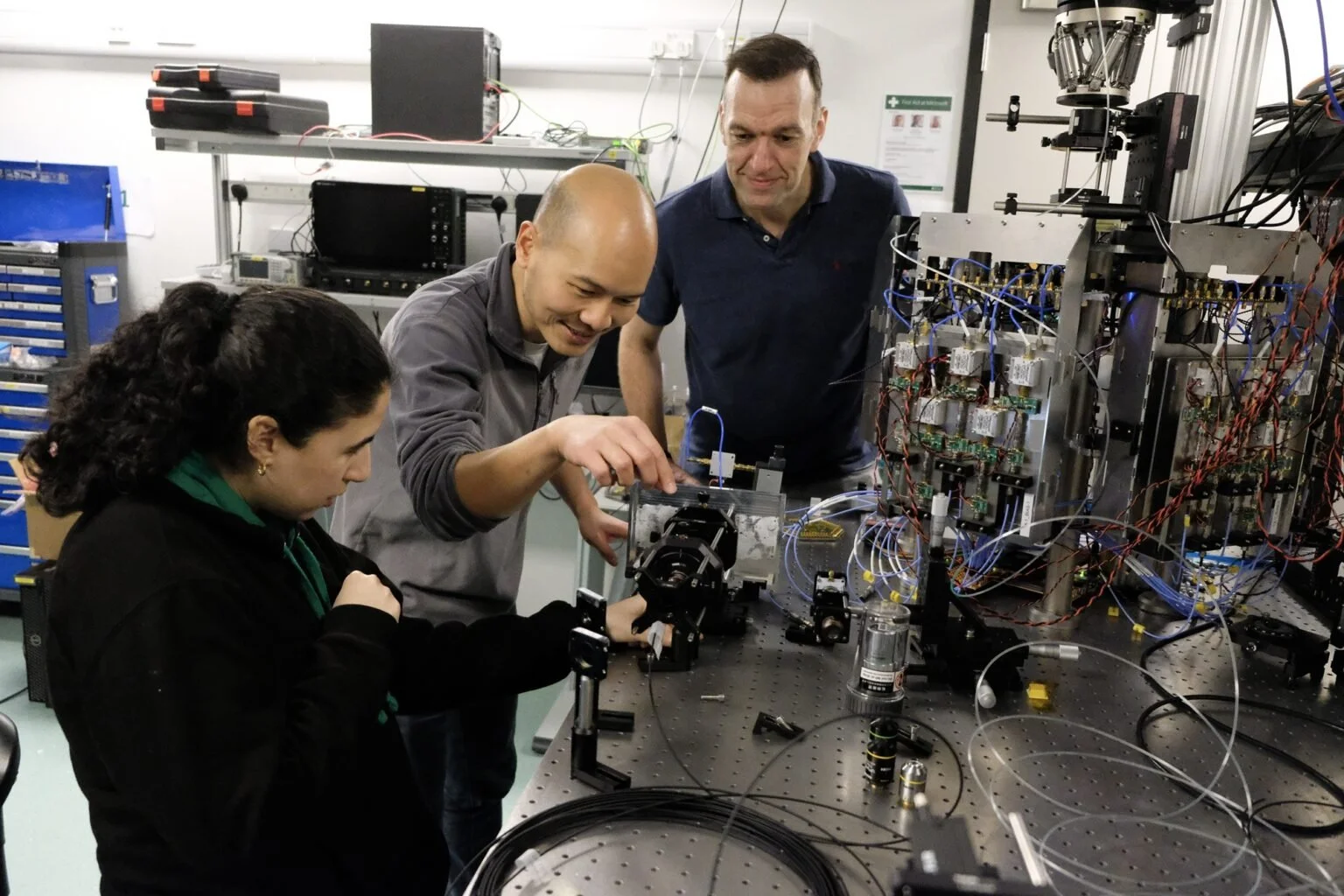
This project included collaboration with Microsoft Research, the Azure engineering team, and external partners, with work spanning optical engineering, signal processing, and hardware design. A working prototype was developed at Cambridge Research Laboratories, and the system was reduced to a compact transceiver form factor for integration into servers.
Microsoft expects this technology to be commercially available with industry partners starting in the second half of 2027, positioning it as part of the next generation of data center networking.
Berger highlighted the long-term implications in a post on LinkedIn, noting that this approach could “open up additional design options to significantly improve the system” while addressing energy and scalability challenges across the AI infrastructure.
ETIH Innovation Award 2026
ETIH Innovation Award 2026 is now open and highly appreciatedStrengthen your educational technology organization to deliver measurable impact across K-12, higher education, and lifelong learning. The award welcomes applications from the UK, the Americas and overseas, and applications will be assessed on the basis of evidence of achievement and practical application.