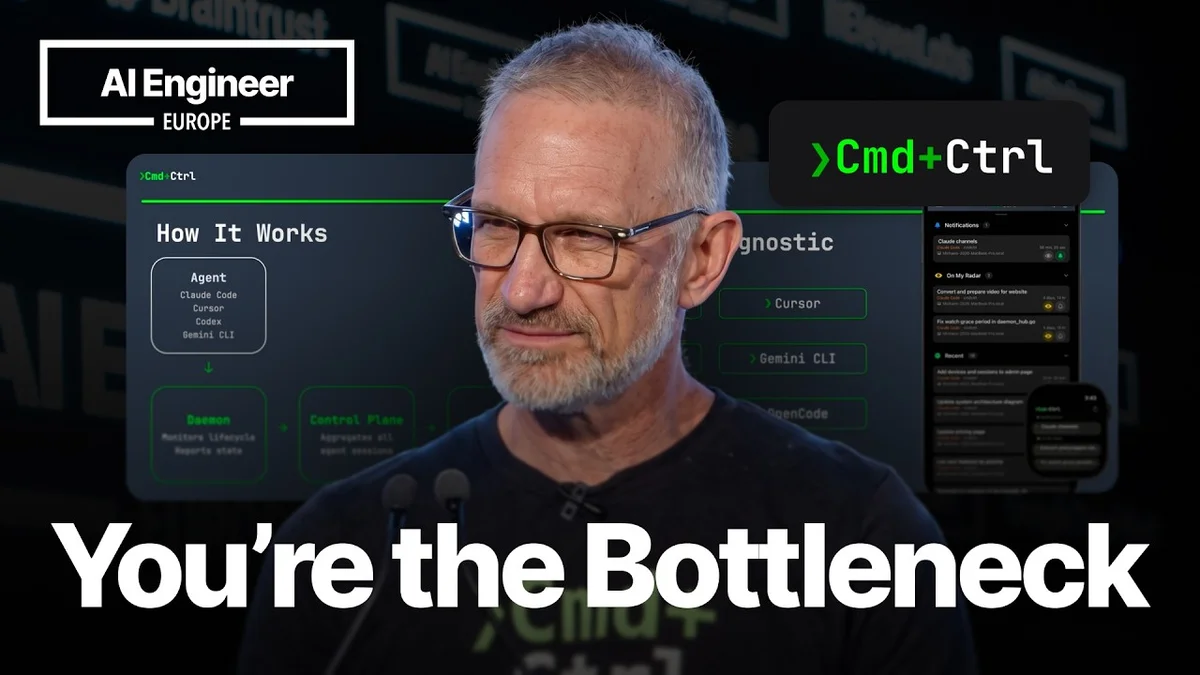
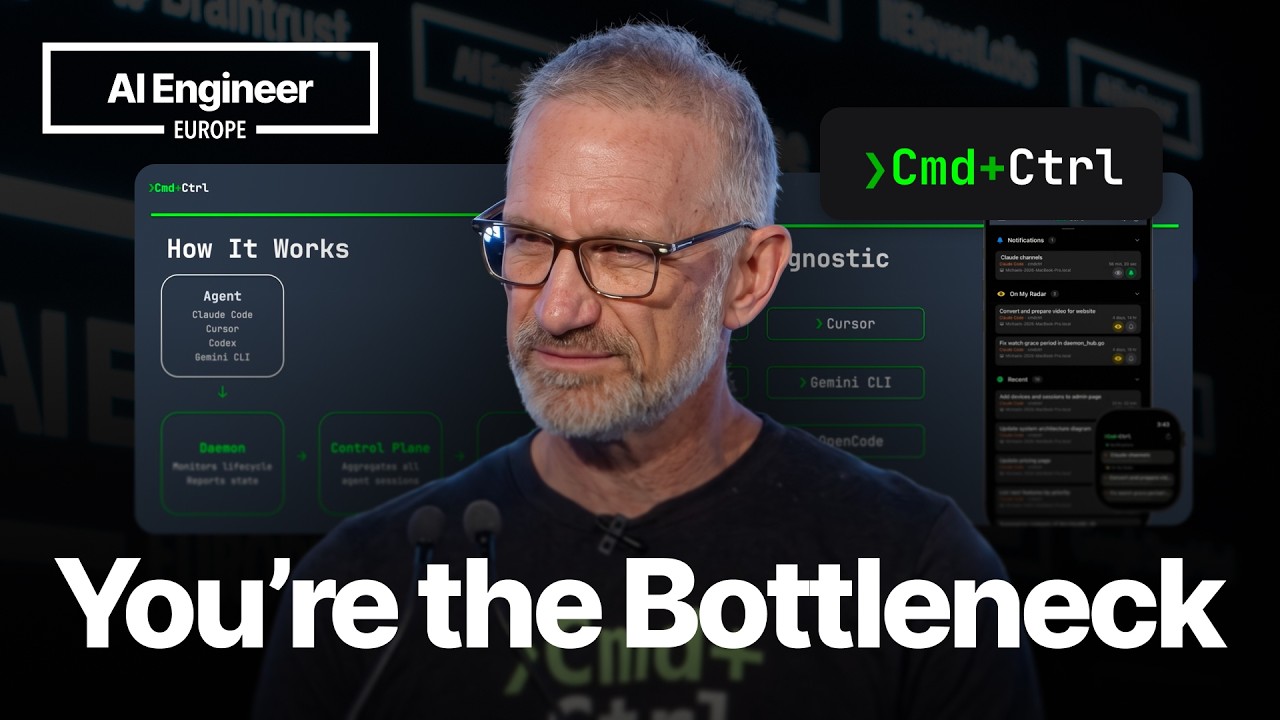
Michael Richman, founder of Cmd+Ctrl, addressed the growing concern about FOMAT, or “an agent’s fear of losing time,” at the AI Engineer Europe conference. He articulated a challenge many developers face: the AI agent can become unavailable or unresponsive when its input or intervention is most important.
Michael Richman talks about FOMAT: Agents’ fear of missing out on time — from an AI engineer
Visual TL;DR. FOMAT: Fear of missing out on agent time leads to unpredictability of workflow. Increased agent autonomy exacerbates workflow unpredictability. Workflow unpredictability is solved by the Cmd+Ctrl platform. Agent choreography is enabled on Cmd+Ctrl platforms. Agent choreography displayed through seamless session management. Agent choreography leads to FOMAT reduction. Reducing FOMAT will lead to improved flow for AI engineers.
FOMAT: Agents’ fear of running out of time: Anxiety when AI agents require human input
Workflow unpredictability: Agents find themselves in situations that require intervention at critical times
Increased agent autonomy: Intervention windows can expand from hours to days
Cmd+Ctrl Platform: Michael Richman’s Agent Management Solution
Agent choreography: Seamlessly coordinate agent tasks and human intervention.
Seamless session management: Proven platform features for smooth agent workflows
Reduced FOMAT: New flows reduce anxiety about agent availability.
Improved AI engineer flow: Developers can trust agents to run autonomously.
Visual TL;DR
Understanding FOMAT: Unavailability Anxiety
Richman painted a vivid picture of FOMAT, likening it to the common fear of missing out on an important event or opportunity. In the context of AI, this fear manifests itself when an agent tasked with a complex operation gets stuck or requires human input when the user is not available. He emphasized that while agents may now require a user’s attention within minutes or hours, increasing autonomy could extend the “window” for intervention to days, potentially exacerbating the problem.
The core of the problem, Richman explained, is the unpredictability of AI agent workflows. Users can’t always predict when an agent will need their attention, so they always feel a low-level fear of being out of sync with their digital assistant. This problem is further exacerbated when users are away from their primary development machine, making timely input impossible.
Cmd+Ctrl Solution: Agent Choreography
To combat FOMAT, Richman introduced Cmd+Ctrl, a platform designed to provide centralized management and visibility of AI agent sessions. The system acts as a “control plane” that aggregates all agent sessions, regardless of the underlying framework or agent type. This allows users to monitor the lifecycle and health of agents, whether they are running on a local machine or in the cloud.
Cmd+Ctrl’s architecture includes a “daemon” that monitors the agent’s lifecycle and reports its status. This information is aggregated by the control plane and provides a unified overview through a user-friendly interface that can be accessed from web, mobile (iOS and Android), or desktop applications.
Seamless session management demo
Richman demonstrated real-world applications of Cmd+Ctrl, showing how users can start a new session, select an agent and workstation, specify a working directory, and define a task. He highlighted the ability to receive notifications and interact with agents remotely, and illustrated this in a scenario where an agent is given a task over the phone and can then resume and manage it from a desktop terminal, or vice versa. This seamless transition between devices and environments is key to mitigating FOMAT.
Also highlighting the platform’s coding tool-agnostic nature, Cmd+Ctrl supports a variety of popular AI coding tools and frameworks, including Claude Code, Cursor, Codex CLI, Gemini CLI, GitHub Copilot, OpenCode, and more integrations are planned. This flexibility allows users to integrate the tool into their existing development ecosystem.
FOMAT mitigation: new flow
Richman contrasted the “old flow,” which focused on a single task, with the “new flow,” which he called “agent choreography.” This new paradigm involves managing multiple agents simultaneously, coordinating their interactions, and ensuring that the agents work at the right time and, importantly, effectively, no matter where the user is. Cmd+Ctrl aims to provide the tools necessary for this agent’s choreography and allow users to be productive without being tied to a single workstation.
The ultimate goal, Richman concluded, is to reduce the cognitive load associated with managing AI agents, allowing developers to focus on creativity and problem-solving rather than the operational overhead of keeping agents synchronized and responsive. He encouraged the audience to try out the tool and provide feedback, emphasizing the collaborative nature of developing these new AI workflows.