Emerging email newsletter platform Beehiiv became the latest e-commerce software company to announce MCP integration for artificial intelligence this month.
Beehiiv’s announcement itself may not seem significant. However, consolidation may represent a larger trend.
Merchants’ software tools increasingly have direct and even native connections to AI. Examples include Shopify, WooCommerce, Yottaa, and Shippo.
What is MCP?
Anthropic, creators of the popular Claude LLM, defined the Model Context Protocol in 2024. It is “a new standard for connecting AI assistants to systems where data resides, such as content repositories, business tools, and development environments. It aims to enable frontier models to generate better and more relevant responses.”
Essentially, MCP (and competitive protocols) ensure a secure two-way connection between a data source and an AI-powered tool or agent.
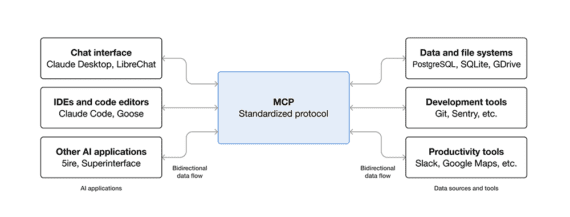
MCP describes one way to connect data sources and services to AI-enabled agents and tools and integrate AI into your business operations. Click on the image to enlarge.
Instead of building one-off integrations for all services via APIs, companies can expose their entire tools and data to AI systems. AI models can query these systems and take actions.
Business leaders can think of MCP as an AI infrastructure. It sits between AI and the systems that run your business. Additionally, when software supports MCP, the opportunities to integrate with AI for analysis, generation, and automation are relatively greater and easier.
business shift
Today, many AI tools can summarize reports, draft emails, and answer questions. MCP-style integration makes these tools work. An AI assistant can check inventory, compare shipping rates, evaluate campaign performance, and then make adjustments, possibly in real-time.
Let’s consider a simple case. The AI system detects increases in shipping costs across a set of orders. Access our shipping tools to compare shipping carrier rates and choose the cheaper option. The same system updates orders and notifies customers. This can also occur when someone is picking items in a warehouse.
This type of loop is what MCP and similar protocols attempt to enable.
Here are some examples:
Shopify hydrogen update Introducing AI support for Storefront MCP.
This integration allows AI agents to browse products, manage carts, and assist with checkout. In effect, the storefront becomes a structured environment that AI can navigate. AI has been able to do this before, but MCP provides rules that make it more successful.
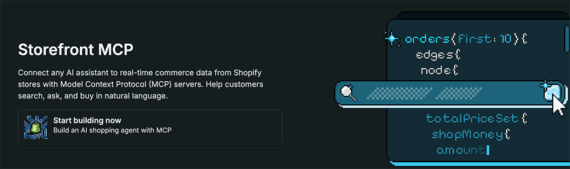
Shopify is an example of an e-commerce-related MCP implementation.
Shippo’s MCP server Publish shipping workflows to AI systems. The AI assistant can create shipments, compare carrier rates, generate labels, track packages, and verify addresses. These are typically tasks that require manual steps or custom integrations.
AI systems identify clusters of delayed shipments. Check alternative carriers, update fulfillment rules, and flag affected customers. The shopper experience improved, and agents acted within a set of guidelines but without direct supervision.
Beehiiv MCP integration Link your newsletter account to an AI tool like ChatGPT or Claude.
The current version focuses on analysis. AI can assess trends in subject lines, subscriber growth, churn, and engagement. This insight helps you make content and monetization decisions. It might help clarify how email marketing contributes to e-commerce sales, so to speak.
API remains
MCP is not a replacement for application programming interfaces. It complements them.
The API is accurate and stable. Suitable for core integrations such as order processing and payments. MCP is flexible. This protocol allows AI systems to move between tools without strict workflows.
In practice, e-commerce stacks are likely to combine APIs for reliability and MCP-style interfaces for adaptability.
Other protocols
MCP is part of a broader shift to agent applications and commerce. Other protocols are emerging.
For example, OpenAI’s Agentic Commerce Protocol aims to enable product discovery and trading within AI environments such as ChatGPT. Google is developing a similar approach to AI interfaces.
These protocols define how shopping happens within the AI-driven surface. MCP focuses on how AI systems access business operations behind the scenes.
For sellers, the distinction is important. There are a set of standards that govern how consumers find and purchase products. The other controls how the business executes and manages those transactions. Each case illustrates the evolution of business and its software tools through AI.
implementation
Perhaps most importantly, MCP signals a shift from AI as a chat tool to an operator in business.
E-commerce leaders should focus on being ready to adapt to the use and integration of AI, rather than the protocols themselves. Having clean, organized data and a clear workflow is more important than being the first to adopt a new tool.
Expect stacks where APIs provide reliability and layers like MCP provide flexibility. We will also monitor where AI-driven shopping takes place, as protocols from platforms like OpenAI and Google can shape demand as well as backend operations.