
Overview of Artificial Intelligence in Healthcare Market:
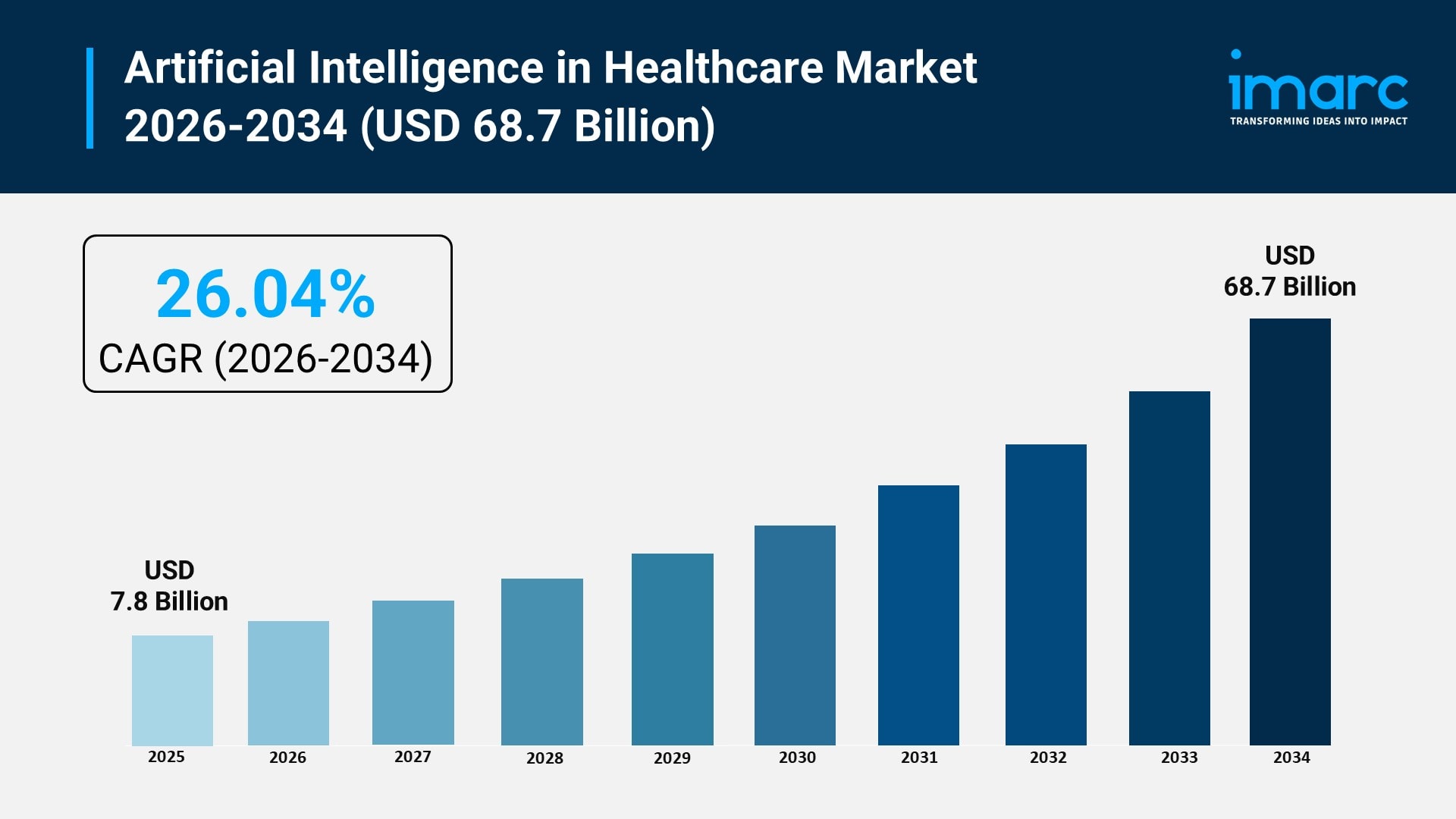
Exponential data growth, maturing machine learning capabilities, and increasing pressure on healthcare systems around the world are rapidly accelerating the adoption of AI in clinical and administrative settings. According to the latest data from IMARC Group, the global artificial intelligence market size in healthcare reached USD 7.8 billion in 2024. Looking ahead, IMARC Group expects the market to reach USD 68.7 billion by 2033, registering a CAGR of 26.04% between 2025 and 2033. Rising demand for personalized medicines, increasing popularity of remote patient monitoring facilities, and advances in machine learning techniques for analyzing medical images, detecting anomalies, and predicting patient outcomes are some of the key factors driving the market.
AI in healthcare is no longer a futuristic concept, but is already integrated into everyday clinical workflows. Hospitals use AI to read radiology scans faster and with fewer errors. Pharmaceutical companies are compressing drug discovery timelines by years. Primary care providers are deploying virtual nursing assistants to handle patient triage around the clock. The US FDA has approved approximately 950 AI/ML-enabled medical devices by mid-2024, with approximately 100 new approvals added each year, highlighting how quickly this technology has moved from pilot to mainstream implementation.
Based on IMARC Group’s segmentation, the market is classified by offering (hardware, software, services), technology (machine learning, natural language processing, context-aware computing, etc.), application (robot-assisted surgery, virtual nursing assistant, administrative workflow assistance, fraud detection, medication error reduction, clinical trial participant identification, preliminary diagnostics, etc.), and end users (health care providers, pharmaceutical and biotechnology companies, patients, etc.). Software, including EHR systems, image analysis platforms, and clinical decision support tools, dominates the product segment, while machine learning has the largest share by technology. Healthcare providers account for the major end-user segment, with North America leading the market geographically due to a mature digital health ecosystem, strong regulatory clarity, and significant investment from both the public and private sectors.
Evaluate market opportunities with business sample reports
Growth drivers of artificial intelligence in the healthcare market:
Growing demand for personalized medicine and high-precision diagnosis
The shift from one-size-fits-all treatments to individualized treatments is one of the strongest structural drivers in this market. AI can simultaneously analyze a patient’s genetic profile, medical history, and real-world outcome data, something human clinicians cannot do at scale. In recent years, the global precision medicine market has exceeded US$75 billion, and AI is increasingly becoming an enabling technology. Google Health’s multimodal AI platform for diabetic retinopathy detection demonstrated 98.5% accuracy in clinical validation, demonstrating how AI-powered diagnosis can match or outperform expert-level assessment, at a fraction of the cost.
Accelerate efficiency in drug discovery and R&D
Pharmaceutical research and development is expensive and time-consuming by design, but AI is starting to change both equations. Researchers at MIT and McMaster University trained a generative AI model to screen over 36 million molecular structures to identify new antibiotic candidates that are effective against drug-resistant bacteria like MRSA. DeepMind spinoff Isomorphic Labs is putting AI-designed drugs into human trials, developing compounds in a fraction of the time required by traditional methods. AI is moving from an innovation experiment to a commercial necessity for pharmaceutical and biotech companies facing rising R&D costs and faster time-to-market pressures.
Increasing pressure and operational burden on healthcare workers
The World Health Organization predicts a global shortage of 11 million healthcare workers by 2030, and AI-driven automation is filling an urgent operational gap. AI tools handle clinical documentation, appointment scheduling, pre-authorization processing, and patient triage, freeing clinicians to focus on complex decision-making. IBM Watson Health’s upgraded clinical trial matching platform that uses NLP to interpret EHRs helped cancer research institute improve patient enrollment efficiency by 35%. Administrative workflow assistance is currently one of the fastest growing AI application segments in healthcare, reflecting real demand from overstretched systems.
Trends in artificial intelligence in the healthcare market:
Generative AI and agentic models are entering clinical practice
The latest wave of AI in healthcare is one that can reason, plan, and act across multi-step clinical workflows, rather than just reading images or reporting anomalies. At Microsoft Ignite 2025, the company introduced “agent” healthcare AI models such as MedImageInsight Premium (which provides up to 15% higher diagnostic accuracy in radiology) and CXRReportGen Premium, which generates chest X-ray reports that can be used in the clinic. Google has introduced open research models, such as MedGemma and TxGemma, built specifically to accelerate clinical language tasks and drug development workflows. These are not incremental upgrades. These represent a generational shift in how AI supports clinical decision-making.
Remote patient monitoring is rapidly expanding across healthcare settings
Remote patient monitoring has become a primary care tool, going far beyond postoperative follow-up. Platforms like Athelas enable continuous tracking of chronically ill patients at home, reducing readmissions and allowing for early intervention. AI makes this scalable. Instead of clinicians manually reviewing streams of monitoring data, algorithms flag only those patients that require attention. This model is particularly powerful in managing the growing burden of chronic diseases, which account for the majority of global health spending. This trend is also receiving policy tailwinds, with several major national health systems expanding reimbursement for AI-powered remote monitoring programs.
Regulatory clarity accelerates institutional adoption
One of the biggest barriers to implementing AI in healthcare has always been regulatory uncertainty, but that is changing. EU AI legislation now formally classifies medical AI as high risk, creating a structured compliance pathway rather than a gray area. The FDA-established AI/ML medical device approval track has produced nearly 950 approved products, providing procurement teams with a clearer framework for evaluation. According to a 2025 survey of more than 700 healthcare executives conducted by Menlo Ventures, the purchase cycle for AI healthcare tools, which typically took 12 to 18 months, has been reduced to less than six months for leading health systems. Confidence in the regulatory framework frees up an organization’s budget at scale.
Recent news and developments in artificial intelligence in the healthcare market
April-May 2025: Google launches MedGemma and TxGemma, open research models designed to support clinical language tasks and accelerate drug development workflows. This initiative specifically targets diagnostic and drug discovery use cases, and also includes upgrades to Google’s broader AI platform for healthcare providers and research institutions, strengthening Google’s position as a leading player in applied medical AI.
June 2025: Johnson & Johnson, in partnership with NVIDIA and Amazon Web Services (AWS), launches the Surgical Polyphonic AI Fund, pledging to fund AI solutions to real-world surgical challenges, with winners to be announced quarterly through the end of next year. At the same time, J&J introduced MONARCH QUEST, an AI-enhanced navigation software for bronchoscopy systems, and expanded its use of NVIDIA’s Isaac for Healthcare platform to create digital twins for surgical simulation.
November 2025 (Microsoft Ignite): Microsoft announced significant expansions to its healthcare AI portfolio, introducing MedImageInsight Premium, a multimodal model for X-ray and pathology that delivers up to 15% higher accuracy than previous open-source models, and CXRReportGen Premium, trained on real-world clinical data to generate ready-to-use chest X-ray reports. Microsoft also released a purpose-built validation tool that allows clinical teams to evaluate AI performance on specific tasks before full implementation, addressing key concerns for implementation across hospital systems.
Note: If you require specific details, data, or insights that are not currently within the scope of this report, we would be happy to accommodate your request. As part of our customization services, we collect and provide any additional information necessary to meet your specific requirements. Please let us know your exact needs. We will ensure that your reports are updated to meet your expectations.


