


Accurate propagation modeling is of paramount importance for effective radio deployment, coverage analysis, and interference mitigation in wireless communications. Pathloss modeling, a widely adopted approach, enables general predictions of signal power attenuation along a wireless link, providing network planners with important insights into physical layer attributes. however, Non Line of Sight (NLOS) In this scenario, traditional models such as Longley-Rice and free-space path loss (FSPL) become less accurate because they cannot account for signal attenuation and interference caused by electromagnetic interactions with terrain and clutter.
Traditional models require complex knowledge of the entire path profile, including the full spatial variation of terrain (DTM) and surface (DSM) data, effectively treating it as a one-dimensional problem. Alternatively, some models utilize thousands of features in his two-dimensional (2D) and three-dimensional (3D) representations of terrain and clutter and perform point-to-multipoint predictions.
In this paper, the researchers (Jonathan Ethier and Mathieu) sought to answer the following important questions: “Can simple features obtained from path profiles be used as the sole input to a predictor of path loss along a wireless link while still providing sufficient accuracy for predicting wireless coverage?” To answer the question, they employed
- Machine learning (ML)-based modeling, comparison with traditional approaches, and
- We emphasized the use of measured data for training to ensure reliable ground truth.
Researchers took advantage of publicly available ITU-R UK Ofcom Drive test datasets for training and testing, consisting of measurements across different frequencies and geographically distinct sites. This dataset, consisting of more than 8.2 million measurements, served as the basis for their study. Additionally, we leveraged the DTM and DSM online databases to extract path profiles and derive features such as total obstacle depth, terrain depth, and clutter depth along the direct path.
The researchers investigated three functional configurations:
- Frequency and link distance
- Frequency, link distance, obstacle depth
- Frequency, link distance, terrain depth, and clutter depth
These features were used as input to three different modeling techniques: Curve-fit logarithmic regression, boosted trees (XGBoost), and fully connected neural networks (FCN).
To ensure robustness and avoid overfitting, the researchers adopted a strict round-robin approach, training the model on five cities and testing it on the sixth city, repeating this process six times. I repeated. This minimized geographic contiguity and data leakage, allowing us to rigorously evaluate the generalizability of our model.

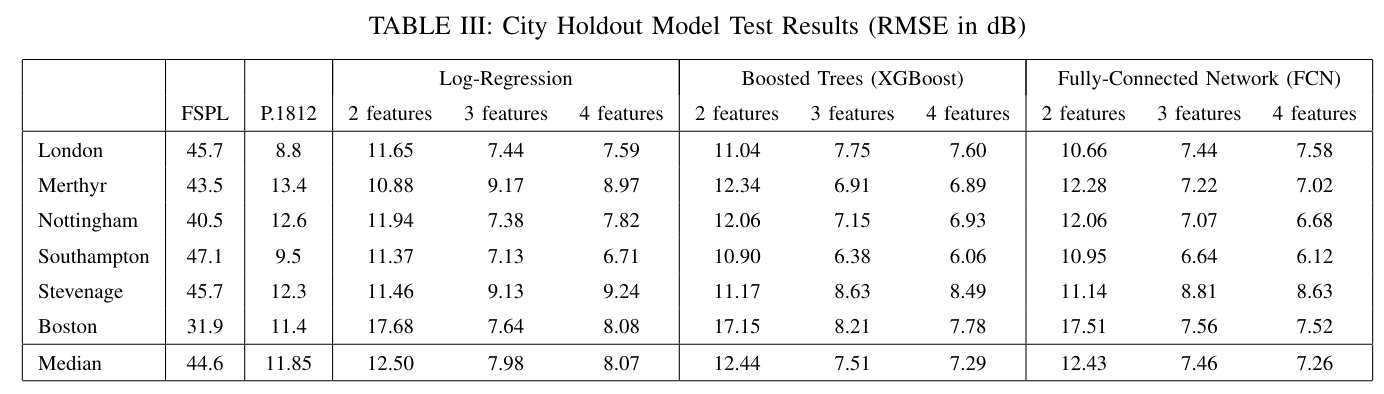
The results revealed the following: FCN model outperformed boosted tree and log regression, further includes features that lead to a lower root mean square error (RMSE). Introducing obstacle depth as a third feature significantly improved the performance, reducing the RMSE by about 5 dB. However, separating obstacle depth into terrain and clutter depth showed little improvement, likely due to temporal mismatch between measurements and geospatial information. .
Further analysis of obstacle loss (difference between ML predicted path loss and FSPL) shows that the FCN model learns physics-based behavior and predicts obstacle loss as frequency and obstacle depth increase. It has become clear that the number has increased accordingly. However, limitations have been observed, such as the effect of link distance on obstacle loss and non-zero obstacle loss when the obstacle depth is zero, which the researchers hope to address in future studies. That's what I'm aiming for.
researchers have proven that You can train accurate ML-based propagation models using simple scalar features that describe terrain and clutter.A well-generalized model with RMSE in the range of 6-8 dB is obtained. This approach performs better than traditional models while relying on significantly fewer features than models that use high-resolution images and detailed path profiles.
The implications of this work are far-reaching, as it paves the way for more efficient and accurate propagation modeling, ultimately enhancing wireless network planning, deployment, and optimization. By harnessing the power of machine learning and simplified functionality, researchers have ushered in a new era of path loss modeling, revolutionizing the field and opening the door to future advances.
Please check paper. All credit for this study goes to the researchers of this project.Don't forget to follow us twitter.Please join us telegram channel, Discord channeland linkedin groupsHmm.
If you like what we do, you'll love Newsletter..
Don't forget to join us 42,000+ ML subreddits


Vineet Kumar is a consulting intern at MarktechPost. He is currently pursuing his bachelor's degree from the Indian Institute of Technology (IIT), Kanpur. He is a machine learning enthusiast. He is deeply passionate about research and the latest advances in learning, computer vision, and related fields.


