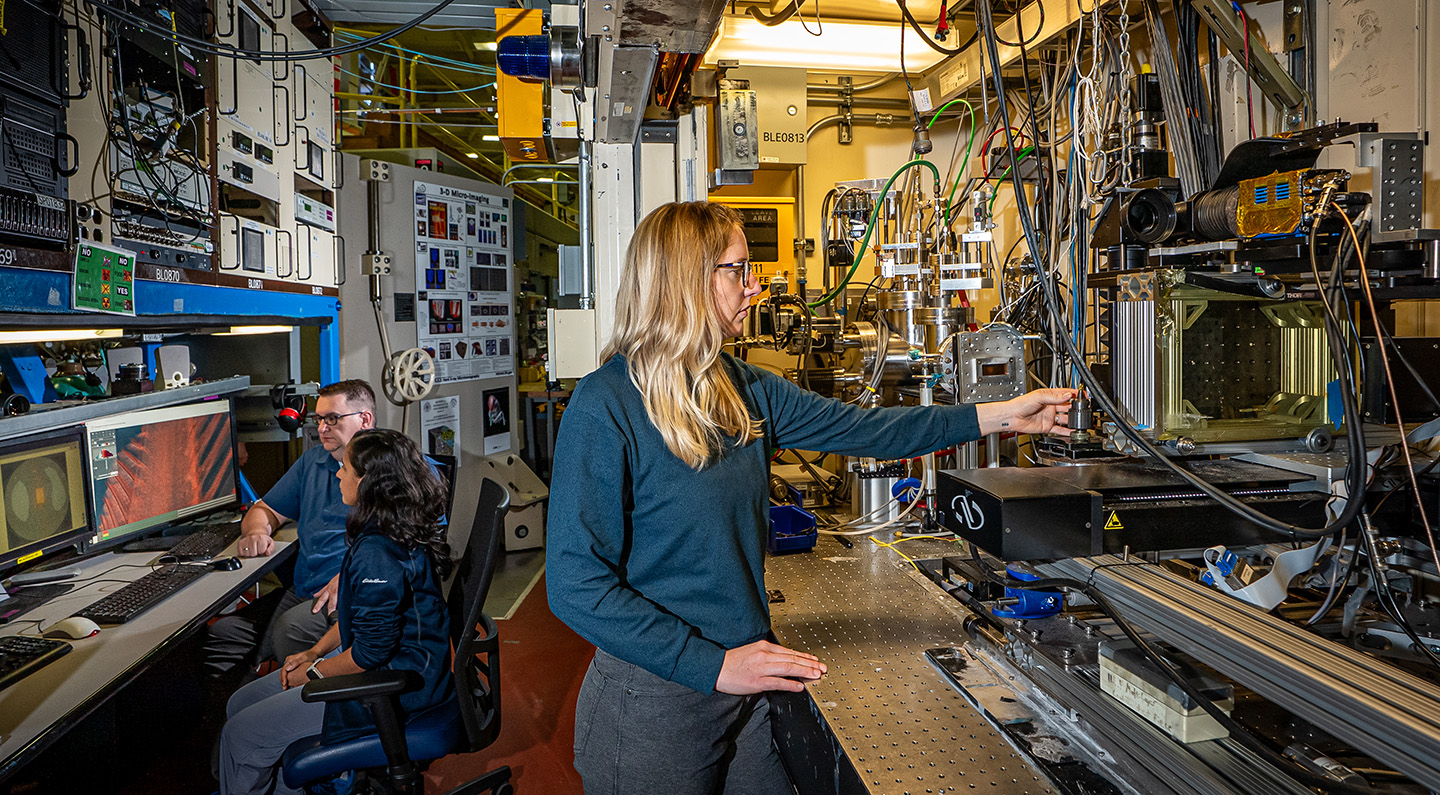
Lawrence Berkeley National Laboratory (Berkeley Lab) is working to transform petabytes of image data from the nation’s advanced light and neutron scattering user facilities into actionable knowledge, demonstrating advanced AI-powered discovery capabilities that can be applied to energy, semiconductors, medicine, and other essential technologies.
This multi-laboratory effort, called SYNAPS-I (SYnergistic Neutron and Photon Science – Intelligence), is part of Genesis Mission, a new national initiative led by the Department of Energy aimed at accelerating advances and discoveries in AI and delivering solutions to science, energy and national security challenges. The foundation of the Genesis mission is the Transformative AI Models Consortium, which leverages DOE’s unique data, facilities, and expertise to build and deploy self-improving AI models. SYNAPS-I is one of three AI modeling teams led or played primarily by Berkeley Lab, building on AI expertise in high performance computing, managing large datasets, and partnering with industry to pioneer AI models.
“Our national research facilities already lead the world in scientific discovery, and SYNAPS-I fundamentally accelerates the path from experiment to insight by incorporating AI directly into analytical workflows,” said Alex Hexemer, senior scientist for Advanced Light Sources (ALS) at Berkeley Lab and lead contact for SYNAPS-I.
The SYNAPS-I platform integrates large-scale machine learning models and fundamental models across all participating light and neutron sources to enable integrated analysis of image data from state-of-the-art X-ray and neutron instruments at seven DOE Basic Energy Science User Facilities, including ALS, a synchrotron light source that produces X-ray, ultraviolet, and infrared light. Increased data output from recently completed and ongoing facility upgrades, such as Berkeley Lab’s Advanced Light Source Upgrade (ALS-U) project, provides even greater opportunities to accelerate scientific discovery across a wide range of fields.
“Our national research facilities already lead the world in scientific discovery, and SYNAPS-I fundamentally accelerates the path from experiment to insight by embedding AI directly into analytical workflows.”
/Open to the public. This material from the original organization/author may be of a contemporary nature and has been edited for clarity, style, and length. Mirage.News does not take any institutional position or position, and all views, positions, and conclusions expressed herein are those of the authors alone. Read the full text here.