image:
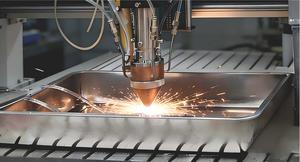
A close-up of a laser directed energy deposition (LDED) system producing a new AI-designed ultra-high-strength steel. This ultra-high strength steel offers a rare balance of strength and ductility, excellent corrosion resistance, and requires only a 6-hour single-step heat treatment at low cost.
view more
Credit: Yating Luo, Tao Zhu, Cunliang Pan, Xu Ben, Xudong An, Xiaoming Wang, Hongmei Zhu*
Machine learning strategies have produced a new class of ultra-high strength and ductile steels for 3D printing that are low in cost, resistant to rust, and require only a fraction of typical processing time.
in International Journal of Extreme Manufacturingnew research has demonstrated that optimal alloy recipes can be rapidly identified by integrating artificial intelligence with the fundamental physical and chemical properties of elements. The resulting metal achieves a rare balance of extreme strength and ductility, solving persistent bottlenecks in heavy industry and aerospace engineering.
Currently, producing ultra-high strength and ductile steel through 3D printing requires large amounts of expensive elements such as cobalt, molybdenum, or high levels of nickel. Even with these premium ingredients, printed parts must undergo complex multi-step heat treatments in industrial furnaces to reach final strength and often remain highly vulnerable to corrosion in harsh environments.
To circumvent this trial-and-error chemistry, a team of researchers from South China University and Purdue University turned to “interpretable machine learning” models. Instead of treating the AI as a black box that simply guesses combinations, the researchers fed the algorithm 81 fundamental physicochemical characteristics of different elements, such as atomic radius, electron behavior, and sound transmission speed.
Prediction of properties
The algorithm calculated that a specific mixture of iron and chromium, mixed with precisely small amounts of cheaper elements such as silicon, copper, and aluminum, would form the ideal internal structure. After 3D printing the metal Fe-15Cr-3.2Ni-0.8Mn-0.6Cu-0.56Si-0.4Al-0.16C (wt.%) using laser-induced energy deposition technology, the researchers baked it in a one-step tempering process at 480°C for just 6 hours.
Physical tests matched the algorithm’s predictions. The resulting steel withstood a stress of 1,713 MPa and elongated by 15.5% before failure. This represents approximately a 30% increase in strength and twice the ductility compared to the raw printed state of the metal.
The research team investigated the internal structure of the metal to understand the mechanism behind this performance. They found that a short heat treatment causes the metal to grow a dense network of nanoscale particles such as copper and nickel-aluminum.
When a metal is subjected to physical stress, these tiny particles act as obstacles that locate and prevent structural defects from spreading, significantly increasing the force required to fracture the part. At the same time, microscopic pockets of a soft phase known as austenite act as shock absorbers by changing their crystal shape and absorbing energy, a phenomenon that prevents the steel from breaking under tension.
Rust resistance
The AI-designed recipe also solved the rust problem inherent in many high-strength alloys. In common steels, carbide formation causes chromium to be leached from the surrounding metal, creating a weak chromium-deficient zone where corrosion progresses. The researchers found that nanoscale copper particles in the new steel effectively scavenge chromium during formation, ensuring that the chromium remains evenly distributed throughout the surrounding matrix. In salt water tests, the new alloy degraded at a rate of just 0.105 millimeters per year, significantly faster than standard commercially available stainless steels such as AISI 420.
Although interpretable machine learning approaches have been successful in reducing costs and processing times, researchers note that this methodology relies on datasets that are highly specific to specific manufacturing technologies. Different 3D printing methods heat and cool metal at significantly different rates, so data from one manufacturing process is often not compatible with another.
In future studies, researchers will need to rescreen these fundamental physical characteristics when applying AI to entirely new material classes. However, this study provides a clear blueprint for moving away from time-consuming empirical testing and provides a fast-track path to designing custom high-performance components.
International Journal of Extreme Manufacturing (IJEM, Case: 21.3) is dedicated to publishing the best advanced manufacturing research at extreme dimensions to address both fundamental scientific challenges and critical engineering needs.
- Maintained #1 Successive bachelor’s degrees in engineering and manufacturing
- Average time to first decision after peer review: 34 days
- open access publication APC exemption
Visit our webpage, like us on Facebook, and follow us on Twitter and LinkedIn.
journal
International Journal of Extreme Manufacturing
Article title
Interpretable machine learning integrated with physicochemical capabilities for the development of ultra-high strength ductile steels by additive manufacturing
Article publication date
March 31, 2026
Disclaimer: AAAS and EurekAlert! We are not responsible for the accuracy of news releases posted on EurekAlert! Use of Information by Contributing Institutions or via the EurekAlert System.