

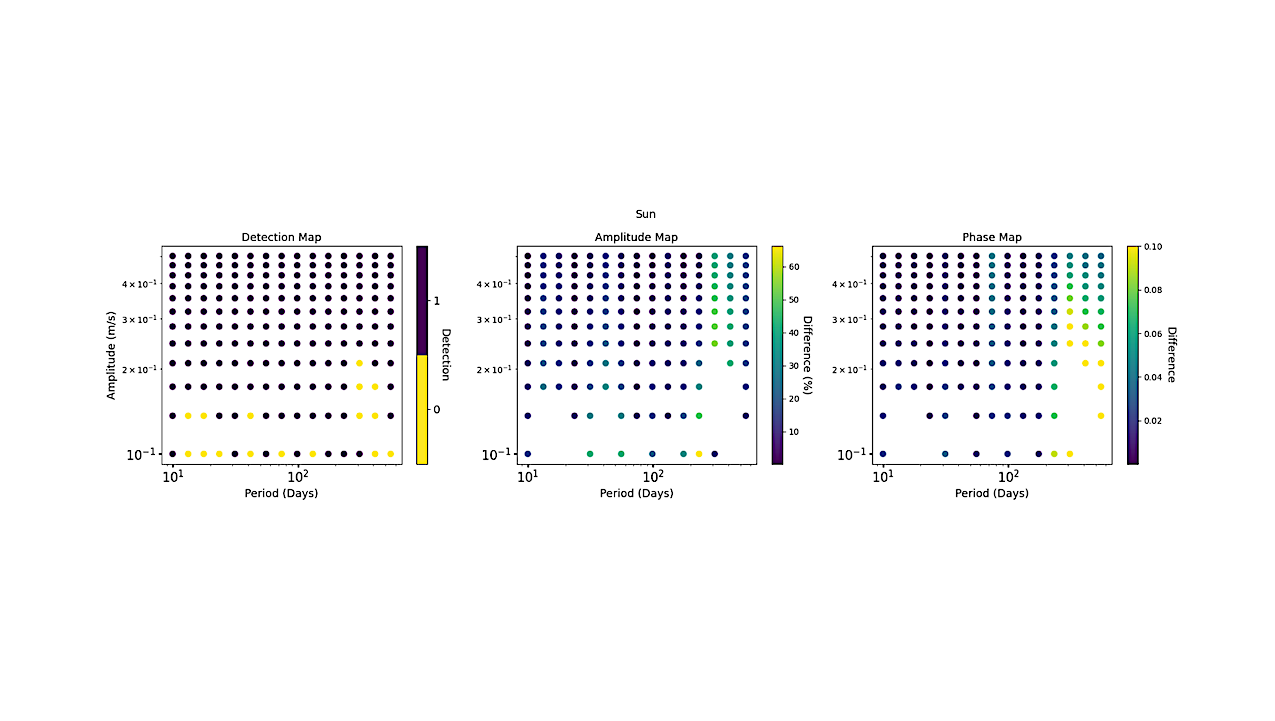
Exoplanet detection limits from a neural network framework for the HARPS-N solar spectrum. Left: Detection limit map in the period-amplitude domain. Red dots indicate successful detection by the trained NN with false alarm probability (FAP) > 0.1%. Center: Amplitude comparison of the injection and recovery signals in the period-amplitude domain. Most reconstructed signals have amplitude differences of less than 20%. The large difference at low amplitudes (0.1 m/s) is likely due to noise in the data. Right: Phase comparison of the injection and recovery signals in the period-amplitude domain. Most of the recovered planets have a phase difference of less than 0.04. The large differences at long periods are probably due to insufficient sampling of the phase of the long period planetary signal. –astro-ph.EP
Exploration of planetary bodies in the Solar System and beyond relies on the processing and interpretation of large-scale datasets that are spatiotemporally inconsistent and heterogeneous.
Recent advances in machine learning (ML) provide unprecedented opportunities to address many fundamental challenges posed by these heterogeneous and hyperdimensional datasets. This review chapter focuses on innovative ML techniques developed and used by NCCR PlanetS members to address three important challenges in (exo)planetary science.
The first challenge is sequence modeling. This involves complex analysis of one-dimensional data such as radial velocity and light curve time series.
Second, there is pattern recognition, including correlation studies, feature extraction, mapping, leveraging convolutional neural networks for cross-correlation between other examples, anomaly detection with variational autoencoders, and unsupervised clustering of mass spectrometry data.
Finally, there are generative models and emulation-based Bayesian analyzes involving the development of predictive models of planetary internal structures using deep neural networks to understand planetary formation mechanisms.
These innovative ML techniques usher in a paradigm shift in processing data and numerical models that represent unique challenges in planetary and exoplanet science, paving the way for revolutionary discoveries and ideas in the field.
J. Davort, VT Bickel, C. Haslebacher, Y. Aliberto, D. Angerhausen, C. Cantello, JA Egger, R. Elzisinger, Y. Eicholzer, EO Garbin, S. Gurciola, A. Leroux, S. Marquez, Y. Chao.
Comments: Chapter accepted for publication in NCCR PlanetS Legacy Book: Benz, W. et al. (Eds.), National Center for Research Competence, PlanetS: A Swiss-wide network expanding planetary science. Springer (2026)
Subject: Earth and Planetary Astrophysics (astro-ph.EP)
Quote: arXiv:2604.09152 [astro-ph.EP] (or arXiv:2604.09152v1 [astro-ph.EP] for this version)
https://doi.org/10.48550/arXiv.2604.09152
focus to learn more
Post history
Source: Jeanne Davoult PhD
[v1] Friday, April 10, 2026 09:39:14 UTC (12,913 KB)
https://arxiv.org/abs/2604.09152
Astrobiology, AI,


