
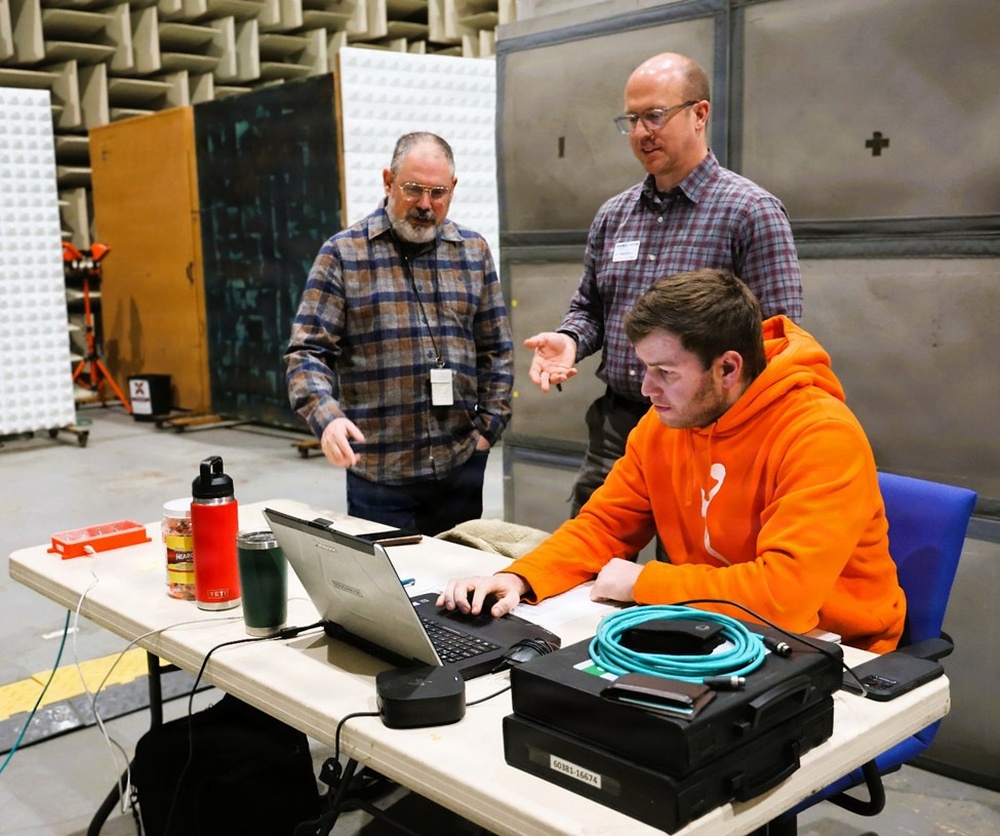
In a soundproof room at the Naval Surface Warfare Center Philadelphia District (NSWCPD), a steel-gray air compressor hums as engineers test an experimental machine learning model designed to detect early signs of failure through vibration analysis. This effort is part of NSWCPD’s growing portfolio of artificial intelligence (AI) and machine learning (ML) projects and shows early promise for potential future Navy use.
High pressure air compressors play a critical role in submarine operations by supporting several critical ship functions. Its reliable performance helps crews maintain maneuverability and keep missions on track.
The Navy’s Condition-Based Maintenance Plus (CBM+) initiative combines traditional maintenance practices with artificial intelligence predictions to not only detect problems, but also estimate how far along they are over time and how long it will take for equipment to fail. At NSWCPD, the compressor project is an exploratory step in that direction, a way for the Navy to use carefully collected vibration data to see what AI and ML can do before considering operations.
“As a war center, we conduct applied research into how AI and machine learning can enhance the tools we provide to seafarers,” said Nigel C. Theis, SES, NSWCPD Technical Director. “Projects like this help us understand where AI adds value, where we still fall short, and how digital innovation can align with our core mission of delivering warfighting capabilities in both fleet acquisition and sustainment.”
NSWCPD has built AI/ML expertise across multiple disciplines. Engineer Dr. Caitlin Sitch recently received a SMART (Science, Mathematics, and Research for Transformation) SEED Innovation Award for her development of an AI/ML algorithm to predict power system health. This effort is aimed at reducing downtime and improving energy resiliency across naval platforms. The command is also promoting “digital twins” of shipboard systems, such as Enterprise Remote Monitoring (eRM), which uses Python-based machine learning models to predict anomalies in the ship’s hull, machinery, and electrical equipment. Previously, we hosted a Navy-wide prize contest for an industry prototype of an AI-enabled information marking tool. These efforts frame the compressor effort as part of a broader effort to apply data science to real naval problems, rather than as a standalone solution.
Within that larger ecosystem, current compressor models are intentionally limited. Because actual failures on operational platforms are rare, a positive outcome for seafarers but a challenge for data science, NSWCPD engineers built a dedicated test loop to induce failures under controlled conditions, including simulating air leaks, inlet restrictions, and cooling water issues. They used a series of accelerometers to capture any changes in vibration. The resulting data provided the team with a safe starting point to evaluate how different machine learning approaches differentiate between normal behavior and known failures.
“Lab tests to date have shown solid results. On sample data, our machine learning model distils thousands of vibration signatures into just 10 key indicators, reliably flagging common failures such as leaks and restrictions,” said Colin Dingley, a machine learning engineer with NSWCPD and a certified information systems security specialist for the command’s cybersecurity personnel. “The next step is to extend the AI with more diverse data and edge hardware to see if this holds up to real-world conditions. This will be challenging, but the early results are encouraging.”
Submarines have unique limitations. Due to limited bandwidth underwater, it is not possible to transmit a full-fidelity vibrational stream to land for analysis. This reality moves processing to the “edge.” This means compact, energy-efficient hardware mounted close to the machine can run AI models locally and share only the most critical health information with operators and onshore systems. Luna Labs designed the embedded eCBM nodes and edge devices that NSWCPD is testing in an anechoic chamber. The anechoic chamber is a quiet environment where engineers can evaluate how well their algorithms work without being affected by other shipboard noise.
“AI will complement our seafarers,” Dingley said. “Machine learning and artificial intelligence will become part of a seafarer’s toolbelt and provide another layer of protection. It is said that seafarers perform maintenance 26 out of 24 hours a day, and we are trying to make it more manageable by using AI to highlight the components that really need attention.”
NSWCPD CBM+/Prognostic Health Monitoring Leader Sherwood “Woody” Poulter traces this line of research back to 2012. This was in 2012, long before AI was a household word and before today’s processors could run large-scale models at the edge.
“As a Naval Research Laboratory, we routinely partner with industry, academia and other government agencies to advance technology,” Poulter said. “Computers that can process these large models now allow us to experiment with AI-powered health monitoring in ways that were not possible 10 years ago.”
Poulter emphasizes that no single machine learning model can handle all shipboard systems. Although each piece of equipment has unique dynamics, operating ranges, and failure modes, the high-pressure air compressors used in this project are common across surface and subsea fleets, making them an ideal test bed.
“This type of compressor is installed in all vehicles,” he said. “It’s important for submarines, but it’s just the tip of the iceberg.”
The long-term vision extends beyond manned platforms.
“In addition to surface ships and submarines, we are actively advancing machine learning with eCBM technology for unmanned subsea platforms,” Poulter said. “In systems where there are no crew members standing nearby with wrenches and clipboards, reliable autonomy depends as much on reliable self-monitoring as on navigation and communications.”
Poulter explains that the core of the work is “condition-based monitoring and prediction.” He often uses the example of cars. An owner’s manual might recommend replacing a fan belt after a certain number of miles, but an AI-equipped car might one day tell the driver that given the way that belt is installed and used, it’s likely to fail within 30 days.
“Let’s apply that to being on a boat,” he said. “Before something breaks, it bends. Our goal is to find bends in the data.”
In reality, “finding the corner” means focusing on vibration as a rich source of information.
“We primarily use vibration sensor data to detect outlier frequencies of interest and compare them to baseline measurements,” Poulter said. “This allows us to apply data analytics and algorithms to build machine learning models for anomaly detection.”
On a normal day, this looks more like pattern recognition than drama. The spectrum changes slightly from normal, and the algorithm silently flags patterns that humans would never see.
Looking ahead, the team views remaining useful life (RUL) estimation as a long-term goal rather than something that can be achieved quickly.
“Remaining useful life analyzes a lot of data,” Poulter explained. “The operator is informed of the specific parts or components in the system that are expected to fail. The system must notify the user or, in the case of unmanned systems, send remote data to the platform operator. But all this is only possible if the model is properly developed using big data and provides a RUL solution.”
For now, NSWCPD leaders view the Compressor project as one of several “learning labs” for AI/ML within the command.
“This work will have a direct impact on warfighters,” Tice said. “Moving AI-powered health monitoring from the lab to the fleet, as we are already doing with condition-based monitoring and enterprise remote monitoring, will help mariners better prepare for and avoid casualties, increase operational time, and extract more value from every maintenance dollar.”
“This technology is not limited to submarines,” Dingley added. “This umbrella is much broader than just a compressor. In theory, it could work with any device if you do the hard work up front to understand the data and properly train the model.”
When the compressor was slowed down in the test facility after its last run, the sound disappeared and became silent, but the data it generated did not disappear. These records now feed a growing digital ecosystem of models, simulations, and lessons learned that will shape how NSWCPD incorporates AI and machine learning into future machine health projects.
“Every time we improve the Navy’s ability to spot problems before they become dangerous, we protect our sailors,” Dingley said. “This is the truth.”
NSWCPD employs approximately 2,700 civilian engineers, scientists, technicians, and support personnel. The command conducts research and development, testing and evaluation, acquisition support, operational and logistics engineering for non-nuclear machinery, ship mechanical systems, and related equipment and materiel for naval surface ships and submarines, and serves as the lead organization for providing cybersecurity for all ship systems.


