Researchers at the University of Illinois at Urbana-Champaign have developed a new method to detect defects in additively manufactured parts.
One of the most important tasks in any factory is determining whether manufactured parts are free of defects. Finding defects can be especially difficult with additive manufacturing (3D printing) because it produces parts with complex three-dimensional shapes and critical internal features that are not easily observable.
This new technique uses deep learning to make identifying defects in additively manufactured parts much easier. To build the model, the researchers used computer simulations to generate tens of thousands of artificial defects that exist only in a computer. Each computer-generated defect varied in size, shape, and location, allowing the deep learning model to train on a range of possible defects and recognize the difference between defective and non-defective parts. The algorithm was then tested on real parts, some of which were defective, some of which were not. The algorithm was able to successfully identify hundreds of defects in real, physical parts that the deep learning model had never seen before.
“This technology addresses one of the toughest challenges in additive manufacturing,” said project leader William King, professor of mechanical science and engineering at the University of Illinois. “Using computer simulation, we can very quickly build machine learning models that identify defects with high accuracy. Deep learning allows us to accurately detect defects that were previously undetectable by computer.”
The research, published in the Journal of Intelligent Manufacturing in a paper titled “Detection and Classification of Hidden Defects in Additively Made Parts Using Deep Learning and X-ray Computed Tomography,” used X-ray computed tomography to inspect the interior of 3D parts that have invisible internal features and defects. While additive manufacturing makes it easy to create 3D parts, inspection is difficult when critical features are not visible.
The authors are Miles Bimrose, Sameh Tawfick and William King of the University of Illinois at Urbana-Champaign, Davis McGregor of the University of Maryland, Chenhui Shao of the University of Michigan, Tianxiang Hu, Jiongxin Wang and Zuozhu Liu of Zhejiang University.
journal: Journal of Intelligent Manufacturing. Publication date 10.1007/s10845-024-02416-0
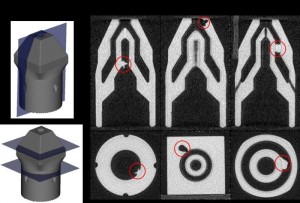
Images: Longitudinal (top) and axial (middle) images of X-ray CT data of a part with six internal defects: a spherical blockage, a star-shaped blockage, a cone-shaped void, a lump-shaped void, an elliptical distortion of the internal channel, and a non-concentric center nozzle.credit: Grainger School of Engineering, University of Illinois at Urbana-Champaign