

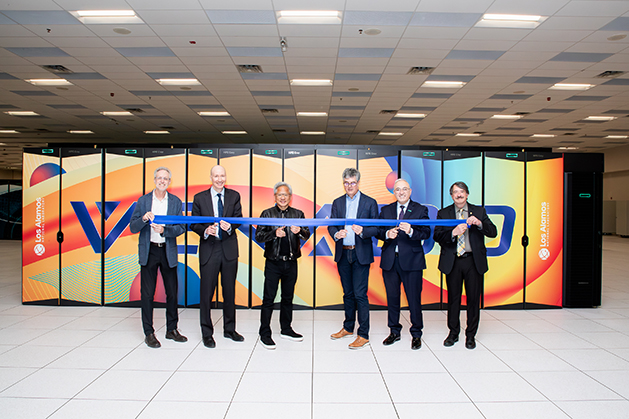
 From left: LANL Interim Deputy Director for Science, Technology and Engineering Mark Chadwick, DOE Secretary David Turk, NVIDIA CEO Jensen Huang, LANL Director Tom Mason, and Hewlett Packard Enterprises CEO Antonio Neri and NNSA Los Alamos Field Office Manager Ted Waika at a ribbon-cutting event at Los Alamos National Laboratory on Monday. Provided by/LANL
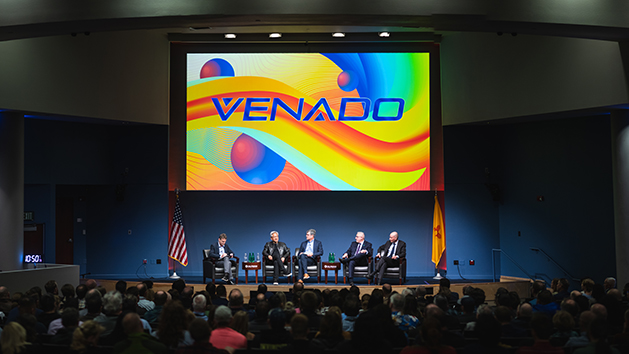 National Security AI Director Jason Pruett (left) moderates a panel discussion held Monday at LANL during the unveiling of Los Alamos National Laboratory's latest supercomputer Venado. The panel discussion included NVIDIA CEO Jensen Huang (second from left), LANL Director Tom Mason, Hewlett Packard Enterprises CEO Antonio Nelli, and DOE Secretary David Turk. . Provided by/LANL
Kirsten Lasky
Los Alamos Daily Post
kirsten@ladailypost.com
In a nondescript room the size of a football field at the Nicholas C. Metropolis Modeling and Simulation Center at Los Alamos National Laboratory (LANL), you can hear the hum of machinery. This hum is created by the magic of giant supercomputing units.
On Monday, lab leaders, Department of Energy Secretary David Turk, NVIDIA CEO Jensen Huang, Hewlett Packard Enterprise (HPE) CEO Antonio Neri and others visited the center's supercomputing system. We celebrated the newest addition to the playing floor, Venado.
The event featured a panel discussion and Venado's ribbon cutting ceremony. Modern supercomputers set themselves apart from other supercomputers because of their unique and cutting-edge technology.
This feat was achieved through collaboration between LANL, HPE, and NVIDIA.
“Venado adds cutting-edge supercomputing to advance national security and basic research, and shows how artificial intelligence can be integrated to address these challenges,” LANL Director Tom Mason said in a press release. It will accelerate.”
During the panel discussion, he noted that the institute has contributed to the success of supercomputers for many years.
“We've been part of every wave of success in this space,” Mason said.
Huang added that for more than 30 years, the frontier of computing excellence has been pioneered, but the past four years have looked different.
“We've been on the boil for a while,” he said.
The Venado announcement is really important and, as Turk said, it touches on four features that we really need to focus on.
These capabilities, he said, are new investments in supercomputing, datasets, partnerships and talent.
“(Their) level of expertise and history of expertise, we need to rely on that,” Turk said of talent.
According to a press release, the NVIDIA Grace Hopper superchip combines an Arm-based NVIDIA central processing unit with an NVIDIA Hopper architecture-based graphics processing unit to support high-performance computing and massive-scale artificial intelligence applications. Superchips can execute millions more instructions per second, typically at lower cost and lower power consumption than traditional chip technology. In initial scale testing, Venado has shown significant results in materials science atomic simulations and high-resolution astrophysical simulations.
“Our supercomputing capabilities represent a critical element in how national laboratories address important problems,” Turk said in a press release. “With its ability to incorporate artificial intelligence approaches, we look forward to seeing how Los Alamos’ Venado system can deliver new and meaningful results in areas of interest.”
Venado's computing power includes an exascale-class HPE Cray EX supercomputer with 2,560 direct water-cooled Grace Hopper superchips. This system also uses 920 of his NVIDIA Grace CPU superchips and will be the first large-scale system equipped with his NVIDIA Grace CPU superchips to be deployed in the United States. NVIDIA packs 144 Arm cores on its Grace CPU superchip to instantly boost performance for a wide range of HPC applications.
“As the first U.S. supercomputer powered by NVIDIA Grace Hopper, the Venado system delivers breakthrough performance and energy efficiency to accelerate scientific discovery,” said Ian Buck, vice president of hyperscale and HPC at NVIDIA. he said in a press release. “Through his continued work with Alamos and his HPE, Venado will become a great scientific instrument for researchers to achieve breakthroughs in materials science, renewable energy, astrophysics, and more. ”
At Monday's event, Markus Berndt, deputy head of the HPC department, emphasized that Venado can be used lab-wide.
“We’re excited about it,” he said. “This is an organizational resource.”
According to a press release, the Venado system is built to prioritize overall performance and workflow efficiency. The system is networked with HPE Slingshot 11 interconnects, and the extremely fast network significantly improves overall system performance. Additional his HPE Cray supercomputing software will improve modeling and simulation workloads and enable researchers to leverage his AI and machine learning to leverage insights and make new discoveries. The Venado is designed and manufactured at HPE's facility in Chippewa Falls, Wisconsin, and takes its name from one of the highest peaks in New Mexico's Sangre de Cristo Mountains. This system was delivered to Los Alamos in his March.
Berndt said at Monday's event that the supercomputer is expected to be fully operational by early summer.
Trish Damkroger, Senior Vice President and General Manager, HPC & AI Infrastructure Solutions, HPE In a press release. “Los Alamos National Laboratory continues to demonstrate cutting-edge research and engineering results with industry-leading supercomputing. We are proud of our long-standing relationship with the Institute, which provides innovative AI solutions that accelerate discovery and make impactful contributions in the field.”
Venado is the result of a co-design process that forms the basis of an ongoing collaboration focused on developing a wide range of computing, memory, and software technologies. Codesign combines the expertise of vendors, hardware architects, system software developers, domain scientists, computer scientists, and applied mathematicians to collaborate and make informed decisions about hardware and software components.
 From left: Hewlett Packard CEO Antonio Neri, NVIDIA CEO Jensen Huang, LANL Interim Deputy Director for Science, Technology, and Engineering Mark Chadwick, DOE Secretary David Turk, LANL Director Thom Mason, and LANL HPC Program Manager. Jim Lujan toured the supercomputing floor at the Nicholas C. Metropolis Center for Modeling and Simulation during a ribbon-cutting event Monday. Provided by/LANL


