NEW YORK — LinkedIn has developed a suite of AI tools and features aimed at improving the user experience for job seekers, recruiters, sales teams and other business users.
The update, announced this week at an event for journalists and content creators, is part of a broader strategy to integrate AI across the professional networking platform's products. The AI features aim to provide users with better insights and customization options, but they also come with challenges and considerations.
LinkedIn Premium AI Updates
The big announcement was the general availability of an AI-powered premium experience that provides personalized insights and recommendations based on a user's profile and activity. The AI-powered features are rolling out now to all Premium subscribers.
The AI tool helps users create their profile headline and about me section by analysing their existing profile content to highlight their skills, education, and experience. In terms of messaging, it suggests personalized drafts to start conversations with recruiters, connections, and prospects.
“Personalization works here because we know you as a member and we know who you're trying to reach out to,” said Prasanthi Padmanabhan, vice president of engineering at LinkedIn, in an interview with TechTarget Editorial. “We craft our messaging based on those insights so it doesn't come across as a robotic, out-of-the-box outreach message.”
During a demonstration of the premium AI tool for a TechTarget Editorial, a LinkedIn representative explained that the underlying algorithms draw on broader LinkedIn data in addition to user information: For example, the generative AI model the platform uses to refine profile headlines is fine-tuned based on data from profiles that get the most clicks from recruiters, the spokesperson said.
Similarly, the message generator uses feedback from recruiters and users about preferred message content, which keeps personal information out of direct messages, a separate spokesperson said.
LinkedIn is positioning these features as a way to mitigate the “blank page” problem, but is careful to avoid promoting the use of AI-generated content without reviewing it.
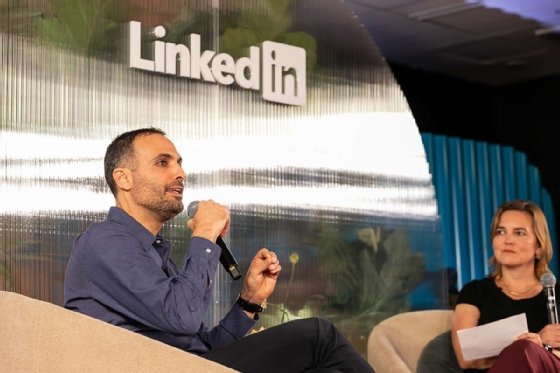
“We wanted experts to feel in control,” said LinkedIn's chief product officer, Tomer Cohen, in an onstage discussion with LinkedIn's senior editor-in-chief, Jesse Hempel, who likened the AI to a passenger navigating the space, while human users “drive the car.”
But even if you view the AI suggestions as a starting point rather than an end product, some users may find the suggestions too far-fetched or too general. Taylor, a job seeker who works in the tech industry and asked to be identified only by her first name because her current employer is not aware of her job search, shared her experience testing the premium AI features with TechTarget Editorial.
“The new sentences are not completely wrong, but they're not completely accurate either,” she said of the AI-generated suggestions for her profile. “You can tell it's just taken information from my past work and put it in sentences instead of bullet points.”
“I don't want to use AI tools as a substitute for thinking and writing for myself,” she added.
Additionally, LinkedIn is introducing “AI-powered insights” on posts that will appear directly in premium users' news feeds and suggest prompts and follow-up questions. Users can click on these prompts to engage with a generative AI chatbot on the topics raised in the post.
For job ads, a similar feature allows premium subscribers to find roles that match their preferences and evaluate their suitability for a particular position. The tool offers tips for skill development, helps with drafting cover letters and suggests resume enhancements.
But as with the profile suggestions, Taylor found the job listing feature wasn't specific enough. The AI tool told her her profile was a good match for the job description and that she might be ready to apply, and it offered tips like highlighting her familiarity with a specific tool mentioned in the job listing.
“This isn't bad advice, but I might have thought the same thing myself after just scanning the job advert,” she said.
When I clicked on the suggested prompt to learn more about the work-life balance at the company in question, the generic answer again popped up: the organization “offers programs to help you live your best life, both physically and financially.”
“We need more information than that to decide whether we should apply for a place,” she said.
Updates for LinkedIn Business Users and Recruiters
The company also announced several updates for LinkedIn Business users, including non-AI personalization for small businesses and AI enhancements to Recruiter search. The small business features will be available globally by the end of July, while the Recruiter updates began rolling out last fall and will be available to English-speaking customers globally soon.
Small businesses can now create premium Company Pages that provide customizable elements that are visible to customers and partners, as well as insights into the company's on-page engagement. One new tool, Custom Buttons, allows business owners to add personalized CTA buttons to their LinkedIn profiles, posts, and messages. These buttons can drive actions, such as visiting a website or booking an appointment.
For recruiters, the AI integration enhances search capabilities by recommending additional skills to target and expanding search parameters beyond job titles. In a demo with TechTarget Editorial, a LinkedIn spokesperson showed that when a recruiter searches for a data analyst, consultants and data scientists with similar skills may also be surfaced.
The AI-powered recruiter search will also show the gender ratio of candidate results and suggest locations and companies that can improve gender diversity in hiring. The feature was developed in line with Microsoft's Responsible AI Principles, a spokesperson said.
LinkedIn Learning's AI Capabilities
LinkedIn Learning will also be getting an AI update with personalized skill development coaching.
Users can access a chatbot within the LinkedIn Learning interface to recommend courses and strategies to address work challenges and professional development needs. The tool analyzes information about a user's current role, career goals and skills, and uses generative AI to suggest skills to develop through LinkedIn Learning's content library.
Some courses also offer a more unusual way to learn: interacting with AI versions of top instructors. The tool uses instructor-created content to train an AI chatbot designed to mimic a real instructor. By integrating information about the learner's career goals and desired skills, the chatbot aims to give the impression of interacting directly with an expert.
LinkedIn tracks and monetizes these expert chatbot interactions and compensates instructors through royalties, the company said, but the exact details of monetization are unclear and these tools raise questions about reputational risks, including the potential for inaccurate AI-generated information to be attributed to expert voices.
LinkedIn is currently testing the expert advice feature with a few select instructors, and will decide to roll it out more broadly based on how the pilot performs, Padmanabhan said during the onstage product announcement.

Technology to reduce hallucinations in generative AI
A big, common challenge with generative AI is dealing with hallucinations, or instances where the AI generates inaccurate or misleading information. In an interview with TechTarget Editorial, Padmanabhan detailed elements of LinkedIn's technology architecture designed to mitigate this issue.
LinkedIn uses several OpenAI large-scale language models as foundational models, including GPT-3.5, GPT-4, and GPT-4 Turbo, via the Microsoft Azure Gateway. These models are fine-tuned on LinkedIn data and optimized for specific use cases.
“Tweaking is really important when you want to power features with LinkedIn's own data,” Padmanabhan says. “It's going to feel different than if you just went into the ChatGPT interface and asked questions.”
The generative AI pipeline then provides the fine-tuned LLM with access to factual information via Search Augmentation Generation (RAG). This approach uses LinkedIn's internal data and external APIs, such as the Bing Web Search API, to retrieve relevant information.
The generative AI tool also uses thought-chaining prompts (a strategy that prompts the AI to reason through a problem step-by-step) to convert a user's free-form query into a more structured, LLM-ready prompt behind the scenes. The goal is to generate reliable output using RAG and prompt engineering strategies without degrading the user experience.
“You want to make sure that you're not impacting latency or performance of that experience,” Padmanabhan said. “It's a balance between quality and responsiveness.”
Managing Data and Accuracy Challenges in the Real World
Brenda Disher, senior vice president of business strategy and marketing at Siemens Digital Industries Software, also emphasized the importance of data accuracy and integrity during a panel at the LinkedIn event.
“AI is illusionary,” Discher said. “It's not 100% accurate all the time, so we have to be very, very careful about integrating it into the products we offer to our customers.”
Discher shared the example of a battery manufacturer that used generative AI to optimize the design of cooling units: Inaccurate training data could have devastating consequences.
“We really need to be careful about bias in AI,” she says. [prediction] It might be a little bit off tomorrow, but if there is a major problem with a machine part, an airplane or a car, it matters.”
Part of leadership decisions regarding AI is determining whether adopting AI is the right approach.
“Be intentional about what you want technology to do and what you don't want it to do,” said IBM chief human resources officer Nick Lamoreaux on the same panel. “I think some companies are getting this wrong right now.”
Lev Craig is the site editor for TechTarget Editorial's Enterprise AI site, covering AI and machine learning. Craig holds a BA in English from Harvard University and has written about enterprise IT, software development, and cybersecurity.