By 2025, it looks like every major product, application, and service will be integrating AI in some way.
AI has many benefits, and while those benefits are tempered by legitimate concerns and hesitations, the benefits are also real, including those seen in educational settings.
I’ve been a technical trainer for over 20 years, providing content on Windows Server, Linux, networking, cybersecurity, and other practical systems and network management skills. My time included traditional face-to-face classroom delivery as well as internet-based live online training.
After I left the training industry, I started creating courseware and designing labs. This gave me a better understanding of what course development entails.
To understand the full potential of AI in technical training, instructors should separate their use of AI into two parts. One is as a tool for creating and delivering learning. Two are necessary elements of the curriculum itself, enabling students to learn how to effectively manage complex environments.
In this article, I explore my thoughts on how AI will impact technical training and curriculum design, including the following key points:
AI is just another tool for trainers. AI will not replace curriculum creators, and it will not replace instructors. Trainers can take advantage of the benefits it offers during the learning experience while considering the potential risks.
AI is an important tool for modern managers. As AI becomes increasingly integral to many technical roles, instructors need to provide thoughtful learning courseware and learning resources that explain AI technology and how to use it within existing IT roles.
AI will not replace curriculum creators, and it will not replace instructors.
damon gahnCog Spinner Coaction Owner
AI can help conduct training
Like almost every other industry, technical trainers are facing dramatic headlines about being replaced by AI. However, many IT learners prefer human interaction in their training. Sure, students can learn by reading and completing labs that simulate real-world environments, but nothing beats having an experienced human trainer available to answer questions, rephrase explanations, provide examples, and customize the learning environment.
Instructors can think of AI like any other innovative technology or tool. In educational settings, AI can provide context and information that supplements other equally important mechanisms, such as labs and reading materials.
Here are some ways you can integrate AI into your training delivery.
Improved delivery. Online collaboration technology uses AI to dynamically adjust performance settings to ensure the highest quality UX. For example, Zoom uses AI to optimize the online collaboration experience. It also offers AI assistant “Zoom AI Companion”.
Lab optimization. Online virtualization lab providers use AI to optimize performance, create additional VMs, and dynamically manage network traffic. A scaled environment provides the best performance and experience with a balance of cost and resource utilization.
laboratory management. AI provides scoring opportunities to assess participants on their ability to complete specified tasks. AI also makes it possible to personalize lab activities, avoiding time spent developing skills that users have already mastered.
review. AI provides instructors with an unparalleled opportunity to generate questions, quizzes, and review material, enhancing the content delivered in class.
classroom materials. AI can generate shipping resources. For example, AI can create images, network diagrams, and other references. Generative AI allows instructors to create reference materials based on student questions and examples to further personalize the training experience.
All of these approaches complement the power of AI to explore information and answer questions quickly. Whether it’s a custom AI chatbot or an AI service like Perplexity, AI helps students and instructors alike find information faster.
AI can assist training development
AI offers data-driven design and delivery options aimed at learning specific skill gaps that organizations have identified. These capabilities enhance the standard approach of identifying skill gaps, transferring knowledge, and supporting the learning process. This process relies on various components such as evaluation, design, and support.
evaluation
AI-powered assessments generate quizzes, hands-on activities, and scenario-based exams based on participant responses, allowing for a comprehensive and personalized assessment of an individual’s skills.
The data extracted from these results will help you create an efficient and effective study plan. Post-learning assessments validate your training investment.
design
AI will have a major impact on instructional design and curriculum development. Instructional designers can use AI to adapt learning materials to different learning styles, enable personalization, and tailor the knowledge transfer process to participant needs identified through AI-driven assessments.
Shipping and support
AI also provides course designers with new and unique delivery and support options. For example, AI chatbots enable on-demand, contextual support during the learning process, providing answers to questions in real-time.
We appreciate that these options and opportunities improve instructors’ ability to provide exactly the knowledge that learners need. We are reminded of how difficult it is for instructors to assess the level of knowledge and experience of different students and tailor training content to the needs of their students.
We appreciate that these options and opportunities improve instructors’ ability to provide exactly the knowledge that learners need.
damon gahnCog Spinner Coaction Owner
AI can assist training participants
The benefits and drawbacks that AI will bring to education are yet to be discovered. Just as AI helps other students, it also benefits IT students in the following ways:
Accessibility options. AI can provide real-time captions, transcripts, and content translation, including live training sessions. We’ve also optimized our text-to-speech tools for a more accessible learning experience.
Save time. AI can save you time researching information, finding answers to specific questions, and documenting configuration steps.
Natural language dialogue. Natural language AI allows learners to express their queries in a way that is meaningful to them and receive useful responses from chatbots and other tools.
Custom requests and queries. AI effectively handles participant-specific requests. Learners can request examples, diagrams, or case studies based on their criteria.
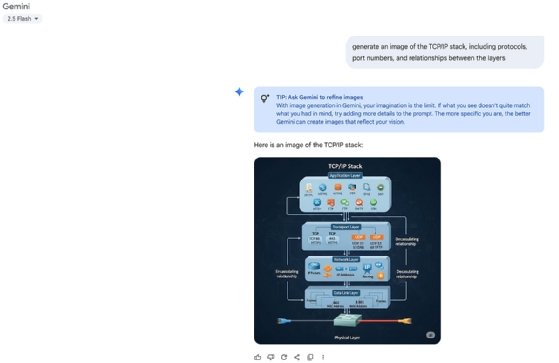
For example, imagine a learner trying to understand the TCP/IP stack, the interrelationship of its layers, and the concept of port numbers. Using tools such as Google Gemini, students can enter queries such as “Generate an image of a TCP/IP stack, including protocols, port numbers, and relationships between layers.”
The result should look like Figure 1.
Figure 1. Students query an AI chatbot to deepen their knowledge and understanding of complex technical topics.
I believe that such an approach is effective in the learning process and recommend that students take advantage of these AI applications.
Risks of AI in education
Of course, learners can abuse AI or use it in counterproductive ways. AI also has its own flaws and limitations. Concerns that instructors should consider include:
Access your assets. Not everyone has access to AI tools. In some cases, usage may be limited by a paid subscription structure.
Overreliance on AI. Students may become too reliant on AI, which can impede learning or create a false sense of skill and test readiness. People who rely on AI to find every step can find it difficult to perform daily tasks without it.
Limits and controls. Privacy, intellectual property, and data sovereignty concerns can limit access to AI tools.
Academic integrity. As seen in many industries, AI threatens ownership, originality, and integrity. If your learning environment requires original materials such as case studies, research papers, or scenario-driven essay questions, participants may be tempted to use generative AI rather than demonstrate their knowledge and skills.
There will be an increasing need to cover AI technology in technical education
In addition to using AI as a tool to support training development, delivery, and participant experience, instructors should also consider that AI technology will become an increasingly featured topic within training.
Any discussion of skill development for today’s IT operations staff must include AI. On-premises systems such as database servers, web application services, and other infrastructure systems benefit from AI configuration and optimization. Cloud services are also candidates for AI-driven optimization. From monitoring to disaster recovery, AI helps cloud administrators manage single-vendor, hybrid, and multicloud environments.
In other words, using AI to manage the physical and virtual infrastructure your business resides on is critical to any training plan.
AI is equally essential to developer and DevOps roles. AI assistance in coding has many benefits, including generating new code and conducting code reviews.
Technical trainers can incorporate these benefits into their training content, along with topics such as AI ethics and privacy. It is equally important to emphasize the importance of using AI as a tool rather than a crutch. Coding, and many other technical skills, remain complex and require human intuition and creativity.
Damon Garn owns Cogspinner Coaction, providing freelance IT writing and editing services. He has written multiple CompTIA study guides, including the Linux+, Cloud Essentials+, and Server+ guides, and has contributed extensively to Informa TechTarget, The New Stack, and the CompTIA Blog.