- Researchers say they have developed the first AI algorithm specifically designed to detect trafficked marine wildlife carcasses from 3D X-ray images.
- The system was most effective at finding species with unusual shapes, such as shark fins and seahorses, but it also detected sea cucumbers with 86% accuracy.
- Interpol seized more marine specimens in 2025 than reptiles, birds and primates combined, but experts say this illegal trade remains under-recognized compared to tracking terrestrial animals and their parts.
- The effectiveness of the new approach may be limited by access to 3D X-ray equipment at airports and postal routes, and by authorities seeking to distinguish species from the same genus.
On Sunday, April 26, Argentine authorities intercepted an unusual cargo that arrived at an airport near Buenos Aires. Inside, so many fish, dying fish, octopuses and crabs were discovered that the National Rescue Center had to install 10 new emergency tanks to assist survivors. This is the third time in a year that authorities have seized an illegal shipment of marine life at the same airport. Associated Press Reported.
Marine wildlife trafficking continues to grow globally, driven by demand for ornamental fish, premium foods, and traditional medicines. Much of that trade occurs through airplane baggage and flights, where the vast majority of animals, dead or alive, are never found.
The combination of artificial intelligence (AI) and 3D X-ray machines could change the game, according to an international research team. Scientists trained the algorithm on samples from seahorses, shark fins and sea cucumbers and achieved a detection rate of 86% to 96%, according to a research paper published last week.
Vanessa Pilotta, a marine biologist at Australia’s Macquarie University and lead author of the paper, told Mongabay: “Currently, our methods of detecting things that shouldn’t be in bags on the front lines rely on human inspection and biosecurity dogs.” “AI could be used to complement that. It’s not a silver bullet, but it’s an assistant and a tool.”
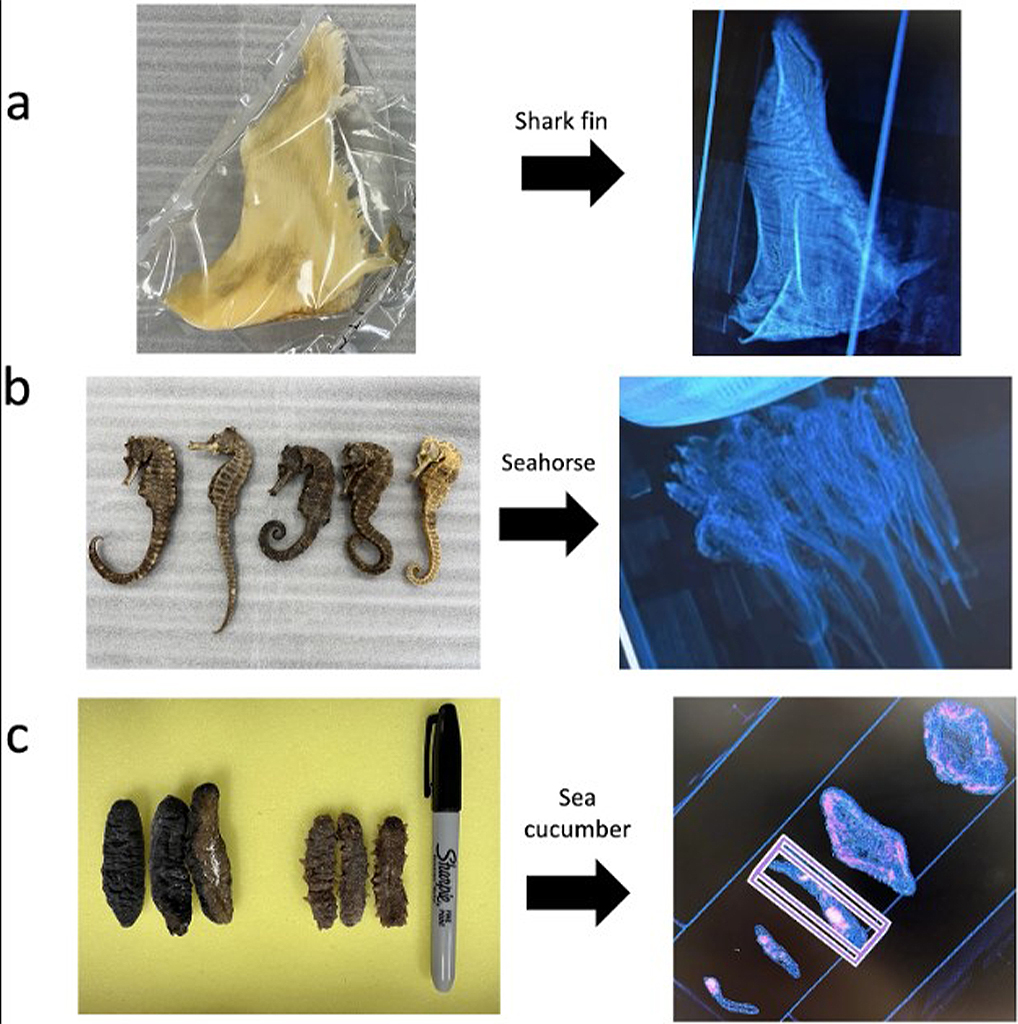
Other researchers and enforcement agencies said they welcomed the study, but stressed that it would only serve as a complementary tool. “Detection is the first link in a long chain and is not the whole answer,” a spokesperson for the United Nations Office on Drugs and Crime told Mongabay in a written statement. “Technology can flag bags. People, forensic scientists and prosecutors turn flagged bags into sentences.”
The study follows a 2022 paper by the same team that trained an algorithm to discover terrestrial species.
Michelle Annagnostou, a research fellow at the University of Oxford’s Wildlife Trafficking Program who was not involved in the study, said such innovations in detection were “exciting”, especially if they contributed to broader attempts to tackle the entire trafficking system. “We’ve been arresting people for decades and we haven’t made much progress,” Anagnostu told Mongabay. He recommended thinking from an institutional perspective, including putting resources into enforcement agencies, educating the public, and fighting corruption and poverty in supply countries.
Illegal wildlife trade not only causes biodiversity loss, but also spreads infectious diseases, introduces invasive species, and contributes to other forms of organized crime and labor abuses. Marine wildlife trafficking is a growing proportion of the total illegal animal trade and is likely to be under-reported, according to Operation Thunder, a global enforcement effort between Interpol and the World Customs Organization. Last year, 91,000 illegally trafficked marine animals were seized, almost double the number of reptiles, birds and primates combined.


Despite this, trade in marine animals is underestimated, says Sarah Foster, a fisheries researcher at the University of British Columbia in Canada and a member of the IUCN group that conserves seahorses, pipefish and seadragons. “Our biggest challenge in marine conservation is getting people to recognize fish as wild animals in the same way they care about elephant ivory or rhino horn,” she told Mongabay.. “Marine” [species] Illegal wildlife trade doesn’t get as much attention as it does on the ground, but I’m glad to see papers like this are trying to change that and coming up with solutions. ”
To train the first algorithm dedicated to detecting marine wildlife trafficking, Pilotta’s team collected 68 individual samples of seahorses, shark fins, and sea cucumbers. Most of these were on loan from the Australian Museum’s collection and were originally seized during a real-world human trafficking bust. One fin was freshly collected from a beached bull shark (Porgy whale). Another sea cucumber of unknown species was purchased from an East Asian grocery store in Sydney, along with some of the dried sea cucumber samples used in the study.
“I was just like any other tourist in Sydney who goes to Chinatown. It was a no-brainer,” Pilotta recalls. Dried fins and sea cucumbers were easily found. “But for me, as a whale biologist, it was completely foreign. It was my out-of-water experience. The idea was not to support this entire market, but to use a real-world example to show what this is like.”


Pilotta said the researchers spent six months looking at “how traffickers think” and creating just under 6,000 “bags”, 3,500 of which had samples hidden between or inside items typically used to hide smuggled animal parts, such as toys, clothing and aluminum foil. An additional 2,400 bags containing no animal parts were prepared. These were then scanned with a 3D X-ray machine manufactured by Rapiscan, a US-based security company that funded the research.
Algorithms trained on these images had a 95-96% success rate in detecting shark fins and seahorses. We identified sea cucumbers 86% of the time. False alarms were most frequently issued for seahorses (9%) and only 1-2% for shark fins and sea cucumbers.
The difficulty of the algorithm for identifying sea cucumbers points to one potential limitation of this approach, according to Pilotta. “Fins and seahorses look the same, but there are more variations.” [with] Therefore, algorithms that distinguish between legal and illegal samples within the same species can be more difficult.
This algorithm focused only on small carry-on bags. “We know that a lot of things are missing” in maritime transport, Anagnostu said. Currently, we are collaborating with AI to screen suspicious maritime shipments.
So far, the algorithm has only been tested on dead, mostly dry samples and works only with X-ray machines that can create 3D images in real time. Pilotta acknowledged that “not everyone in the world has access to this technology,” but added that it is becoming more common.
Toby Brecon, a computer science professor at Britain’s Durham University who specializes in the analysis of X-ray images, told Mongabay that Pilotta was right to be optimistic about the widespread use of 3D scanning. “All major airports worldwide now have carry-on baggage in place. Carry-on baggage is arriving a little later, but the technology is being driven by safety requirements and this [work] You could also take advantage of that. ”
Pilotta’s next step is to share his algorithmic “recipes” to help detect additional species in other regions. “When I first started this work, I never thought that AI would be so helpful to what I do as a scientist. I’m talking about AI here. I know it’s not the answer to everything, but I’m talking about it in an optimistic and progressive way.”

Banner image: spiny seahorse (hippocampal tissue). Seahorses are frequently trafficked marine animals. Image courtesy of © Hamadi Mwamlavya, via iNaturalist (CC BY-NC 2.0).
Four suspected wildlife traffickers arrested in Guinea, seizing dried seahorses and shark fins
Quote:
Anagnostou, M., Doberstein, B., Armitage, D., Stoett, P., Glasson, A. (2025). Unravel and unravel the mysteries of crime and illegal wildlife trade in South Africa, Hong Kong, and Canada. Journal of Economic Criminology, 10100196.doi:10.1016/j.jeconc.2025.100196
Bezerra Santos, MA, J.A. Mendoza-Roldan, R.A. Thompson, F. Dantas-Torres, D. Otranto (2021). Illegal wildlife trade: A gateway to zoonotic diseases. Trends in parasitology, 37(3), 181-184. doi:10.1016/jp.pt.2020.12.005
Cardoso, P., Amponsah-Mensah, K., Barreiros, J.P., Bouhuys, J., Cheung, H., Davies, A., … Fukushima, C.S. (2021). Scientists warn humanity against illegal and unsustainable wildlife trade. biological conservation, 263109341.doi:10.1016/j.biocon.2021.109341
Pilotta, V., Meagher, P., Huang, H. T., Shen, K., Thompson, W., Dolman, B., … O’Brien, J. K. (2026). Marine wildlife trafficking: Automatic detection of shark fins, seahorses, and sea cucumbers using AI algorithms. Frontiers of ocean sustainability, 4. doi:10.3389/focsu.2026.1776978
Pirotta, V., Shen, K., Liu, S., Phan, H. T., O’Brien, J. K., Meagher, P., Mitchell J., Willis J., and Morton, E. (2022). Detect illegal wildlife trafficking through real-time tomography, 3D X-ray imaging, and automated algorithms. Frontiers of Conservation Science, 3. doi:10.3389/fcosc.2022.757950
feedback: Use this form to send a message to the editor of this post. If you would like to post a public comment, you can do so at the bottom of the page.