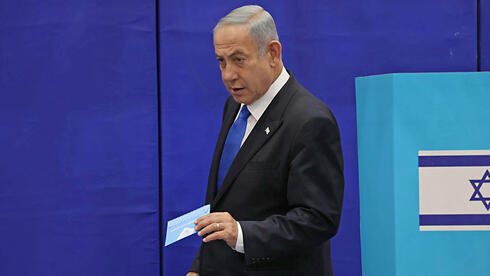
But beneath that visible agenda lies another, quieter agenda. Due to the timing of the upcoming elections and the structure of Israel’s economy, Israel is on the verge of becoming the first meaningful Western democracy to elect a prime minister in the AI era.
1 View gallery
Whether voters fully realize it or not, Israel’s next leader will be judged not only on war management, diplomacy, and coalition survival, but also on whether they understand that AI, advanced computing, energy, and industrial capabilities have become the nation’s core infrastructure.
AI is more than just a technology wave. It is becoming a driver of military superiority, productivity, public sector effectiveness, energy demand, labor market disruption, industrial policy, and national sovereignty. For all countries, but especially for Israel, this is not an incidental problem. It is directly connected to the future security and prosperity of the country.
That’s because Israel has been unusually exposed. High-tech industries account for about a quarter of GDP, more than half of exports, and a disproportionate share of tax revenue. This sector is one of the central pillars supporting the State of Israel. If Israeli technology becomes uncompetitive, the impact will not be limited to founders and venture capitalists. It will be reflected in tax revenues, wages, defense capabilities, public services, and the ability of the nation to finance its burdens.
That is why treating AI as an “innovation policy” is too narrow. The coming decades will not depend on whether Israel funds a few more startups or an incubator program. AI leadership will depend on the physical and institutional infrastructure of computing, power, transmission, cooling, data access, scientific talent, applied research, advanced manufacturing, and international partnerships.
In other words, AI policy is infrastructure policy. That is defense policy. It’s an educational policy. It’s energy policy. And it is increasingly a sovereign policy.
The next prime minister should make this a national project based on four pillars. Creation of a national research institute. Hard science education. Israel’s Taiwan/TSMC moment by championing specialized local industrial capabilities. An alliance that includes the creation of an AI diplomatic force.
Israel starts this race with a real advantage. It remains one of the most research and development intensive economies in the world. They have elite engineering talent, deep military technology roots, strong universities, dense startup ecosystems, and a culture of urgency that often allows them to move faster than larger powers. There are also things that many countries don’t have. It is already an advanced defense industry located at the intersection of sensors, autonomy, cyber, communications, electronics, aerospace, robotics, and real-world deployment. In the AI era, these military assets are directly correlated to economic and technological superiority.
There have been some small positive steps recently, including the National Supercomputer Initiative, the establishment of the National AI Directorate, and the signing of Pax Silica with the United States. However, they have not yet become national doctrine and are far from the wartime efforts needed at this time.
The next government should create a Prime Minister’s Office for national science and AI infrastructure. This should not be another advisory body. It must have substantial authority over multiyear budgeting, interagency coordination, computing infrastructure, energy planning, data access, regulatory sandboxes, national research programs, defense integration, and international partnerships.
The reason this office must be located within the Prime Minister’s Office is simple. In Israel, the security services are almost always the most powerful, organized and operational part of the government. While that is often a strength, it also means that only the Prime Minister’s Office can force real cooperation between the defense establishment, civilian departments, academia, industry, regulators and the financial system. The core of this reform is not to replace the security system. This allows Israel’s security system and other government departments to work together as one national engine.
The first pillar should be national laboratories. Israel needs to build three. One focuses on frontier AI and advanced computing. One focuses on quantum computing. The other focuses on advanced materials, chemicals and manufacturing. The United States has 17 national laboratories with budgets of $30 billion. The three countries of Israel need a budget of at least $1 billion a year, and there could be ways to increase government spending through “offsetting” programs required by commercial partners involved in infrastructure development (Pillar 3).
The second pillar is hard science education. Israel needs to fundamentally change its training in physics, chemistry, materials science, electrical engineering, and advanced manufacturing. It should start at K-12 age, but it should be accelerated through a military ecosystem where Israel has historically nurtured young talent into world-class technological capabilities. The IDF must not only consume human resources. This should help develop the next generation of hard science operators and engineers.
The third pillar should be Israel’s TSMC moment: the defense of local industrial capabilities. Israel doesn’t have to manufacture everything. Pretending otherwise is fantasy. But Israel needs to identify a small number of strategic bottlenecks at the intersection of AI, defense, energy, and supply chain resilience. Core areas should be rare chemicals, advanced materials, critical mineral processing and replacement, and specialized manufacturing facilities. These industries will be self-sufficient and profitable in the long run, but establishing and winning a “global race” for AI infrastructure capital will require smart public-private investment vehicles, incentive structures, procurement commitments, and off-take agreements in areas where the market alone does not move fast enough.
The fourth and final pillar should be building alliances, an AI diplomatic force. Israel is too small to build meaningful AI infrastructure on its own, but it is too strategically exposed to be just a customer of foreign platforms, foreign hyperscalers, and foreign supply chains. While the United States should be a central partner, this effort should also include major technology companies and allies. Israel should build an incentive infrastructure to attract hundreds of billions of dollars in foreign investment over the long term, while ensuring that these partnerships create jobs, infrastructure, and strategic depth for both Israel and its allies.
The first AI prime minister does not need to be an engineer. But he is an entrepreneur in demeanor and a strategist in discipline, and he must be prepared to treat this as a national wartime effort. In a country where the margin of error is never large, the choices made could shape not just the next government, but the next generation.