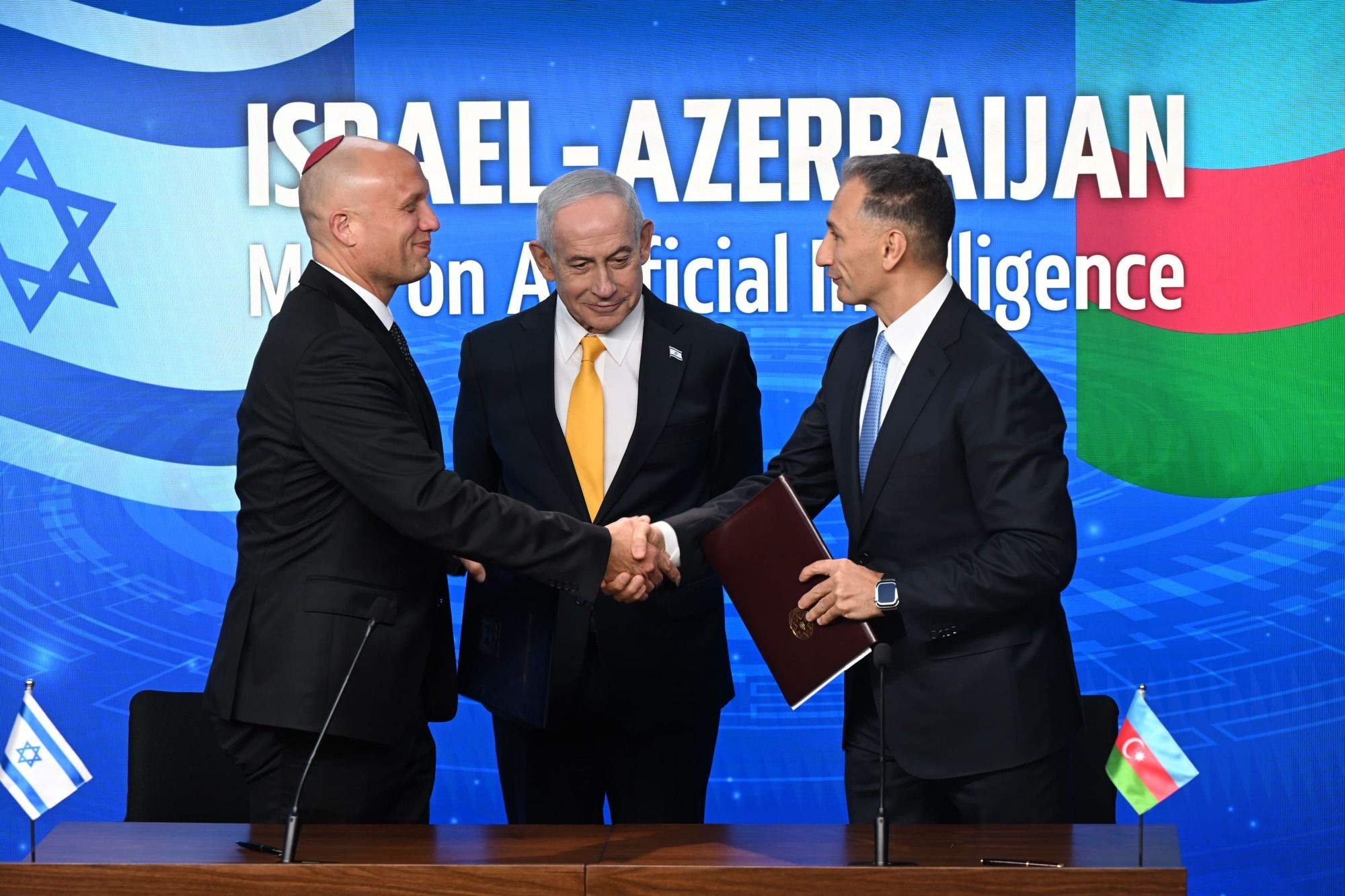
Israel and Azerbaijan signed a memorandum of understanding (MOU) in the field of artificial intelligence on Tuesday at the Prime Minister’s Office in Jerusalem. The agreement aims to strengthen cooperation between the two countries and advance Israel’s global leadership in AI.
The MOU was signed by Brigadier General Erez Askar, Director General of Israel’s National AI Directorate, and Rashad Nabiyev, Minister of Digital Development and Transport of Azerbaijan. Prime Minister Benjamin Netanyahu also attended the ceremony.
The partnership will focus on supercomputing infrastructure, applying AI to critical private sectors, developing human capital, and conducting joint research. This follows the Joint AI Declaration signed between Israel and the US last month.
“AI is not just a tool of the future, it’s a tool of today, rushing towards tomorrow. We have to make sure that we can be among the leading nations in this field, and I think that together we can do much, much better,” Netanyahu said. He added that the agreement marks “another step up the ladder of closer ties” with Azerbaijan.
Brigadier General Askar said the memorandum is an “additional important layer” in cooperation between Israel and Azerbaijan. “Cooperation in the field of artificial intelligence represents the future of our two countries with unique challenges and could lead to solutions that change the lives of our people, and indeed the entire world,” he said.
Israel and Azerbaijan have maintained a long-standing partnership based on mutual respect and strategic interests. The new MOU aims to formalize cooperation in cutting-edge technology and put both countries at the forefront of AI innovation.
Officials said the agreement will enable joint projects, research programs and knowledge-sharing initiatives, with far-reaching implications for economic development, technological advancement, and regional cooperation in science and technology.