Artificial intelligence is proving to be a big bet for many companies across the enterprise, and gamblers are nervous.
According to a survey of 2,400 employees and C-suite leaders around the world released this week by agentic AI platform Writer Inc., 79% of executives admit to struggling with AI-related issues such as delayed ROI, strategy gaps, and internal power struggles. Nearly 40% of CEOs confessed to feeling “high or devastating stress” about deploying their company’s AI strategy.
Writer’s findings highlight the high-stakes environment surrounding AI adoption, as companies grapple with a rapid rate of new model releases, rising costs, and growing security concerns. AI is causing tensions between information technology organizations and other industries, with more than half of respondents reporting the use of AI as “chaotic and random.”
This volatile climate may be setting the stage for a day of reckoning. One industry leader in the midst of the agent AI revolution agrees.
“Too many boards today have no idea how much data is leaving their organizations,” said Boomi LP CEO Steve Lucas, speaking with SiliconANGLE at the HumanX conference in San Francisco this week. “When chaos reigns, boards demand order.”
Aiming to utilize AI
Lucas was an early predictor of the rise of agentic AI. He spent a significant portion of his Spring 2024 Boomi World keynote explaining how the use of AI agents accelerates the process of rethinking enterprise applications.
In recent weeks, Boomi has moved to provide more resources for trust and governance in the use of AI. The company recently announced Meta Hub, which aligns data standards across the enterprise and enables AI agents and humans to rely on consistent and reliable business logic and governance.
“There’s going to be some pushback,” Lucas said. “We want to bring AI to the enterprise.”
Given the pace of agent automation enabled by an increasing number of sophisticated coding tools, achieving such control measures can be difficult. In addition to existing widely used tools such as Anthropic PBC’s Claude Code and OpenAI Group PBC’s Codex, new AI-based coding solutions have automated a wide range of programming tasks, including the creation of new application functionality and the ability to debug existing functionality.
Last week, Cursor, a startup that raised more than $3 billion in funding from tech giants including Nvidia Corp. and Google LLC, announced a new version of its AI coding platform with a chatbot interface that employs multiple AI agents to complete user-specified tasks. Cursor’s growing popularity, with a reported 1 million daily users, highlights the growing influence of AI coding platforms in enterprises, said Michael Truell, co-founder and CEO of Cursor, who spoke at HumanX on Tuesday.
“Right now, about 65% to 70% of enterprise code is written by AI,” Truell said. “Coding agents are becoming critical infrastructure for enterprises, and we have a long way to go before coding vendors reach the same level of importance as the cloud.”
Coding and models spark debate
Despite the success of coding platforms such as Cursor, not all leading figures in the AI world believe that software development can or should be fully automated. Andrew Ng, who founded and led Google Brain, appeared at the conference on Wednesday and took issue with some saying that human coding will no longer be necessary, offering a different view.
“I think people will look back on that as the worst advice ever,” Ng told the rally. “I think everyone should learn to code.”
Paradoxical opinions like Ng’s are an example of the chaotic state of the AI world in 2026. This was further highlighted by news from model provider Anthropic earlier this week.
The company announced Tuesday that it will release a preview of Mythos, the most powerful Frontier model it has ever created. The problem, however, is that it is only available to a small number of partners and cybersecurity researchers based on its apparently powerful ability to identify vulnerabilities in proprietary and open source software. The company said it was limiting emissions for “public safety and national security” purposes.
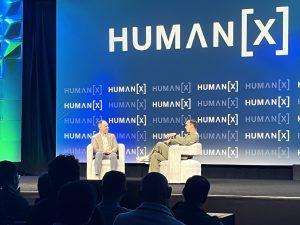
OpenAI Chairman Bret Taylor and Sources’ Alex Heath spoke about responsible AI at HumanX.
The move drew criticism from some in the industry for not disclosing the unprecedented cybersecurity risks the model revealed. However, OpenAI’s chairman attended this week’s conference and went on record to support Anthropic’s decision.
“Conceptually, I think this is a very smart idea,” said Brett Taylor, former co-CEO of Salesforce Inc. and co-founder of Sierra Inc. “I think this is part of a responsible iterative rollout. This is the type of thing that we need to know how to do as a research institution.”
Fight the hype cycle
In the larger picture, there is an ongoing debate among technology leaders about whether AI is overrated or underperforming. Appearing on HumanX on Tuesday, Amazon Web Services CEO Matt Garman expressed no concerns about talk of an AI “bubble.”
“I’m very bullish that there’s a lot more to come,” Garman told the rally. “The last big bubble we had was the Internet bubble. Last time I looked, the Internet was pretty big.”
However, Ali Ghodsi, CEO of Databricks Inc., offered a different perspective. He has been outspoken in recent months about the soaring valuations of AI startups, claiming that venture capitalists are being told privately that they are becoming exhausted by the current hype cycle.
“I think it’s still very bubbly,” Godi said Tuesday. “There is a gap between the artificial general intelligence that we already have and the agency side of the enterprise. [Agents] Context is missing. It won’t be fixed in the next model release. ”
While the next big language model may not fully bring AI to where it’s needed, the leading model providers continue to expand their influence and market influence. Reports of OpenAI’s initial public offering later this year put its valuation at nearly $1 trillion. Anthropic’s own offering is currently projected to raise more than $60 billion for a $380 billion valuation.
For all this incredible wealth, the central question that has been the focus of many hallway discussions at HumanX this week remains. Where is all this going and what does it mean for mere mortals?
Just as he predicted the agent revolution two years ago, Boomi’s Lucas has a pretty good idea of where that path will lead, at least as far as the two biggest model providers are concerned.
“I know the endgame here,” Lucas told SiliconANGLE. “The ultimate goal of Anthropic and OpenAI is to create a digital version of each of us. It’s not just a system or an app, it’s a person.”
Photo: Mark Albertson/SiliconANGLE
Support our mission of keeping content open and free by joining the theCUBE community. Join theCUBE’s Alumni Trust Networka place where technology leaders connect, share intelligence, and create opportunities.
- over 15 million viewers of theCUBE videospowering conversations across AI, cloud, cybersecurity, and more
- 11.4k+ theCUBE Alumni — Connect with over 11,400 technology and business leaders who are shaping the future through our trusted, unique network.
About SiliconANGLE Media
Founded by technology visionaries John Furrier and Dave Vellante, SiliconANGLE Media has built a dynamic ecosystem of industry-leading digital media brands that reach more than 15 million elite technology professionals. Our new, proprietary theCUBE AI Video Cloud leverages theCUBEai.com neural networks to deliver breakthrough advances in audience interaction, helping technology companies make data-driven decisions and stay at the forefront of industry conversations.