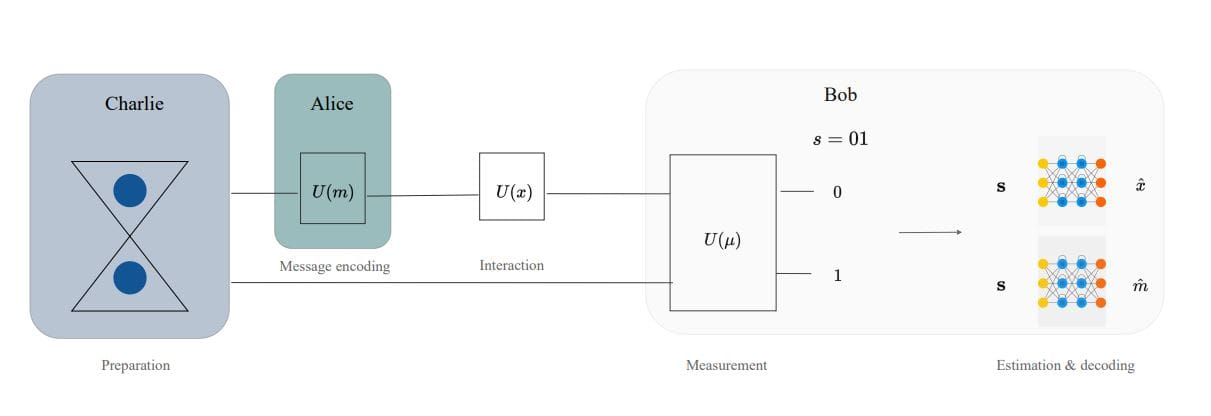
The demand for increasingly sophisticated wireless networks is driving innovation in how information is sent and received, and researchers are now exploring the potential of quantum technology to address these challenges. Ivana Nikoloska from Eindhoven University of Technology and Osvaldo Simeone from King’s College London, together with colleagues, will introduce a new approach to integrated sensing and communication that harnesses the power of quantum entanglement. In their work, they introduced a protocol that allows ultra-dense coding and parameter estimation simultaneously and provides a flexible balance between communication speed and sensing accuracy. This integrated system represents a significant step toward realizing the potential of quantum networks and paves the way for more efficient and powerful communications technologies.
Entanglement enables joint sensing and communication
This work pioneers a new integrated sensing and communication (ISAC) protocol, called QISAC, that leverages entanglement to simultaneously transmit information and estimate unknown channel parameters. In this study, we establish a system in which a third party generates maximally entangled states of two cudits and distributes them to Alice and Bob, forming the basis for joint sensing and communication. Alice uses carefully designed transformations to encode messages, represented as pairs of integers, into qubits and prepare the state for transmission. This encoding process allows us to control the trade-off between communication speed and sensing accuracy.
Following message encoding, Alice sends the qubit to Bob through a channel that depends on unknown parameters. This channel gives the transmitted qubit a dual role as both a carrier of information and a probe of the channel. Upon receiving Alice’s qubit, Bob possesses two qubits, enabling a joint measurement strategy designed to simultaneously decode messages and estimate channel parameters. This study details the mathematical formulation of these transformations and channel operations and establishes a precise framework for analyzing the performance of QISAC protocols. In this study, we investigate a Qudit-based transmission strategy that allows for tunable communication rate reduction and provide numerical results demonstrating the trade-off between communication and sensing performance. This approach enables a flexible balance between reliable message transmission and accurate channel characterization, demonstrating the versatility of the proposed QISAC protocol.
Tangled Qudits enable sensing and coding
Scientists have developed a new quantum integrated sensing and communication (QISAC) protocol that enables both ultra-dense coding and quantum sensing simultaneously. This represents a significant advancement in next-generation network technology. This work focuses on exploiting entanglement between quantum particles to achieve a flexible trade-off between communication speed and accuracy of parameter estimation. The experiment utilizes a qubit system, a quantum unit that is a generalized version of the qubit, to transmit information and perform sensing tasks. The team prepared a maximally entangled two-cudit state and distributed it between a transmitter (Alice) and a receiver (Bob).
Alice uses a variant of ultra-dense coding to encode classical information, while Bob uses variational quantum circuits to optimize the measurement strategy, combined with neural network-based decoders and estimators for classical post-processing. This hybrid quantum-classical system is trained end-to-end to optimize the weighted sum of communication and sensing performance. This protocol can reduce the communication speed and improve the accuracy of quantum sensing. Specifically, this work demonstrates the transmission of messages encoded as pairs of integers. This result illustrates the inherent trade-off between maximizing communication speed and achieving higher accuracy of parameter estimation. This research establishes the foundation for the future development of integrated quantum networks that can simultaneously sense and communicate information with increased efficiency and accuracy.
Simultaneous quantum communication and sensing protocols
This work presents a new protocol for integrating quantum communications and sensing and demonstrates how a quantum receiver can be trained to simultaneously decode classical messages and estimate unknown parameters. By leveraging entangled probe states and a hybrid quantum-classical optimization approach, the team was able to adapt the receiver’s measurement strategy to balance these dual tasks. Simulations characterize the trade-off between communication throughput and sensing accuracy and reveal that the developed design operates effectively at both non-zero communication rates and high sensing accuracy. Although the researchers focus on discrete parameter estimation, they acknowledge the possibility of extending the protocol to continuous parameter or multiparameter sensing scenarios, so this study establishes a flexible framework with expansion potential. Although the circuit complexity increases, further improvements can be achieved by using more expressive parameterized circuits. Addressing performance reliability and model uncertainty under noisy conditions will be another important area for future research08