Broadly neutralizing antibodies (bNAbs) are key in fighting HIV-1. They target the viral envelope protein and potentially reduce viral load to prevent infection. Despite their potential, identifying bNAbs remains laborious, requiring B cell isolation and high-throughput next-generation sequencing. There are only 255 known bNAbs, and discovering new bNAbs is challenging due to the virus's rapid mutations and immune evasion mechanisms. AI tools could revolutionize the field by automatically detecting bNAbs from large immune datasets, but robust criteria for distinguishing bNAbs are still needed.
Researchers from various institutions, including the Lausanne University Hospital and the National Institute of Health, developed RAIN, a computational method to rapidly identify bNAbs against HIV-1. Unlike traditional methods that rely on amino acid sequences or structural alignments, RAIN uses selected sequence-based features and machine learning. Tested on experimentally derived BCR repertoires, RAIN accurately predicted HIV-1 bNAbs, achieving 100% prediction accuracy and high AUC values. Validation included in vitro neutralization assays and cryo-electron microscopy structural analysis, confirming the efficacy of RAIN to identify bNAbs from immune donors with broadly neutralizing sera.
The study followed strict ethical guidelines and was approved by multiple institutional review boards, including those in Switzerland and Tanzania, and informed consent was obtained from all 25 participants. To investigate immune responses to HIV-1, serum IgG antibodies were isolated using the protein G Sepharose method. In this process, serum samples were incubated with resin, IgG was eluted, and desalted before storage. We also isolated memory B cells from peripheral blood mononuclear cells (PBMCs) using magnetic microbeads and performed fluorescence-activated cell sorting (FACS) to achieve high purity of CD20+ IgG+ cells. These cells then underwent single-cell B-cell receptor sequencing using three advanced platforms: 10X Genomics, BD Rhapsody, and Singleton.
For functional analysis, recombinant antibodies and Fab fragments were produced in Expi293 cells and purified by protein A or HisTrap chromatography. Neutralization assays were performed to evaluate the efficacy of antibodies against a range of HIV-1 strains and binding kinetics was assessed by biolayer interferometry. Negative staining electron microscopy and high-resolution cryo-electron microscopy were used for structural studies of antibodies interacting with HIV-1 envelope glycoprotein (SOSIP). Advanced data processing and structural modeling tools such as CryoSPARC, ChimeraX and Phenix were used to analyze these interactions. Furthermore, using the CATNAP database and various machine learning models, we sequenced and annotated the B-cell receptor (BCR) repertoire, identified paired sequences that target HIV-1 and classified these BCRs based on their immunological features.
Identifying bNAbs against HIV-1 is challenging due to their high sequence diversity. Traditional methods that rely on sequence similarity are inadequate due to this diversity. However, bNAbs exhibit properties such as high somatic hypermutation, specific germline usage, and unique structural features that can be exploited. Researchers have developed machine learning frameworks to analyze these properties to automatically identify bNAbs. They curated antibody sequences, extracted unique features, and used algorithms such as anomaly detection and random forests. These models effectively distinguished bNAbs from other antibodies, highlighted key predictive features, and improved the accuracy of identifying potential bNAbs from the immune repertoire.

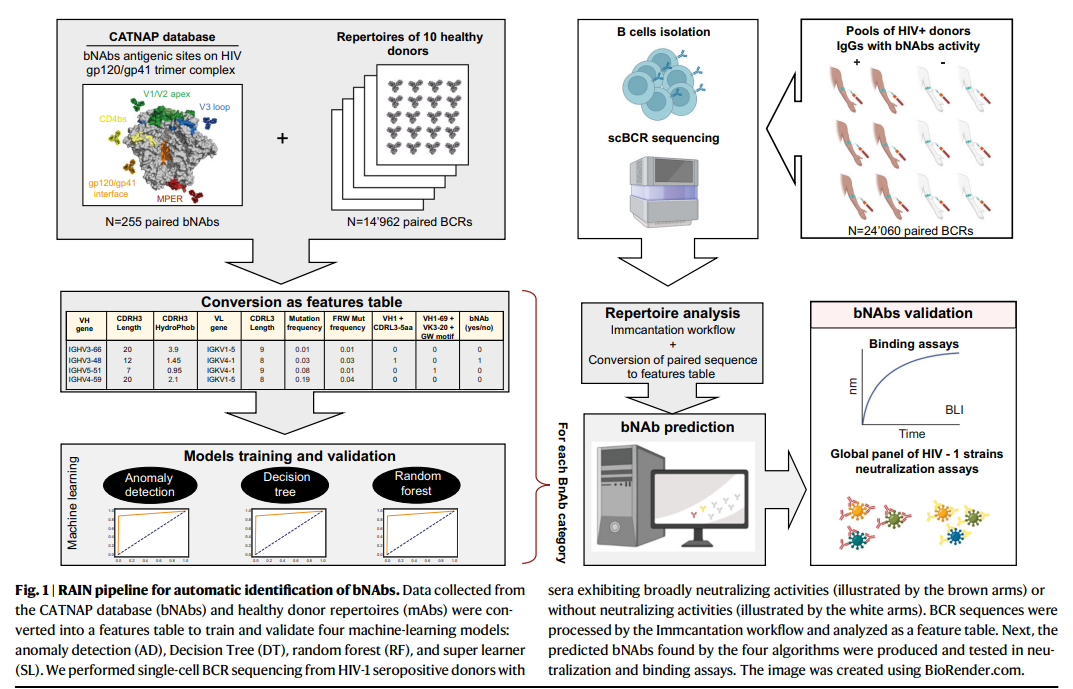
In this study, the researchers aimed to identify bNAbs against HIV-1 from infected donors. They focused on donors with known broad neutralizing capacity and isolated and sequenced IgG class B cells. Using a computational pipeline (RAIN), the researchers identified three potential bNAbs that showed high affinity binding to the HIV-1 envelope and potent neutralizing activity. These findings were confirmed by biophysical and neutralization assays. The identified bNAbs, especially bNAb4251, showed broad and potent neutralization, highlighting the utility of the pipeline for discovering therapeutic antibodies against HIV-1.
Please check paperAll credit for this research goes to the researchers of this project. Also, don't forget to follow us. twitter.
participate Telegram Channel and LinkedIn GroupsUp.
If you like our work, you will love our Newsletter..
Please join us 45,000+ ML subreddits


Sana Hassan, a Consulting Intern at Marktechpost and a dual degree student at Indian Institute of Technology Madras, is passionate about applying technology and AI to address real-world challenges. With a keen interest in solving practical problems, she brings a fresh perspective to the intersection of AI and real-world solutions.