Physical AI systems provide unprecedented levels of machine autonomy, benefiting multiple sectors such as heavy industry, manufacturing, energy retail, transportation, and healthcare. However, the adoption headwinds are significant and may impede widespread adoption.
According to Deloitte’s 2026 State of AI in the Enterprise report, a survey of 3,235 business and IT leaders found that 58% are already using physical AI and 80% say they will start using it within two years. Industrial and retail warehouses are becoming increasingly advanced and intelligent. Unmanned systems and routing engines are meeting the exponential growth in supply chain demand. AI-powered robotic arms and autonomous mobile robots are enabling the selection, assembly, and transportation of a variety of items while reducing accidents and increasing operational efficiency. To realize the benefits of these deployments, companies must deploy complex IT systems that incorporate digital sensors, machine vision, edge computing, cybersecurity, and data analytics.
Find out the infrastructure and costs required to deploy physical AI systems within your enterprise. Learn about physical AI infrastructure best practices and deployment strategies for your organization.
What physical AI systems can offer your business
Using sensor data, physical AI models, also known as embodied AI, understand the real-world environment. These models use the data they collect to reason and interact with their environment to autonomously achieve organizational goals.
Physical AI use cases span a variety of economic sectors. In manufacturing, physical AI can detect anomalies early in production, reduce defect rates, and identify new problems before they become serious. These embodied systems can use image analysis, video streams, and sensor inputs to improve overall surveillance and outperform human inspection. In other high-risk industries, physical AI uses real-time visual and situational analysis to assess hazardous environments and reduce exposure for front-line workers.
Many sectors can benefit from the capabilities of physical AI, but not all companies are ready to adopt this technology.
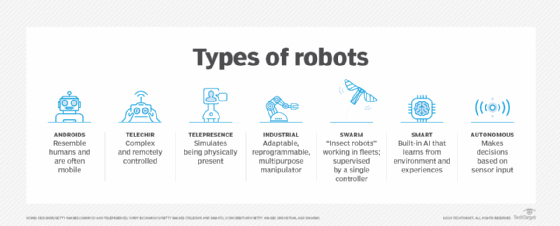
Cost and demand for physical AI systems
In contrast to cloud-based virtual AI deployments such as chatbots, generative AI, and agent AI, physical AI relies on a continuous stream of sensing, understanding, decision-making, and event execution within a real environment. These include remote devices such as industrial IoT machines, robots, and self-driving cars that can recognize movement, interpret context, assess risk, and take specific steps to achieve goals.
There are four main stages in the development of physical AI:
- Recognition stage. This is the integration of static remote devices such as cameras. Light detection and ranging, or lidar. sensors; and computer vision.
- Adaptive reasoning stage. Physical AI models draw conclusions from sensory and data inputs.
- execution stage. This stage bridges the gap between digital reasoning and direct action on edge devices.
- Continuous learning stage. Robots and physical devices use neural processing to automatically update and self-adjust their actions based on new experiences without extensive retraining.
From perception to continuous learning, physical AI requires several things, but the most important is maintaining an accurate data source. Proper security measures are also required to protect the integrity of hardware and devices at the edge. Human oversight enhances risk management and reliability. Edge technologies bring together new levels of computing power and networking. GPUs and neural processing units further enable parallel processing and real-time training simulations needed for physical AI models. The cost of these data, security, edge computing, and AI hardware can be significant, even though cloud services are affordable.
According to a Deloitte report, business leaders cite cost as the main barrier to physical AI adoption. However, research shows that it is gradually becoming more affordable. Bank of America Global Research predicts that the hardware cost for humanoid robots will fall from $35,000 in 2025 to about $17,000 by 2030.
Polaris Market Research predicted that the global edge AI hardware market, valued at $21.86 in 2024, will grow at a CAGR of 17% during the forecast period 2024-34. This is expected to increase the market size to $107.5 billion by 2034. The demand driving this growth is likely to drive down overall hardware costs.
Electricity demand is also a potential barrier to widespread adoption of AI, and the current operating costs of physical AI systems can exacerbate these challenges. In addition to overall power consumption, some physical AI deployments require thermal management systems for specific use cases. Additionally, in other deployments, edge processors must manage highly variable power demands by switching from a low-power idle state to a maximum computing state for short periods of time.
Deployment strategy for physical AI systems
A fundamental advantage of physical AI is its rapid adaptation and integration with existing IT systems. Data-centric architecture, APIs, and edge deployments enable deployment. Organizations can extend data center capabilities into their environments and guarantee sub-millisecond processing for model inference and autonomous operations. Localized static RAM further reduces data movement. Hybrid cloud edge architectures help handle huge amounts of unstructured data. Mesh networks and software-defined WANs connect separate edge environments and support hybrid architectures.
Wi-Fi 6/7 and Ethernet time-sensitive networking provides the ultra-low latency and reliable wireless communications needed for collision avoidance for autonomous robots and unmanned vehicles in manufacturing. Recent advancements in 5G/6G enable the ingestion of large amounts of real-time data from dense sensor networks over large geographical areas. These communications radio access networks and 5G/6G base stations enable the kind of massive interconnection that transforms isolated physical AI initiatives into interactive distributed computing platforms.
By moving computing from centralized data centers to edge environments and embedded devices themselves, energy consumption and data transmission costs can be reduced. While it is true that the power intensity of some physical AI devices requires energy-intensive processing at the edge, there is also great potential for sustainability. These include increasing energy efficiency with autonomous and managed resources, increasing the use of battery power and renewable energy to support on-device computing.
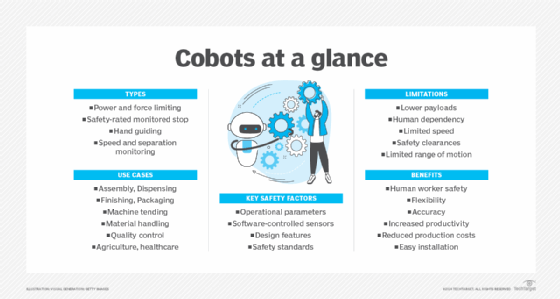
Once the infrastructure is in place, companies need to implement a physical AI operational strategy. A strategy that emphasizes gradual deployment and structured integration prevents workflow disruptions and ensures that legacy IT equipment seamlessly integrates with physical AI sensors, machines, or autonomous devices. Initial deployments should be performed under close administrator supervision. Monitoring should include mapping data flows, evaluating decision-making processes, and identifying whether a particular physical AI system requires additional sensors or connections to prevent processing or operational bottlenecks.
IT leaders should also focus on organizational readiness and change management to assess whether their teams are ready to process information from physical AI and collaborate with intelligent systems. Full buy-in and clear communication from management can help demonstrate how physical AI can support employees, add value, and further enhance safety. Deployments could benefit from controlled adoption pilots and phased rollouts to ensure that physical AI operates reliably under a variety of conditions and meets expectations.
Kerry Doyle writes about technology for a variety of publications and platforms. He currently focuses on a variety of issues relevant to IT and enterprise leaders, from nanotechnology and the cloud to distributed services and AI.