


The use of advanced computational techniques in the physical sciences has become essential to accelerate scientific discovery. This involves integrating large-scale language models (LLMs) and simulation to enhance hypothesis generation, experimental design, and data analysis. By automating these processes, we aim to streamline and democratize access to cutting-edge research tools, push the boundaries of scientific knowledge, and improve efficiency across a range of scientific disciplines.
Researchers face a major challenge in effectively simulating observational feedback and integrating it with theoretical models in the physical sciences. Traditional methods often require a universal approach that can be applied across different scientific disciplines, leading to inefficiencies and limiting the potential for innovative discoveries. It is clear that a more comprehensive and adaptable framework is needed to address this problem and advance scientific exploration.
Existing research involves fine-tuning LLM with domain-specific data to align with scientific information. Methods such as Chain-of-Thoughts prompts, FunSearch, and Eureka leverage LLM for problem solving. Neural Architecture Search (NAS) optimizes neural network architectures and continuous parameters. Techniques such as symbolic regression, population-based molecular design, and differentiable simulation have been employed to advance scientific discovery. These approaches integrate LLM with external resources for hypothesis generation and optimization, enhancing the efficiency and scope of automated scientific exploration.

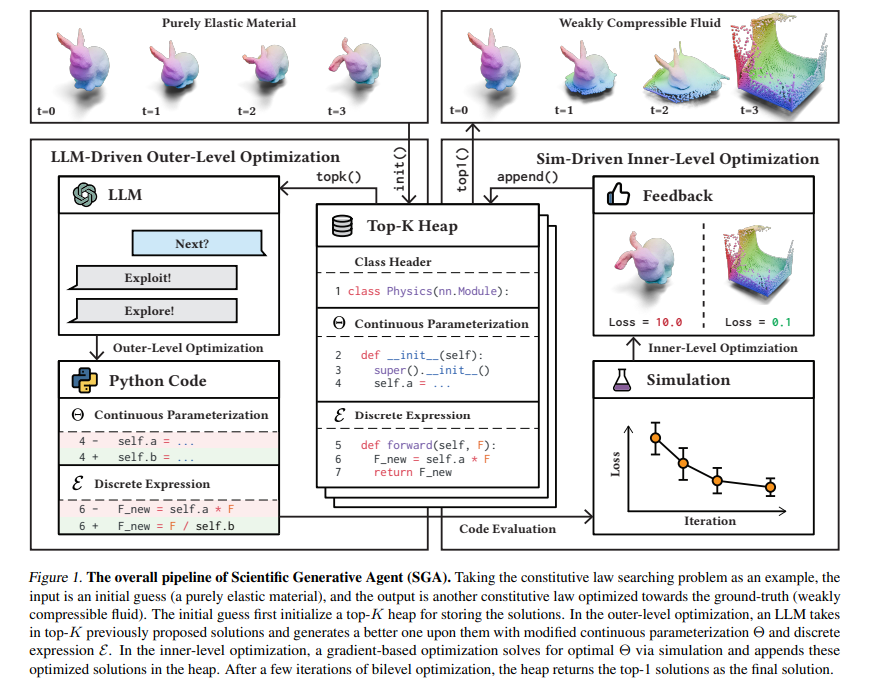
Researchers from MIT CSAIL, CMU LTI, UMass Amherst, and the MIT-IBM Watson AI Lab have presented a new two-level optimization framework called Scientific Generative Agent (SGA). The approach aims to integrate LLMs and simulation to enhance the scientific discovery process and provide a unified methodology for the physical sciences across specific domains. The framework combines the knowledge-driven abstract reasoning capabilities of LLMs with the computational power of simulation to provide a more comprehensive approach to scientific inquiry.
SGA employs a two-level process where LLM generates hypotheses at the outer level and simulation optimizes continuous parameters at the inner level. The researchers used the QM9 dataset for molecular design and a differentiable material point method (MPM) simulator for constitutive law discovery. The framework iteratively refines hypotheses by integrating discrete symbolic variables and continuous parameters, optimizing material properties and fitting molecular structures. The approach performed well in identifying accurate solutions across tasks involving nonlinear elastic materials and certain quantum mechanical properties.

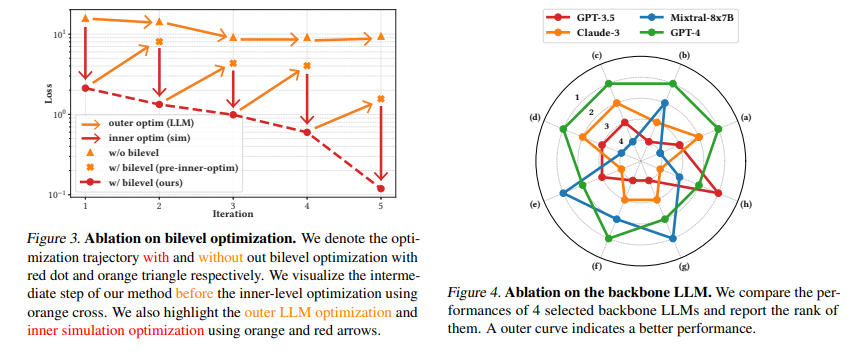
The study showed significant results in which SGA outperformed other methods. In discovering constitutive laws, SGA reduced the loss by 50% compared to the baseline. SGA successfully optimized molecules with specific quantum properties for molecular design, achieving a loss value of 0.0001 in the HOMO-LUMO gap task, compared to 0.003 for traditional methods. The framework's two-level optimization approach consistently achieved low loss values across a range of tasks, proving its effectiveness in accurately identifying new scientific solutions. These results highlight the significant performance and accuracy improvements achieved by SGA.
In conclusion, this work introduces SGA, a two-level optimization framework that combines LLM and simulation for scientific discovery. SGA excels in generating and refining hypotheses, significantly improving constitutive law discovery and molecular design. Results show a significant reduction in loss values, demonstrating the accuracy and efficiency of SGA. This innovative approach offers a versatile, interdisciplinary solution for scientific exploration, increasing the potential for discovery and advancing research methodology. This work highlights the importance of integrating advanced computational techniques to overcome traditional limitations in scientific exploration.
Please check paper. All credit for this research goes to the researchers of this project. Also, don't forget to follow us. twitter. participate Telegram Channel, Discord Channeland LinkedIn GroupsUp.
If you like our work, you will love our Newsletter..
Please join us 42,000+ ML subreddits


Nikhil is an Intern Consultant at Marktechpost. He is pursuing a dual degree in Integrated Materials from Indian Institute of Technology Kharagpur. Nikhil is an avid advocate of AI/ML and is constantly exploring its applications in areas such as biomaterials and biomedicine. With his extensive experience in materials science, Nikhil enjoys exploring new advancements and creating opportunities to contribute.

