-
Written by Leonardo Coelho
-
March 31, 2026
summary
Newsrooms large and small are deploying AI to translate, script, and fact-check in real-time. Five top journalists examined visible and hidden risks at a roundtable at the Knight Center.
“AI showed up and kicked down the door,” were some of the opening remarks from moderator Reis Martins at one of the talks. Roundtable discussion Sponsored by the Knight Journalism Center of the Americas on the use of artificial intelligence in Brazilian newsrooms.
“Our industry was just barely recovering from the social media crisis by figuring out how to deal with these new digital spaces when we were hit with this new big challenge,” said Martins, a reporter for Intercept Brazil and AI Accountability Network Fellow at the Pulitzer Center.
She is joined by Daniela Braga, Artificial Intelligence Editor at Folha de S.Paulo. Tatiana Diaz, investigative journalist. Jade Drummond, Executive Director of Núcleo Jornalismo. Marcela Duarte, Innovation Director at Aos Fatos, said:
The webinar was attended by more than 200 people, including many university students from all over Brazil.
In April she will be part of the group’s launch Ctrl + Zan organization that defends digital rights through investigation and litigation. She highlighted that in a typical university classroom, virtually all students use ChatGPT on a regular basis, according to the Reuters Institute’s 2025 Digital News Report. 9% of Brazilians We are already using AI chatbots to get news.
“We’re no longer debating whether or not we should use it,” she said. “The ship has already sailed.”
For Diaz, understanding the risks of technology is critical as the industry rushes to introduce products, most of which are driven by companies’ own interests, she said.
“We don’t have to be so callous as to destroy these new technologies,” she said. “But we need to use it in a critical and thoughtful process without bringing sensitive information into these systems.” She presented a set of decision-making matrices inspired by the framework created by the Pulitzer Center and Reporters Without Borders for the ethical use of AI in newsrooms.
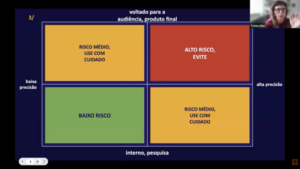
“For this illustration, we avoided anything that required high precision or was aimed at an audience because it was very risky,” said Tatiana Díaz, a veteran Brazilian technology reporter.
“You need to consider whether this content is intended for an audience and whether it will be the final product,” she said. “Is it text that people read, is it an Instagram carousel that people view, is it something that people have access to, or are we using it to analyze a 900-page document for an internal investigation? Why are we using this AI? This determines the risk level of using the tool.”
Diaz said tools that can create images to present to an audience or create transcripts for internal use are typically medium risk and can be used, but with caution.
“There are countless examples of using AI to summarize interviews, but the AI just makes up quotes. It rewrites what the person said in a different way, completely changing the meaning,” she says.
She added that while it may be less accurate, it can be very useful for analyzing large amounts of data, such as transcribing hours of video recordings from YouTube or locating citations.
“I recommend it,” she said. “This is for internal use.”
Diaz ended his presentation by warning that the AI industry is trying to commercialize thought processes.
“We need to protect creativity, humanity, and the ability to improvise, things that machines can’t do,” she says. “If we let go of that, I think the way we think about turning our ideas into business models will become polarized.”
Jade Drummond, executive director of technology news website Núcleo Jornalismo, went on to introduce an outlet-based approach to the use of AI. Núcleo’s staff focuses on detailed reporting and building applications and tools to monitor and track public data.
The use of AI in the editorial process by newsrooms internal policy. “The main point of this policy is that we view artificial intelligence as a tool that does not replace humans. Artificial intelligence should be used as a tool that can enhance the work we do, including enhancing the research and digital products we develop.”
Mr. Drummond cited the need for a reporter’s style and voice to be reflected in the story. However, this outlet does not hesitate to offer AI-based tools such as: NucritoHelps users search content on Núcleo. legislative technologyhelps you keep track of official documents and laws.
It’s important to be open and transparent about your use of AI. She said the majority of viewers felt it was important to reveal the use of AI in editing images, audio, video, and photos, writing text, and more.
From small news organizations to large news organizations, the next panelist was Daniela Braga, AI Editor of Folha de São Paulo, one of the largest newspapers in Latin America. She introduced the growing portfolio the outlet is developing for use by its more than 300 journalists. This includes translators and transcription services, headline generators and, especially urgently, scriptwriters for short videos. Video is becoming more important.
“Journalists can record themselves with the help of AI, reducing the time it takes to create a script based on what they have already written,” she explained. “And we launched a pilot project to use AI to create recipes for our readers. That was the first product we released. We then partnered with hospitals to create chatbots that used their own databases to provide information about breast and prostate cancer.”
The frequently used Folha manual, similar to the AP Stylebook, was used to create a copy-editing app that helps reporters standardize and proofread text. “This manual is a well-known guide to Brazilian journalism and a bible that we have always followed. So we obtained the latest version of the manual and used it to train the AI to correct the texts according to what is written in the manual,” Braga said. “So does Folha use Roman numerals? No, it doesn’t. This means the AI will do this correction for you, but it will never do it automatically. It always requires user action.”
Fact-checking and AI were also discussed at the roundtable. Marcela Duarte, director of innovation at fact-checking site Aos Fatos, says there is no excuse not to use AI. “I’ve seen productivity gains and have been able to analyze large databases that I wouldn’t have been able to do manually, and that I wouldn’t have been able to do by myself or a small team, which would probably take a very long time, maybe a year,” she said.
Among the incoming sounds – and become polarized – In the run-up to the election, Aos Fatos is testing an AI tool called BuscaFatos that allows reporters to fact-check in real time. “We have Escriba, which provides transcripts to newsrooms and some organizations. Escriba transcribes live streams and debates in real time, and this new app [BuscaFatos] “It matches spoken phrases against the AosFatos database and instantly shows visiting reporters whether a particular phrase has already been fact-checked by Aos Fatos, indicating whether it is false or true,” Duarte said.
For her, these tools are important. Because misinformation spreads much faster and farther, and fact-checking comes later to try to address the problem. “Speed is of the essence in this case, so the sooner we can debunk certain information said in the debate, the better.”
You can watch this discussion and the entire webinar for free on the Knight Center. YouTube page.