
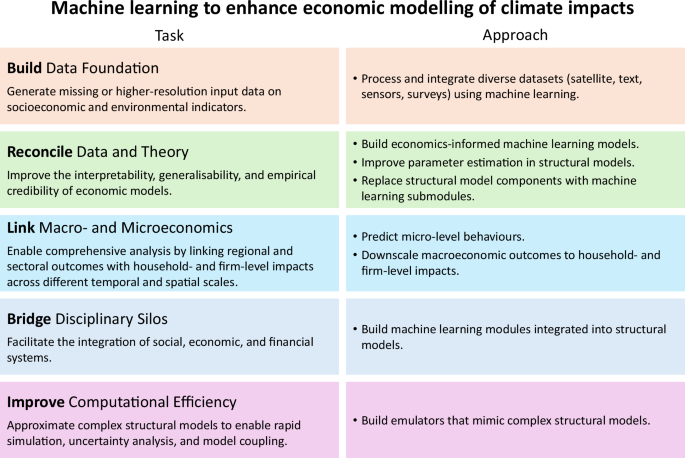
Statistical models are data-driven, less computationally intensive, and often more user-friendly than structural models. However, because statistical models estimate isolated, reduced-form relationships rather than representing the underlying economic structure, they are generally difficult to interpret and are not comprehensive. Data-driven approaches to evaluating policy interventions based on counterfactuals remain limited due to the lack of observational data. Although structural models can simulate interventions beyond observed data, they are often based on simplifying assumptions. The main advantage of structural models is that they allow policy instruments to be expressed explicitly through the underlying mechanisms. Hybrid models can combine empirical realism and causal structure to improve policy analysis. In hybrid modeling, the choice of which mechanisms need to be represented explicitly through structural modeling and which need to be approximated using ML depends on the needs of the parties involved. In principle, key behavioral mechanisms, economic constraints, and policy-related factors should be explicitly modeled. Hybrid models can improve the robustness of policy simulations by combining causal structure and data-driven flexibility. Hybrid models may also provide more robust extrapolations under future climate and socio-economic conditions than statistical models based solely on past climate-economic relationships.
The hybrid model has several advantages in decision-making. For example, when analyzing supply chain impacts, EIML incorporates the structural characteristics of the supply chain (i.e., trade links and intermediate inputs) while simultaneously allowing ML to capture the behavioral responses of consumers and producers. Another application of EIML could be integrating DSGE models with ML. DSGE models are widely used by central banks and provide a strong theoretical foundation. Those structural elements, such as optimization conditions and equilibrium constraints, may guide the ML model. Alternatively, ML can be used to approximate selected components of DSGE models to improve predictive accuracy and capture complex relationships, or to build emulators of these models.24,25. Deep learning is increasingly used to approximate policy and value functions in DSGE models by solving Bellman and Euler equations.26,27. ML can also enhance DSGE models by improving the representation of the financial sector. The financial sector can play an important role in amplifying physical and transition risks through cascading financial shocks.28. Rich financial data allows ML and hybrid models to address this gap.
ML can help bridge the macroeconomic and microeconomic scales. Multiscale assessments can help policy makers and financial institutions identify economic vulnerabilities beyond GDP and assess the cost-effectiveness of adaptation measures. For example, ML can improve the representation of climate-related income distribution effects (e.g., across income groups) in structural models (e.g., integrated assessment models (IAMs) and CGE models). While climate impacts have been shown to exacerbate inequality;29large-scale structural models often lack a detailed representation of distributional results. To address this limitation, structural models can provide an economy-wide perspective by capturing interactions between sectors and regions, while ML-based modules can complement structural models by translating aggregated economic outcomes into household- and firm-level effects. ML can effectively capture the rich high-dimensional heterogeneity across households and firms that is typically lost in aggregated structural models. This hybrid approach can incorporate feedback effects between macroeconomic and microeconomic scales, allowing more accurate regional-level estimates.
ML can also help bridge discipline silos. Climate, economic, and social systems are deeply interconnected through feedback loops that impact incomes, health, migration, and conflict.30. Mechanistically modeling these interactions is difficult. ML has the potential to support more integrated analysis across these domains. For example, ML-based modules on health, migration, conflict, and demographic change can be embedded in structural models to better capture cross-sectoral and cross-regional socio-economic dynamics.
Although hybrid models have the potential to enhance economic impact assessment, fundamental challenges remain. These include limited out-of-sample validity and deep structural uncertainties arising from the complex interactions between climate, economics, institutions, demography, and technology. Compared to physical systems, socio-economic systems are less stable and dominated by more context-dependent relationships. The dynamics of social systems are difficult to model due to heterogeneity and behavioral variability. The structural insights underlying hybrid models are as reliable as their ability to represent socio-economic structures and dynamics. Therefore, whether a hybrid model can capture emergent behavior is an important research avenue. Addressing these challenges will require interdisciplinary and interdisciplinary collaboration among climate scientists, economists, social scientists, data scientists, and practitioners, bringing together disciplinary expertise, rigorous theory, and data-driven methods.


