Cybercrime
The blog uncovers threat actors using the 2024 Olympics to lure victims into investing in Initial Coin Offerings (ICOs), a similar tactic that has been found to be using AI-generated imagery for fake ICO websites.
Reading time: ( word)


Key Point:
- Threat actors are attempting to use the 2024 Olympics to lure victims into investing in initial coin offerings (ICOs).
- A similar tactic has been found to be the use of AI-generated images for fake ICO websites.
- Going forward, we can expect to see more ICO scams leveraging AI-generated content to maximize the cost and time efficiency of the tool to create more compelling sales pitches.
Cybercriminals are capitalizing on the buzz surrounding the 2024 Olympics by targeting victims with a series of scams that exploit the mega event to capture public interest and attention. This blog aims to expose an Initial Coin Offering (ICO) scam that is exploiting interest in the Olympics, which will be held in France from July 26th to August 11th.
Cryptocurrencies are here to stay, but the average internet user still doesn't fully understand the concept. Cybercriminals take advantage of this unfamiliarity by creating ICO scams that offer victims the opportunity to invest in cryptocurrencies, then run off with the money.
Would-be investors are invited to buy a new cryptocurrency token through an existing cryptocurrency, such as Bitcoin or Solana, and are told that they will develop a project that will generate profits and promise returns to investors. However, the promises never materialize, and the cybercriminals later disappear with the investors' money and evidence that the ICO scam existed. The website and its associated social media accounts disappear; leaving the victim with no way to get their investment back. Other scams use liquidity rug pulls. In this scheme, the launched token is paired with another well-known token, such as Ether or Solana, and listed as a liquidity pool on a decentralized exchange (DEX). Once enough victims put money into the pool, the cybercriminals withdraw most of the liquidity, causing the value of the token to plummet and leaving investors with a worthless asset.
Olympic Token ICO Scam
Domain name Olympic was registered on March 30, 2024, and its website went live the day after it offered Olympic Games Tokens, a digital asset in which any internet user can invest. As shown in Figure 1, the website is simple and easy to understand, and even shows a roadmap for the project, albeit vague. It is affiliated with the International Olympic Committee, uses the Olympic Games 2024 logo, and even has a countdown to the event. Investors are offered the opportunity to trade their tokens on Raydium, a legitimate cryptocurrency exchange. Note that many exchanges allow users to create and remove liquidity for their tokens, so the ability to trade a token on a legitimate exchange does not guarantee that the token itself is legitimate.
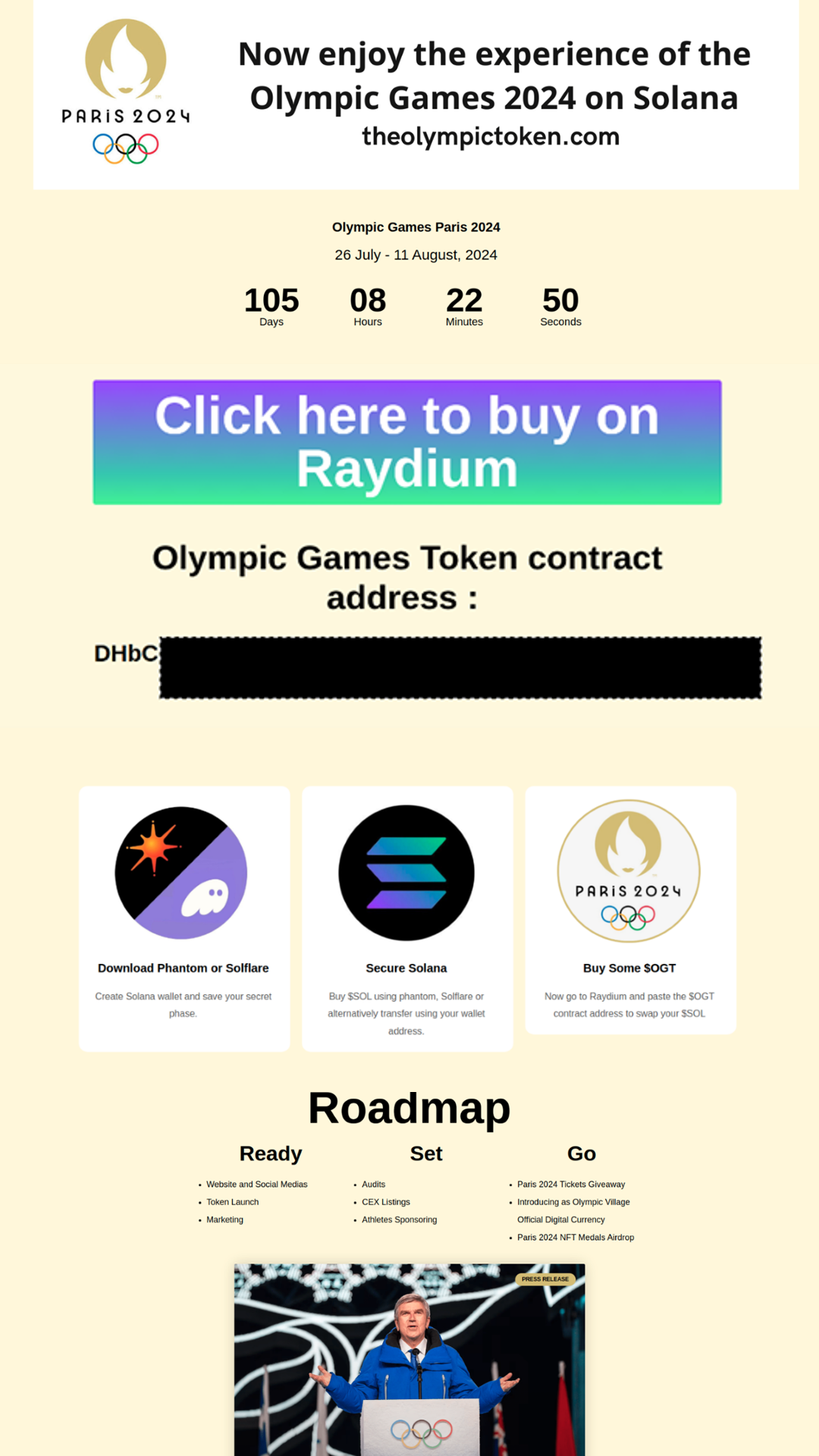
Fake ICO websites also link to white papers, but the links do not lead to the actual white papers for the projects, but instead link to legitimate white papers. Olympic Website. This should be an immediate red flag. A legitimate ICO will always present a whitepaper that explains the internal concept of the project.
The X (formerly Twitter) account operated by the cybercriminals began promoting the website as soon as it was launched. The Telegram channel also actively encouraged its members to buy Olympic Games Token (OGT) with a sense of urgency. The cybercriminals are likely using other social networking platforms to lure people to the fake ICO website and Telegram channel. An ICO scam usually works like this: Once the fake website is launched, aggressive marketing takes place on social networks, forums and other online platforms to attract traffic and potential victims to invest in the project.



A few days after the domain was registered, the website was taken down, but the scammers behind the scheme are suspected to have resumed their activities on a new website, olympictokensolana.com, which contains the exact same content as the first fake ICO website.
Other Olympics-related cryptocurrency scams
During our monitoring over the past few months, we have found at least 10 websites using the 2024 Olympics to lure victims into ICO scams, some of which were quickly shut down after being discovered.


We noticed that not only were they well-designed to pass off as legitimate sites, but they also used AI-generated imagery, but it seems that ICO scam websites that don’t provide roadmap information or whitepapers make up for it with AI-generated imagery.
Because it takes time and skill to create a website that looks legitimate enough to successfully lure victims, using AI-generated content is likely a more cost-effective and time-efficient option for scammers. Cybercriminals can always choose to steal images, designs and content from real, legitimate sites, but this option may not be as appealing as potential victims may spot the plagiarized content and realize they're being scammed.
AI is becoming increasingly useful to cybercriminals, whether it's generating text for phishing campaigns, correcting spelling and grammar errors, or even generating text in languages the scammers don't speak. In the ICO scams we've looked at, we've seen at least three different ICO scam websites take their use of AI even further, generating images and designs for their websites. We believe we'll see more scams and cybercrime adopt the use of AI-generated art in the future.


Conclusion
As cryptocurrencies continue to gain adoption across industries, ICOs are getting a lot of attention. Creating new tokens on the blockchain has become easier and cheaper, especially with the right tools now available to everyone. According to onchain data, over 1 million new tokens have been created on various blockchains in the past few months. Most of these new tokens have no utility and are simply meme coins (cryptocurrencies that are often created as a joke or based on a meme or hot event), but they are not necessarily scams. Many new coins are scams or vulnerable, but they cannot be unequivocally classified as such until an exit scam occurs. The examples featured in this blog fall into the meme coin category because they capitalize on the interest surrounding the 2024 Olympics, but some of them have been revealed to be scams.
Many cases of fraudulent ICOs have already been reported, especially during the ICO boom in 2017. Frequent scams have been seen in the Solana presale and meme coin sectors, highlighting the need for caution when investing in new projects. Even if meme coins are not scams, it should be noted that these tokens are highly volatile and may experience extreme fluctuations in price and value. Therefore, investors should be careful and do thorough research before investing in any cryptocurrency, especially meme coins.
Cryptocurrency investors should be aware of potential scams and rug-pulling. A legitimate ICO must have:
- A good website and social media presence. A professional, well-designed website and an active social media presence are key indicators of legitimacy. Scammers often use poorly designed websites and inactive or fake social media profiles, whereas legitimate projects usually have an active online presence to engage with their community.
- A transparent team. Verify the identity and credentials of the team members behind the token. Anonymous or unverifiable team members are a red flag. Legitimate projects are usually transparent about the people involved and their backgrounds.
- Active community. Look for active, engaged communities on platforms like Discord, Telegram, Twitter, etc. A healthy community may indicate genuine interest and support, while scams often have low community engagement or fabricated interactions.
- Comprehensive white paper. Make sure the token has a detailed whitepaper outlining its goals, utility, and technical aspects. A thorough whitepaper shows the seriousness and planning of the project, while scam whitepapers are often vague or plagiarized.
- the validity of the claim. Verify what a token claims to be: who it represents, partnerships, use cases, endorsements, etc. Scammers often make false claims to attract investors, so verification helps distinguish real projects from fraudulent ones.
- Token distribution. Evaluate whether the distribution of tokens is balanced and not overly concentrated in a few wallets. High concentrations of token ownership may indicate potential manipulation or tampering.
- Smart contract audit. Check whether smart contracts have been audited by a trusted third-party auditor. Audits can help identify vulnerabilities and increase trust, but a lack of auditing or a poor quality audit can be a red flag.
- Liquidity management. Determine whether liquidity is locked to prevent developers from prematurely withdrawing and whether the majority of liquidity is managed by the developers or distributed among the community. Locked liquidity protects investor funds and reduces the risk of rug-pulling, while decentralized management of liquidity increases trust and reduces the risk of manipulation by developers.
In the case of Olympic Token, the website they set up raises red flags, the number of token holders is very low, and the white paper shows nothing substantial. Investors and those interested in cryptocurrencies should be very careful and follow the guidelines provided to avoid becoming a victim of such a scam.
Most of the domains related to the scams mentioned in this blog are either gone, suspended or have no content whatsoever. All remaining domains related to the scams mentioned in this blog have been blocked by Trend Micro.
tag
sXpIBdPeKzI9PC2p0SWMpUSM2NSxWzPyXTMLlbXmYa0R20xk