

The call for papers for ICML 2026 has officially started.
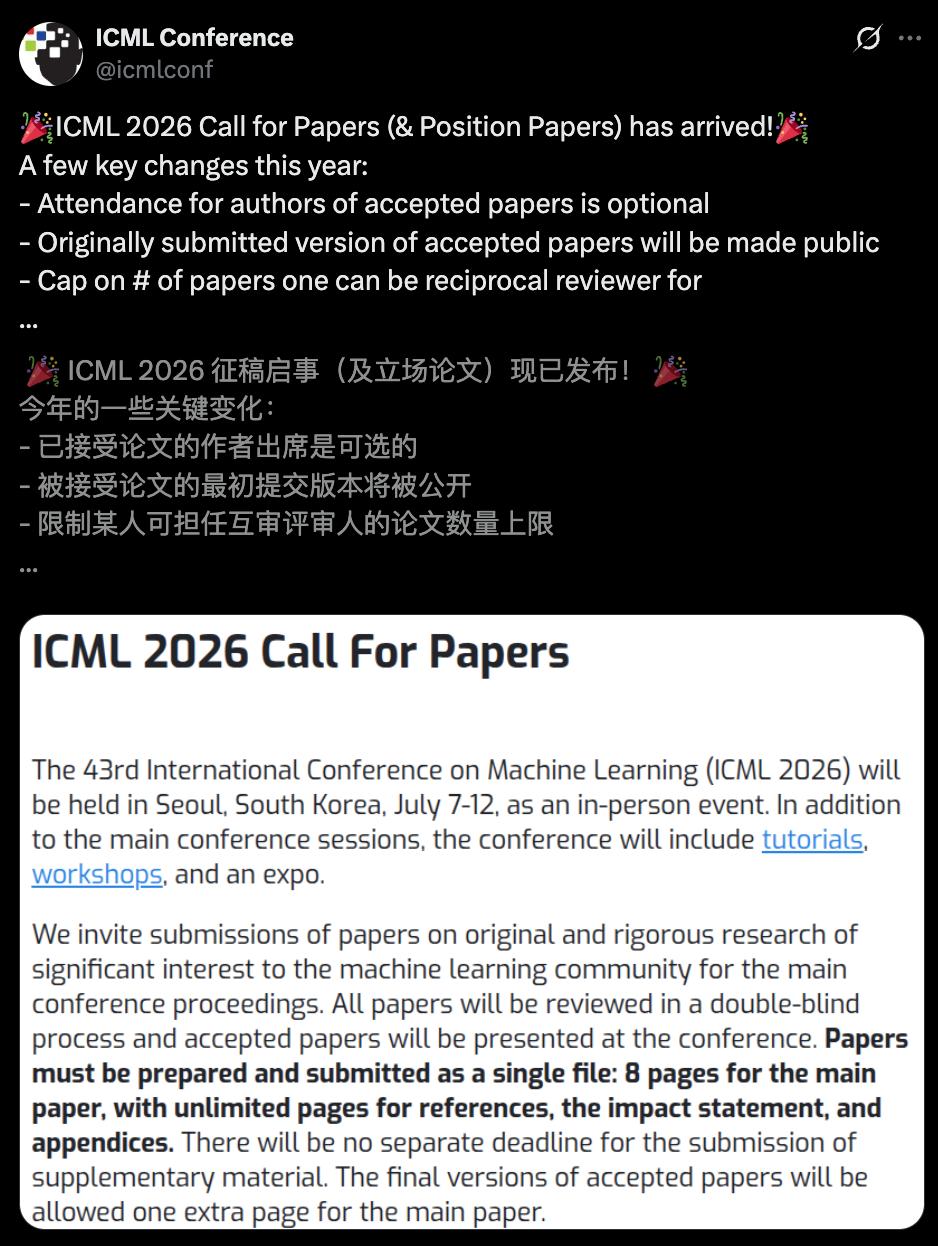
Today, the ICML Organizing Committee released a related memo regarding submissions to this top-class conference. Three points are very important:
Authors of accepted papers are free to choose whether or not to attend the conference.
We will publish the “original submitted version” of accepted papers.
Set an upper limit on the number of peer-reviewed papers.
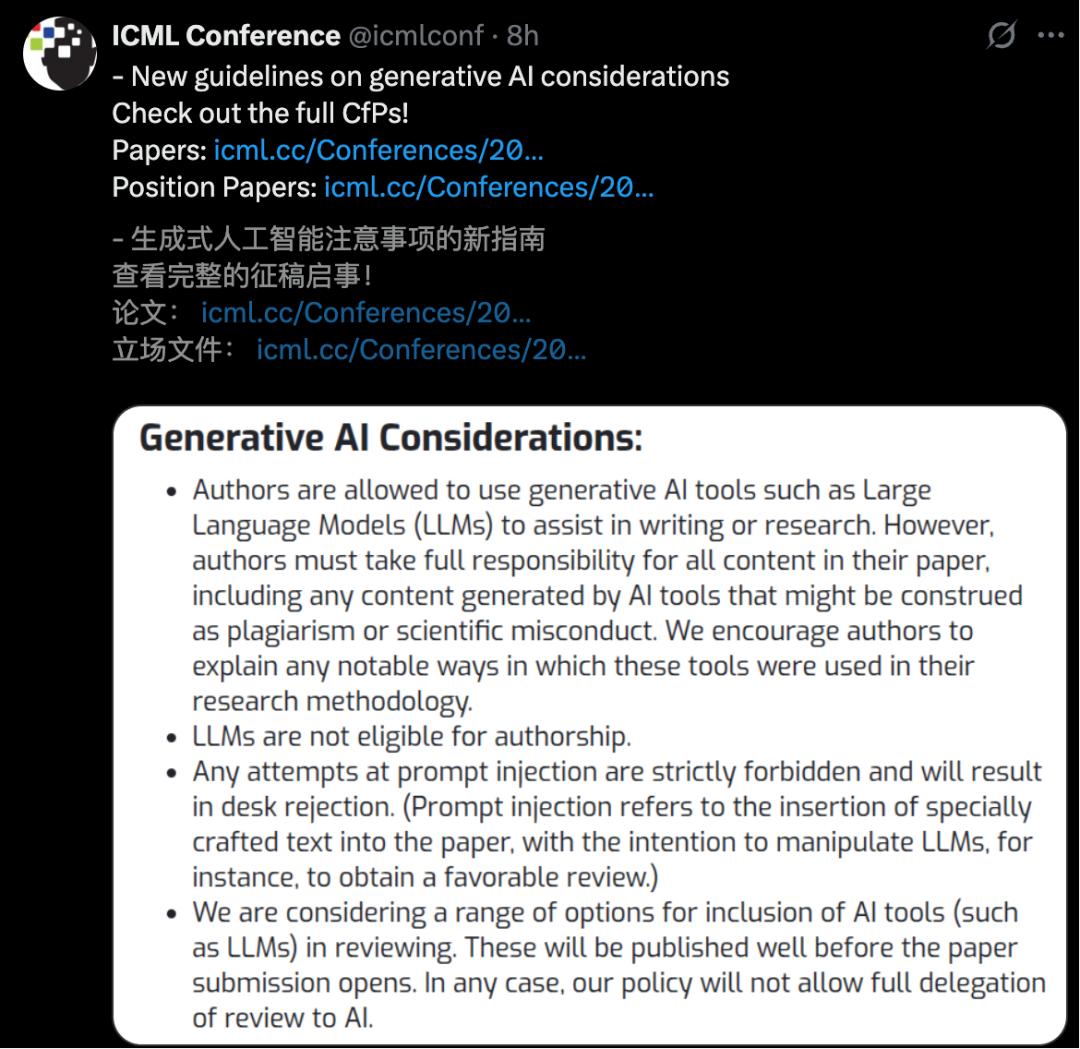
Additionally, ICML 2026 makes it clear that while the use of LLMs to support writing or research is permitted, all responsibility rests with the author.
This includes AI-generated content that may be considered plagiarism or academic misconduct.
Meanwhile, the organizing committee prohibits listing LLMs as authors and strictly prohibits “immediate injection.” Otherwise, your submission will be directly rejected.
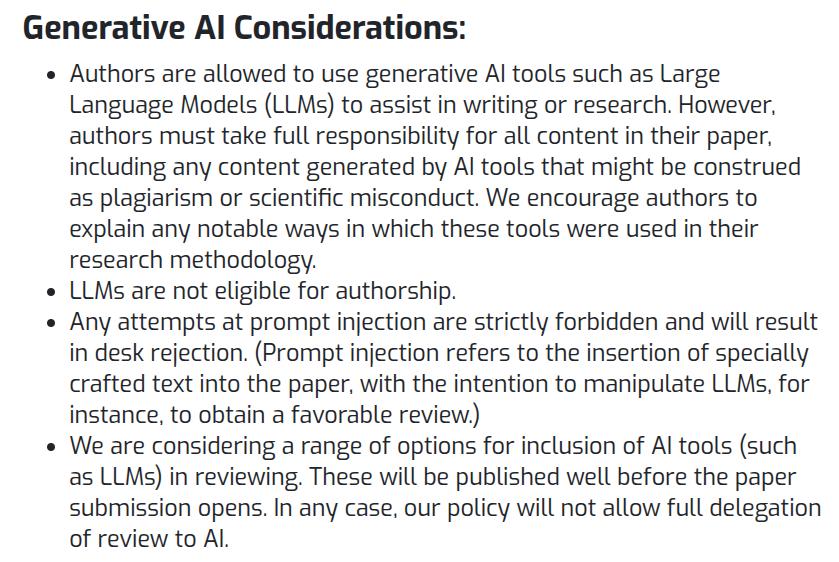
The 43rd International Conference on Machine Learning ICML 2026 will be held from July 7th to 12th, 2026 in Seoul, South Korea.

Full paper submission deadline: January 28, 2026.

ICML paper call, fully open
According to an official announcement, all papers will be reviewed through a double-blind review process and accepted papers will be presented at the conference.
The paper must be created and submitted as a single file. The main text is 8 pages, with no page limit for references, impact statements, and appendices.

There is no separate deadline for submitting supplementary materials. The final version of the accepted paper will allow additional pages to the main paper.
Below are the different policy changes in ICML 2026.
1. Attendance of approved paper authors is optional
After receiving an acceptance letter, authors have until a specified date to decide whether to present their paper directly at the conference or to publish the paper only in the proceedings (without presenting it at the conference).
Regardless of selection, all accepted papers will be treated equally in the process.
All of them will be eligible for the ICML Award and the title of excellence, which corresponds to the previous “Oral Presentation” and “Spotlight Poster”.
For papers included only in proceedings, at least one author must register virtually.
2. Release the original submitted version and a camera-enabled version for accepted papers.
For all accepted papers, in addition to the camera-ready version, we will also publish materials such as the original submitted version (including supplementary materials), anonymous peer review comments, meta-review comments, rebuttals, and discussions between reviewers and authors.
Authors of rejected papers also have the option to publish the original version submitted, review comments, meta-review comments, rebuttals, and discussions between reviewers and authors.
3. Setting an upper limit on the number of peer-reviewed papers
Additionally, ICML will set a cap on the number of papers that can be designated as peer reviewers and update its policy regarding the use of AI tools in the peer review process.
Of course, ICML 2026 allows for a wide range of topics for paper submissions, including but not limited to:
General machine learning (active learning, clustering, online learning, ranking, supervised learning, semi-supervised learning, self-supervised learning, time series analysis, etc.)
Deep learning (architecture, generative models, theory, etc.)
Evaluation (methodology, meta-research, reproducibility and validity, human-machine interaction, etc.)
Machine learning theory (statistical learning theory, bandit, game theory, decision theory, etc.)
Machine learning systems (implementation and scalability improvements, hardware, libraries, distributed methods, etc.)
Optimization (convex and non-convex optimization, matrix/tensor methods, stochastic, online, non-smooth, composite, etc.)
Probabilistic methods (Bayesian methods, graphical models, Monte Carlo methods, etc.)
Reinforcement learning (decision and control, planning, hierarchical reinforcement learning, robotics, etc.)
Trustworthy machine learning (reliability, causality, fairness, interpretability, privacy, robustness, security, etc.)
Application-driven machine learning
Here are the key points, important dates, and submission sites:
Submission site opens: January 8, 2026.
Abstract submission deadline: January 23, 2026, AoE (January 24, 2026, noon, UTC – 0).
Full paper submission deadline: January 28, 2026, AoE (January 29, 2026, noon, UTC – 0).
Abstracts and papers can be submitted via OpenReview: https://openreview.net/group?id=ICML.cc/2026/Conference
Note: Position papers must be submitted via a separate OpenReview site as described in the Call for Position Papers.

AI can assist with writing, but cannot be listed as an author
Regulation of the use of generative AI is particularly important within this policy.
Now, with ICML 2026, authors will be able to use GenAI tools, such as large-scale models, to support their writing and research.
However, authors must take full responsibility for all content in their papers, including content generated by AI tools that could be considered plagiarism or scientific misconduct.
LLMs do not qualify as authors.
Any “instant injection” is strictly prohibited and submissions will be directly rejected. Prompt insertion refers to the insertion of hidden text into a paper for the purpose of manipulating the LLM to obtain a favorable review.
ICML is considering various options for incorporating AI tools (such as LLM) into the review process. Additionally, it is not allowed to completely delegate the review to AI.
Regarding peer review, eligible authors are required to review ICML papers. However, there are two requirements: a per-post requirement and a per-author requirement.
Requirements per submission:
All submissions must have at least one author agree to act as an ICML reviewer.
The designated author must meet the definition of reviewer eligibility as described in the Review FAQ. New this year: Authors can designate themselves as peer reviewers on up to two submissions on which they are the author.
Exception: A submission is exempt from this requirement if there are no eligible authors (as defined in the Peer Review FAQ), or if all eligible authors have already served as peer reviewers for two submissions, or are serving as a SAC, AC, or other organizational role for ICML 2026.
To meet this requirement or claim an exception: The abstract submission form allows submitters to specify authors who meet this requirement or to indicate that their submission is exempt from this requirement.
Requirements per author:
In addition, each author with four or more submissions must agree to serve as an ICML reviewer (in this case, authors can serve as mutual reviewers for up to two submissions).
In the event of an unexpected shortage of qualified reviewers, the program chair may lower the submission threshold to three (in which case authors newly subject to this requirement will be notified).
Exception: This requirement is waived if the author serves as an AC, SAC, or other organizational role for ICML 2026.
To meet this requirement or claim an exception: Authors with four or more submissions must complete the per-author peer review form (link to be announced at a later date) to provide the required information to all reviewers or to indicate that they are exempt from this requirement.

As always, all submissions must be anonymized through a double-blind review process and must not contain any information intended to violate, or result in a violation of, the double-blind review policy.
Authors can post versions of their work on preprint servers such as arXiv. During the judging period, you may also give a lecture on your submitted work.
However, under no circumstances should authors advertise their work for submission to ICML during the review period, that is, between the time an author submits their paper and the time they are notified of an acceptance decision.
If the author has published or plans to publish a non-anonymous version of the paper before the ICML decision is made, the submitted version must not refer to the non-anonymous version.
Authors must strictly adhere to standard ethical conduct in peer review. especially:
Plagiarism in any form is prohibited.
Immediate injections are prohibited.
Promotion of work submitted to ICML during the review period (e.g., lectures, social media, etc.) is prohibited.
Any form of collusion (authors collaborating with reviewers, ACs, or SACs to obtain favorable or unfavorable reviews), whether explicit or implicit, is prohibited.
Additionally, authors must not submit a paper that is the same or substantially similar to a version that has been published, accepted for publication, or concurrently submitted to any other conference or journal.
Such submissions violate the double submission policy and the organizer reserves the right to reject or remove such submissions from the proceedings.
Simultaneous ICML submissions with overlapping author sets will also be considered earlier works. For example, if publishing one would make the other increment too large, this could be considered a reason for rejection.
Judging criteria require submissions to report original, rigorous research of critical importance to the machine learning community.
All claims must be clearly stated and supported by reproducible experiments and/or reliable theoretical analysis.
Contributions should be placed in the context of the broader scientific and machine learning research literature, with appropriate recognition and distinction of relevant prior work.
References:
https://x.com/icmlconf/status/1986089104367308805
https://icml.cc/Conferences/2026/CallForPapers
This article is from the official WeChat account “New Information Center”. Author: New Information Agency. Editor: Taozi. Republished by 36Kr with permission.


