
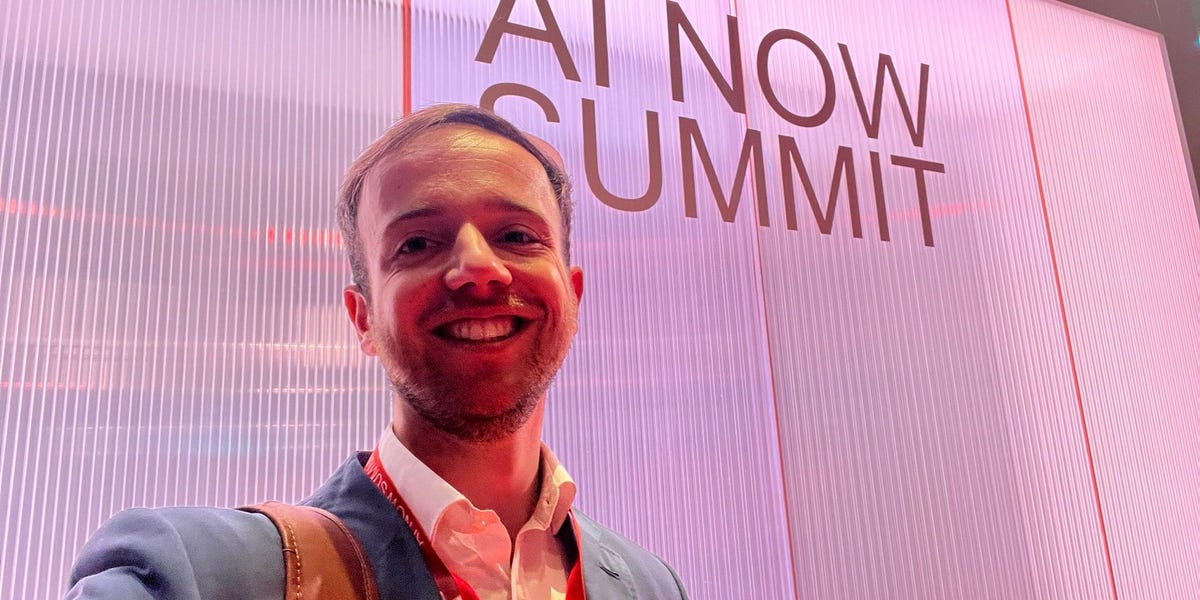
Mistral AI’s first summit felt more like a campaign rally for Europe’s AI ambitions than a startup conference.
The French AI startup, founded just three years ago, filled Paris’ Le Carrousel du Louvre (an event space beneath the Louvre’s famous glass pyramid) on Thursday with executives from SAP, BNP Paribas, Accenture, and Airbus, government officials, engineers, and startup founders.
Giant screens were set up on either side of a catwalk-like stage, and Mistral’s executives appeared in casual attire in jeans and T-shirts, giving the atmosphere more Silicon Valley than Paris.
Several attendees told me they left with the same impression. Europe is finally building its own AI ecosystem, rather than relying entirely on American tech giants.
Mistral Summit Vision Stage. Thibault Spillet/Business Insider
‘Huge’ number of participants
“What surprised me is that Mistral announced this event just a month ago, but the turnout is pretty good,” said Martin Zeps, who heads the AI business at Latvia’s largest mobile phone company. “I thought it would be a small gathering, but this is a big one.”
James Shannon, director of sales at Growthbook, said he was impressed by the “trajectory and speed” with which Mistral has grown its customer base and established itself in the AI market.
While OpenAI is widely associated with consumers and Anthropic is associated with enterprise customers, Mistral appears to be focused on large-scale custom AI models, he said.
“It feels like a big moment for Mistral,” Shannon told Business Insider, calling the summit “a really good PR moment for Mistral.”
That momentum was central to Mistral’s message throughout the day.
In the opening keynote, CEO Arthur Mensch and co-founders Timothée Lacroix and Guillaume Lample laid out their vision for building a European AI stack.
Mensch said AI only creates value when applied to real business problems, while Lacroix detailed the company’s expansion of its infrastructure footprint, including new data center capacity near Paris. Rampur, meanwhile, highlighted Mistral’s commitment to an open source model that customers can customize using their own data.
The message echoed Mensch’s warning to French lawmakers earlier this month that Europe has just two years to build up enough AI infrastructure to avoid becoming what he called an AI “vassal state” of the United States.
But with a valuation of about $13.6 billion, Mistral still dwarfs its U.S. rivals, even though it has emerged as Europe’s most prominent AI startup, ahead of rivals such as Germany’s Aleph Alpha, France’s Company H, and Sweden’s Labable.
Companies like OpenAI, Anthropic, and Google’s Gemini have raised tens of billions of dollars and are competing to build massive AI infrastructure networks. Just this week, Anthropic raised $65 billion, nearly five times Mistral’s total, giving it a valuation of nearly $1 trillion.
Timothée Lacroix, Arthur Mensch, and Guillaume Lample explained their vision for Mistral AI in their opening keynote speech. Thibault Spillet/Business Insider
Europe wants to control its AI future
Executives said growing concerns about where data is stored is driving demand for European alternatives.
Jan van den Bremen, Accenture’s head of technology for Europe, the Middle East and Africa, said governments and businesses alike are becoming more aware of data sovereignty.
“We’ve become a data-driven economy,” he told Business Insider. “You need to know where your data is and what’s going to happen to it.”
That sentiment was echoed on stage by Rodolphe Saade, chairman and CEO of shipping giant CMA CGM, which has partnered with Mistral for two years. Saade said geopolitical uncertainty and the need for data protection made having a French AI partner increasingly attractive.
“Having a French solution definitely helps,” he said.
Rodolphe Saade, chairman and CEO of shipping giant CMA CGM, said Mistral’s French roots and focus on data sovereignty made it a natural partner. Thibault Spillet/Business Insider
Charles Holive, chief AI officer at BNP Paribas CIB, said Mistral’s open source model allows companies like his to run AI systems on their own infrastructure while keeping costs down.
Andrew Parker, head of partnerships and business development at 7SG, said it was clear that governments and businesses across Europe were looking to rely less and less on US cloud and AI providers.
“They’re all trying to build their own little basic private technology stack, the cloud,” Parker said, citing the risks of the U.S. Cloud Act, a 2018 law that allows U.S. authorities to force U.S.-based cloud providers to hand over data stored overseas under certain circumstances.
“A player who was late”
Even though Europe lags behind the U.S. in AI infrastructure and investment, Parker said the region could benefit from joining the competition later.
“There’s almost an advantage to being a slow player,” he said. “We can look back at history and say, ‘This is where everyone failed.'”
Parker also said that Europe’s approach to AI appears to be more coordinated between government and private companies than in the United States. He noted that a number of ministers and government officials were speaking at the Mistral Summit.
“The United States is hyper-capitalist and business comes first,” he says. “Government and private AI are going hand in hand here.”
Mistral AI’s Summit Networking Room. Thibault Spillet/Business Insider
Still, not everyone went away completely satisfied.
Amira Soltani, Zayo Europe’s European sales director, said she left the company because she wanted to learn more about the technical details.
“We hear a lot about computing and services, but we don’t really understand how it works,” she said. “It’s much more marketing.”
But that may have been the purpose of the summit.
Europe’s biggest companies seemed to be rallying around Mistral because it has become a symbol of something bigger: the belief that Europe can still build, control, and profit from the next big wave of technology.
Despite his enthusiasm, Parker acknowledged the scale of the challenges ahead, saying Europe still lags behind the US in terms of AI infrastructure, talent and investment.
“Europe is waking up to catch up,” Parker said. “I’m glad to finally see this coming to fruition.”